


Development and Validation of Novel Nomograms to Predict the Overall Survival and Cancer-Specific Survival of Cervical Cancer Patients With Lymph Node Metastasis
- PMID: 35372011
- PMCID: PMC8968041
- DOI: 10.3389/fonc.2022.857375
Development and Validation of Novel Nomograms to Predict the Overall Survival and Cancer-Specific Survival of Cervical Cancer Patients With Lymph Node Metastasis
Erratum in
-
Corrigendum: Development and Validation of Novel Nomograms to Predict the Overall Survival and Cancer-Specific Survival of Cervical Cancer Patients With Lymph Node Metastasis.Front Oncol. 2022 Apr 28;12:916310. doi: 10.3389/fonc.2022.916310. eCollection 2022. Front Oncol. 2022. PMID: 35574297 Free PMC article.
Abstract
Objective: The objective of this study was to establish and validate novel individualized nomograms for predicting the overall survival (OS) and cancer-specific survival (CSS) in cervical cancer patients with lymph node metastasis.
Methods: A total of 2,956 cervical cancer patients diagnosed with lymph node metastasis (American Joint Committee on Cancer, AJCC N stage=N1) between 2000 and 2018 were included in this study. Univariate and multivariate Cox regression models were applied to identify independent prognostic predictors, and the nomograms were established to predict the OS and CSS. The concordance index (C-index), calibration curves, and receiver operating characteristic (ROC) curves were applied to estimate the precision and discriminability of the nomograms. Decision-curve analysis (DCA) was used to assess the clinical utility of the nomograms.
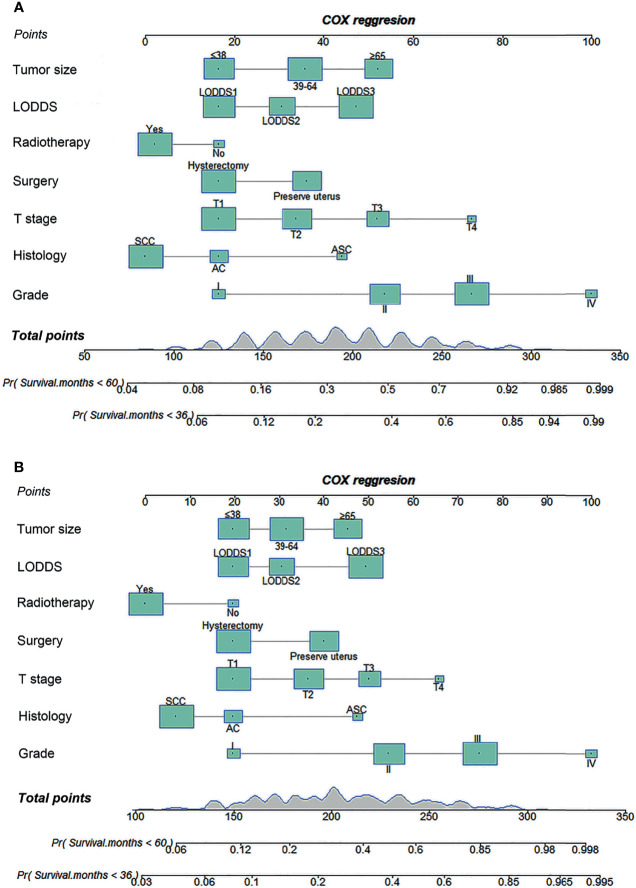
Results: Tumor size, log odds of positive lymph nodes (LODDS), radiotherapy, surgery, T stage, histology, and grade resulted as significant independent predictors both for OS and CSS. The C-index value of the prognostic nomogram for predicting OS was 0.788 (95% CI, 0.762-0.814) and 0.777 (95% CI, 0.758-0.796) in the training and validation cohorts, respectively. Meanwhile, the C-index value of the prognostic nomogram for predicting CSS was 0.792 (95% CI, 0.767-0.817) and 0.781 (95% CI, 0.764-0.798) in the training and validation cohorts, respectively. The calibration curves for the nomograms revealed gratifying consistency between predictions and actual observations for both 3- and 5-year OS and CSS. The 3- and 5-year area under the curves (AUCs) for the nomogram of OS and CSS ranged from 0.781 to 0.828. Finally, the DCA curves emerged as robust positive net benefits across a wide scale of threshold probabilities.
Conclusion: We have successfully constructed nomograms that could predict 3- and 5-year OS and CSS of cervical cancer patients with lymph node metastasis and may assist clinicians in decision-making and personalized treatment planning.
Keywords: cancer-specific survival; cervical cancer; lymph node metastasis; nomogram; overall survival.
Copyright © 2022 Yi, Liu, Wang, Zhang, Pi, Zhou and Mu.
Conflict of interest statement
The authors declare that the research was conducted in the absence of any commercial or financial relationships that could be construed as a potential conflict of interest.
Figures




References
-
- Kim SM, Choi HS, Byun JS. Overall 5-Year Survival Rate and Prognostic Factors in Patients With Stage IB and IIA Cervical Cancer Treated by Radical Hysterectomy and Pelvic Lymph Node Dissection. Int J Gynecol Cancer Off J Int Gynecol Cancer Soc (2000) 10(4):305–12. doi: 10.1046/j.1525-1438.2000.010004305.x - DOI - PubMed
LinkOut - more resources
Full Text Sources
