


Characteristics Associated With Financial or Non-financial Barriers to Healthcare in a Universal Health Insurance System: A Longitudinal Analysis of Korea Health Panel Survey Data
- PMID: 35372247
- PMCID: PMC8971121
- DOI: 10.3389/fpubh.2022.828318
Characteristics Associated With Financial or Non-financial Barriers to Healthcare in a Universal Health Insurance System: A Longitudinal Analysis of Korea Health Panel Survey Data
Abstract
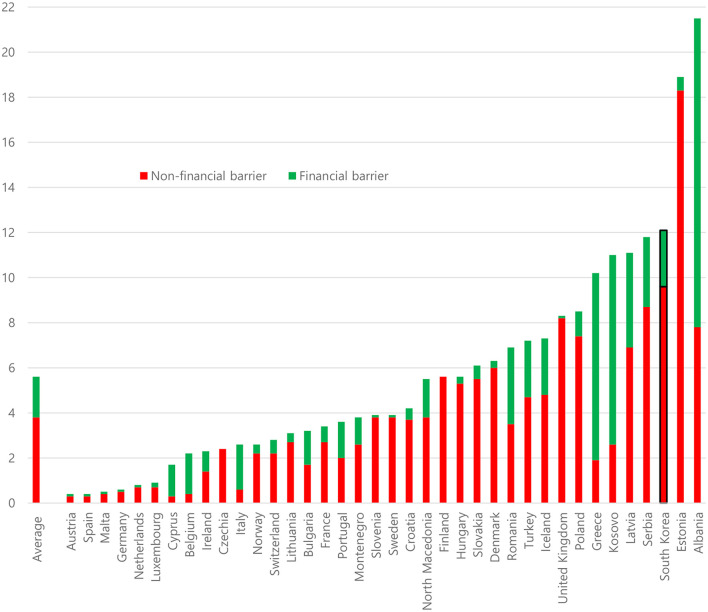
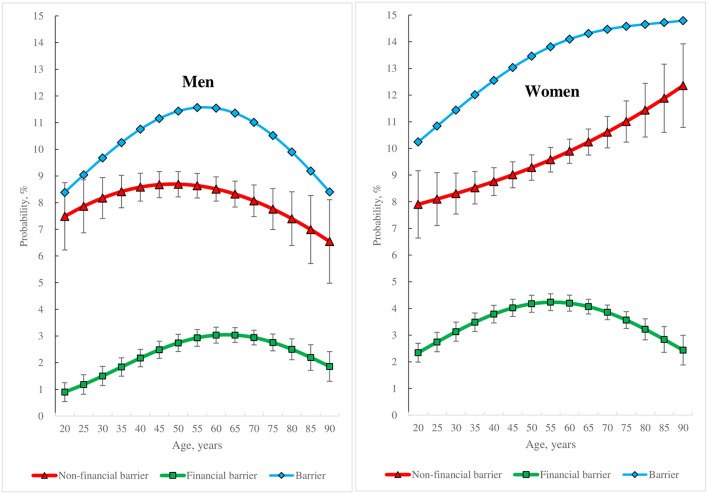
While many studies have explored the financial barriers to healthcare, there is little evidence regarding the non-financial barriers to healthcare. This study identified characteristics associated with financial and non-financial barriers to healthcare and quantified the effects of these characteristics in South Korea, using a nationally representative longitudinal survey dataset. Overall, 68,930 observations of 16,535 individuals aged 19 years and above were sampled from Korea Health Panel survey data (2014-2018). From self-reported information about respondents' experiences of unmet healthcare needs, a trichotomous dependent variable-no barrier, non-financial barrier, and financial barrier-was derived. Sociodemographics, physical and health conditions were included as explanatory variables. The average adjusted probability (AAP) of experiencing each barrier was predicted using multivariable and panel multinomial logistic regression analyses. According to the results, the percentage of people experiencing non-financial barriers was much higher than that of people experiencing financial barriers in 2018 (9.6 vs. 2.5%). Women showed higher AAPs of experiencing both non-financial (9.9 vs. 8.3%) and financial barriers (3.6 vs. 2.5%) than men. Men living in the Seoul metropolitan area showed higher AAPs of experiencing non-financial (8.7 vs. 8.0%) and financial barriers (3.4 vs. 2.1%) than those living outside it. Household income showed no significant associations in the AAP of experiencing a non-financial barrier. People with a functional limitation exhibited a higher AAP of experiencing a non-financial barrier, for both men (17.8 vs. 7.8%) and women (17.4 vs. 9.0%), than those without it. In conclusion, people in South Korea, like those in most European countries, fail to meet their healthcare needs more often due to non-financial barriers than financial barriers. In addition, the characteristics associated with non-financial barriers to healthcare differed from those associated with financial barriers. This finding suggests that although financial barriers may be minimised through various policies, a considerable degree of unmet healthcare needs and disparity among individuals is very likely to persist due to non-financial barriers. Therefore, current universal health insurance systems need targeted policy instruments to minimise non-financial barriers to healthcare to ensure effective universal health coverage.
Keywords: Korea Health Panel survey; South Korea; average adjusted probability; financial and non-financial healthcare barriers; panel multinomial logistic regression; unmet healthcare needs.
Copyright © 2022 Chung.
Conflict of interest statement
The author declares that the research was conducted in the absence of any commercial or financial relationships that could be construed as a potential conflict of interest.
Figures
References
-
- WHO . Universal Health Coverage. Geneva: World Health Organization (WHO) (2021). Available online at: https://www.who.int/health-topics/universal-health-coverage#tab=tab_1 (accessed September 13, 2021).
-
- The World Bank . Universal Health Coverage. DC: The World Bank; (2021). Available online at: https://www.worldbank.org/en/topic/universalhealthcoverage#1 (accessed August 13, 2021).
-
- WHO . Impact of Out-of-Pocket Payments for Treatment of Non-Communicable Diseases in Developing Countries: A Review of Literature. Geneve: World Health Organization (WHO) (2011). Available online at: https://apps.who.int/iris/bitstream/handle/10665/85712/HSS_HSF_DP.E.11.2... (accessed September 12, 2021).
MeSH terms
LinkOut - more resources
Full Text Sources
Miscellaneous
