. 2022 Aug;241(2):500-517.
doi: 10.1111/joa.13660. Epub 2022 Apr 4.

A new early hominin calcaneus from Kromdraai (South Africa)

Affiliations

A new early hominin calcaneus from Kromdraai (South Africa)

Christine M Harper et al. J Anat. 2022 Aug.

Abstract

The Kromdraai site in South Africa has yielded numerous early hominin fossils since 1938. As a part of recent excavations within Unit P, a largely complete early hominin calcaneus (KW 6302) was discovered. Due to its role in locomotion, the calcaneus has the potential to reveal important form/function relationships. Here, we describe KW 6302 and analyze its preserved morphology relative to human and nonhuman ape calcanei, as well as calcanei attributed to Australopithecus afarensis, Australopithecus africanus, Australopithecus sediba, Homo naledi, and the Omo calcaneus (either Paranthropus or early Homo). KW 6302 calcaneal morphology is assessed using numerous quantitative metrics including linear measures, calcaneal robusticity index, relative lateral plantar process position, Achilles tendon length reconstruction, and a three-dimensional geometric morphometric sliding semilandmark analysis. KW 6302 exhibits an overall calcaneal morphology that is intermediate between humans and nonhuman apes, although closer to modern humans. KW 6302 possesses many traits that indicate it was likely well-adapted for terrestrial bipedal locomotion, including a relatively flat posterior talar facet and a large lateral plantar process that is similarly positioned to modern humans. It also retains traits that indicate that climbing may have remained a part of its locomotor repertoire, such as a relatively gracile tuber and a large peroneal trochlea. Specimens from Kromdraai have been attributed to either Paranthropus robustus or early Homo; however, there are no definitively attributed calcanei for either genus, making it difficult to taxonomically assign this specimen. KW 6302 and the Omo calcaneus, however, fall outside the range of expected variation for an extant genus, indicating that if the Omo calcaneus was Paranthropus, then KW 6302 would likely be attributed to early Homo (or vice versa).

Keywords: Homo; Paranthropus; bipedalism; foot; tarsals.


Conflict of interest statement

We declare that we have no conflict of interest.

Figures

FIGURE 1
FIGURE 1
The KW 6302 calcaneus from superior (a), inferior (b), anterior (c), lateral (d), medial (e), and posterior (f) views
FIGURE 2
FIGURE 2
Known early hominin calcanei from the Plio‐Pleistocene from both a superior and lateral view. Surface models were flipped to represent right calcanei for ease of visual comparison. Adapted from Harper et al.,
FIGURE 3
FIGURE 3
The KW 6302 calcaneus cast articulated with the KNM‐ER 1476 talus cast from a posterior view. The KNM‐ER 1476 talus was used for analyses that necessitated a talus because it is of a similar size and articulates well with the KW 6302 calcaneus
FIGURE 4
FIGURE 4
The fully landmarked KW 6302 calcaneus, represented by 621 semilandmarks
FIGURE 5
FIGURE 5
Calcaneal tuber cross‐sectional area relative to calcaneal tuber length. Comparative extant and fossil hominin data from Prang (2015)
FIGURE 6
FIGURE 6
PC plots of complete KW 6302 calcaneal morphology for PCs 1–3. For the extant comparative sample, females are represented by open symbols and males by closed symbols. Specimens of unknown sex are represented by xs
FIGURE 7
FIGURE 7
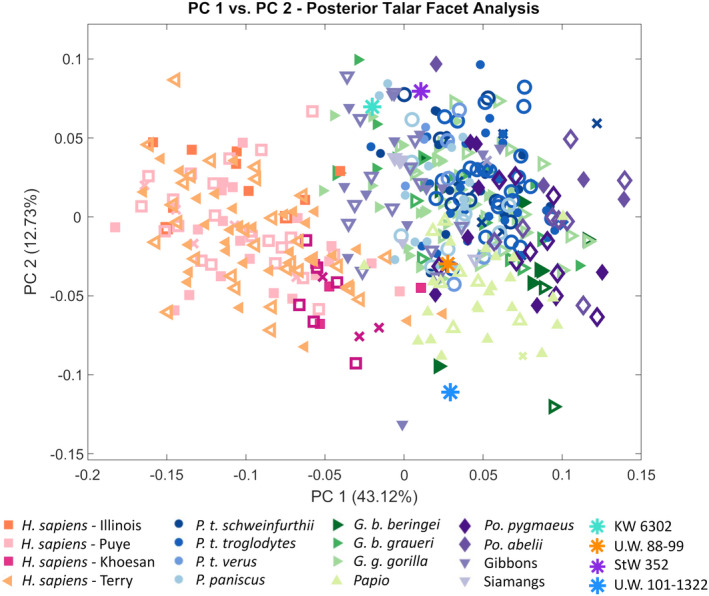
PC plot of PC 1 versus PC 2 for posterior talar facet variation (analyzed individually). For the extant comparative sample, females are represented by open symbols and males by closed symbols. Specimens of unknown sex are represented by xs
FIGURE 8
FIGURE 8
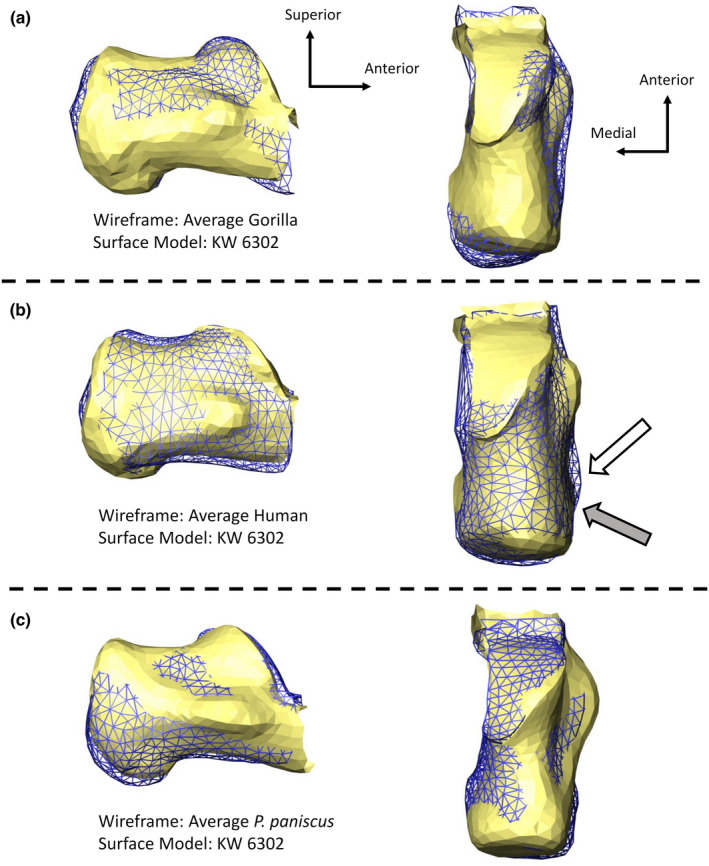
KW 6302 calcaneus relative to the average gorilla (a), the average sedentary modern human (b), and the average pan paniscus (c). The white arrow points to the location of the modern human LPP and the gray arrow points to the KW 6302 LPP
FIGURE 9
FIGURE 9
PC plots of the first two PCs for overlapping calcaneal morphology of KW 6302, Omo 33–74‐896, A.L. 333–8, and A.L. 333–55 (a), as well as the overlapping calcaneal morphology of KW 6302, StW 352, and U.W. 101–1322 (b)
FIGURE 10
FIGURE 10
KW 6302 calcaneal morphology relative to overlapping morphology of fossil calcanei included in the extinct comparative sample from a superior view. For all comparisons, the KW 6302 calcaneus is represented by a surface model and the comparative fossil calcaneus is represented by a wireframe

References

    1. 3D Systems Inc . (2015) Geomagic warp. Rock Hill: 3D Systems Inc.
    1. Berger, L.R. , Ruiter, D.J.d. , Churchill, S.E. et al. (2010) Australopithecus sediba: a new species of homo‐like Australopith from South Africa. Science, 328, 195–204. 10.1126/science.1184944 - DOI - PubMed
    1. Berger, L.R. , Hawks, J. , de Ruiter, D.J. et al. (2015) Homo Naledi, a new species of the genus homo from the Dinaledi chamber, South Africa. eLife, 4, e09560. 10.7554/eLife.09560 - DOI - PMC - PubMed
    1. Blomberg, S.P. , Garland, T. , Ives, A.R. & Crespi, B. (2003) Testing for phylogenetic signal in comparative data: behavioral traits are more labile. Evolution, 57, 717–745. - PubMed
    1. Bojsen‐Møller, F. (1979) Calcaneocuboid joint and stability of the longitudinal arch of the foot at high and low gear push off. Journal of Anatomy, 129, 165–176. - PMC - PubMed

Publication types