


Paid maternal leave is associated with infant brain function at 3 months of age
- PMID: 35373346
- PMCID: PMC9892990
- DOI: 10.1111/cdev.13765
Paid maternal leave is associated with infant brain function at 3 months of age
Abstract
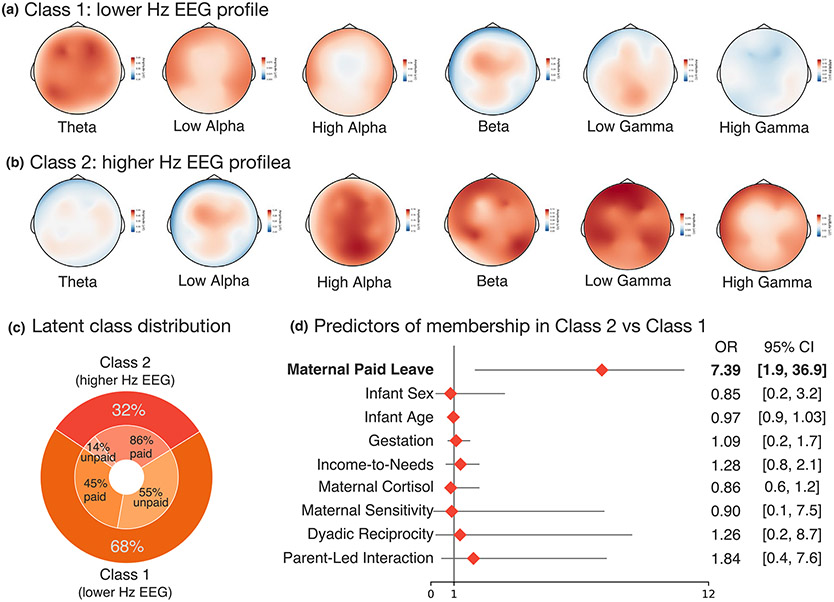
The first months of life are critical for establishing neural connections relevant for social and cognitive development. Yet, the United States lacks a national policy of paid family leave during this important period of brain development. This study examined associations between paid leave and infant electroencephalography (EEG) at 3 months in a sociodemographically diverse sample of families from New York City (N = 80; 53 males; 48% Latine; data collection occurred 05/2018-12/2019). Variable-centered regression results indicate that paid leave status was related to differences in EEG power (ps < .02, R2 s > .12). Convergent results from person-centered latent profile analyses demonstrate that mothers with paid leave were 7.39 times as likely to have infants with EEG profiles characterized by increased higher-Hz power (95% CI, 1.9-36.9), potentially reflecting more mature patterns of brain activity.
© 2022 The Authors. Child Development © 2022 Society for Research in Child Development.
Conflict of interest statement
CONFLICT OF INTEREST
The authors declare no competing interests.
Figures
References
-
- Albagli P, & Rau T (2018). The effects of a maternity leave reform on children’s abilities and maternal outcomes in Chile. The Economic Journal, 129, 1015–1047.
-
- Asparouhov T, & Muthén B (2014). Auxiliary variables in mixture modeling: Three-step approaches using Mplus. Structural Equation Modeling: A Multidisciplinary Journal, 21, 329–341.
-
- Baker M, & Milligan K (2010). Evidence from maternity leave expansions of the impact of maternal care on early child development. The Journal of Human Resources, 45, 1–32.
Publication types
MeSH terms
Grants and funding
LinkOut - more resources
Full Text Sources
