. 2022 Oct 31;63(10):1433-1445.
doi: 10.1093/pcp/pcac043.

Quantitative Proteomics at Early Stages of the Symbiotic Interaction Between Oryza sativa and Nostoc punctiforme Reveals Novel Proteins Involved in the Symbiotic Crosstalk

Affiliations

Quantitative Proteomics at Early Stages of the Symbiotic Interaction Between Oryza sativa and Nostoc punctiforme Reveals Novel Proteins Involved in the Symbiotic Crosstalk

Consolación Álvarez et al. Plant Cell Physiol. .

Abstract

Symbiosis between cyanobacteria and plants is considered pivotal for biological nitrogen deposition in terrestrial ecosystems. Despite extensive knowledge of the ecology of plant-cyanobacterium symbioses, little is known about the molecular mechanisms involved in recognition between partners. Here, we conducted a quantitative sequential window acquisition of all theoretical fragment ion spectra mass spectrometry pipeline to analyze protein changes in Oryza sativa and Nostoc punctiforme during early events of symbiosis. We found differentially expressed proteins in both organisms linked to several biological functions, including signal transduction, adhesion, defense-related proteins and cell wall modification. In N. punctiforme we found increased expression of 62 proteins that have been previously described in other Nostoc-plant symbioses, reinforcing the robustness of our study. Our findings reveal new proteins activated in the early stages of the Nostoc-Oryza symbiosis that might be important for the recognition between the plant and the host. Oryza mutants in genes in the common symbiosis signaling pathway (CSSP) show reduced colonization efficiency, providing first insights on the involvement of the CSSP for the accommodation of N. punctiforme inside the plant cells. This information may have long-term implications for a greater understanding of the symbiotic interaction between Nostoc and land plants.

Keywords: Cyanobacteria; Differential proteomic; Nitrogen; Rice; Symbiosis.


Figures

Fig. 1
Fig. 1
Association of N. punctiforme with O. sativa sp. Indica roots. (A) Green appearance of O. sativa roots inoculated with N. punctiforme at 0, 1, 7 and 35 dpi. (B) Cyanobacterial association with rice roots was quantified as μg chlorophyll a (Chl a)· mg−1 root weight. The values are the means ± standard error of the mean from t triplicate experiments. (C) O. sativa roots inoculated with N. punctiforme at 1, 7 and 35 dpi were visualized by confocal microscopy with Z stacks generated from 90 to 130 frames. Arrows indicate the plant cells colonized. Scale bar: 100 µm. Autofluorescence from the plant cell walls is colored green, while cyanobacterial chlorophyll autofluorescence is colored magenta. (D) Closed view of a plant root colonized with N. punctiforme at 35 dpi. Cyanobacterial filaments (in red) are enclosed inside the plant epidermal cells. Merged images of red autofluorescence and bright field are shown.
Fig. 2
Fig. 2
Overview of the schematic workflow used for quantitative proteomic analysis in N. punctiforme and O. sativa. The first step includes sample preparation and data acquisition by liquid chromatography-tandem mass spectrometry for generation of species-specific spectral libraries. The second step determines relative quantification of protein changes by SWATH-MS analysis. The subsequent data normalization was made with LIMMA R package to extract changes in protein abundance.
Fig. 3
Fig. 3
Global protein expression changes in N. punctiforme and O. sativa during early symbiosis. (A, C), Proteins significantly activated and repressed in N. punctiforme in response to O. sativa at 1 and 7 d, respectively. (B, D) Proteins significantly activated and repressed in O. sativa in response to N. punctiforme at 1 and 7 d, respectively. Significantly increased and decreased protein expression, analyzed by LIMMA R package, is shown in green and red, respectively (fold change >1.5 or <0.66667, and adjusted P-value < 0.05).
Fig. 4
Fig. 4
Heat map profiles of differentially expressed proteins in N. punctiforme and O. sativa. Differentially expressed proteins were clustered into eight and six groups for N. punctiforme (N1 to N8) and O. sativa (O1 to O6), respectively, based on their expression profile (Z-score by row) and Mfuzz analysis. In each condition, the average expression of each of the three technical replicates is shown. Scale bar: blue, downregulated; yellow, upregulated.
Fig. 5
Fig. 5
Selected metabolic group of proteins significantly activated in O. sativa and N. punctiforme at 1- and 7 dpi. (A) An overview of the main functions with significant changes when both organisms were in contact. (B–F) Fold change of proteins in each of the selected metabolic groups at 1 and 7 dpi. The fold change was calculated with respect to the corresponding control without the partner in the same condition. All the proteins show a significant increase in expression with respect to the control (P-value < 0.05). Asterisk denotes proteins found in other Nostoc–plant symbioses.
Fig. 6
Fig. 6
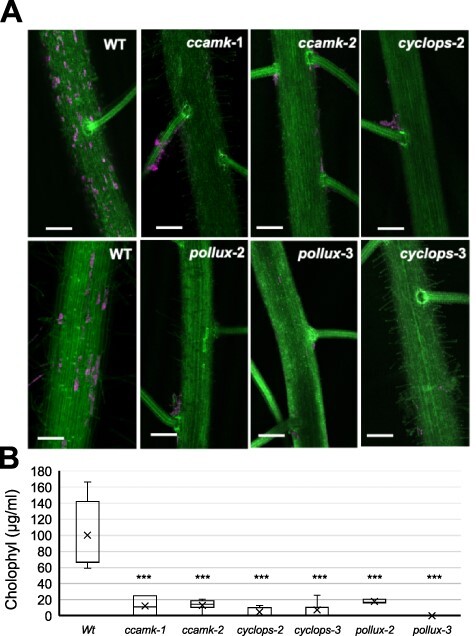
Symbiotic phenotypes of O. sativa CSSP mutants. (A) Oryza sativa roots inoculated with N. punctiforme at 35 dpi were visualized by confocal microscopy with Z stacks generated from 90 to 130 frames. Autofluorescence from the plant cell walls is colored green, while cyanobacterial chlorophyll autofluorescence is colored magenta; scale bar: 200 µm. (B) Number of O. sativa root cells that were colonized by N. punctiforme in different CSSP mutants in each image. Each data point depicts counting from a single image, with a total of 16–21 images counted from two different colonization assays. Student’s t-test indicated that the differences between the wild type and all the mutants were significant (P < 10–3).

References

    1. Adams D.G., Bergman B., Nierzwicki-Bauer S.A., Duggan P.S., Rai A.N., Schüssler A. (2013) Cyanobacterial-plant symbioses. InThe Prokaryotes. Edited by Rosenberg, E., Delong, E.F., Lory, S., Stackbrandt, E. and Thompson, F. pp. 359–400. Springer, Heidelberg.
    1. Almagro L., Gómez-Ros L.V., Belchi-Navarro S., Bru R., Ros-Barceló A. and Pedreño M.A. (2009) Class III peroxidases in plant defence reactions. J. Exp. Bot. 60: 377–390. - PubMed
    1. Álvarez C., Navarro J.A., Molina-Heredia F.P. and Mariscal V. (2020) Endophytic colonization of rice (Oryza sativa L.) by the symbiotic strain Nostoc punctiforme PCC 73102. Mol. Plant-Microbe Interact. 33: 1040–1045. - PubMed
    1. Arnon D. (1949) Copper enzymes in isolated chloroplasts polyphenoloxidase in Beta vulgaris. Plant Physiol. 24: 1–15. - PMC - PubMed
    1. Baldo L. and Werren J. (2021) Evolutionary genetics of microbial symbioses. Genes 12: 327. - PMC - PubMed