. 2022 Apr 12;327(14):1368-1378.
doi: 10.1001/jama.2022.2896.

Association of Transthyretin Val122Ile Variant With Incident Heart Failure Among Black Individuals

Affiliations

Association of Transthyretin Val122Ile Variant With Incident Heart Failure Among Black Individuals

Vibhu Parcha et al. JAMA. .

Erratum in

  • Incorrect Spelling of Author Name.
    [No authors listed] [No authors listed] JAMA. 2022 May 10;327(18):1825. doi: 10.1001/jama.2022.6725. JAMA. 2022. PMID: 35536276 Free PMC article. No abstract available.

Abstract

Importance: A genetic variant in the TTR gene (rs76992529; Val122Ile), present more commonly in individuals with African ancestry (population frequency: 3%-4%), causes misfolding of the tetrameric transthyretin protein complex that accumulates as extracellular amyloid fibrils and results in hereditary transthyretin amyloidosis.

Objective: To estimate the association of the amyloidogenic Val122Ile TTR variant with the risk of heart failure and mortality in a large, geographically diverse cohort of Black individuals.

Design, setting, and participants: Retrospective population-based cohort study of 7514 self-identified Black individuals living in the US participating in the REGARDS (Reasons for Geographic and Racial Differences in Stroke) study with genetic data available and without heart failure at baseline. The participants were enrolled at the baseline visit (2003-2007). The end of follow-up for the majority of outcomes was on December 31, 2018. All-cause mortality data were available through December 31, 2020.

Exposures: TTR Val122Ile (rs76992529) genotype.

Main outcome and measures: The primary outcome was incident heart failure (first hospitalization for heart failure or death due to heart failure). The secondary outcomes were heart failure mortality, cardiovascular mortality, and all-cause mortality. The multivariable Cox proportional hazards regression analyses were adjusted for genetic ancestry and demographic, clinical, and social factors.

Results: Among 7514 Black participants (median age, 64 years [IQR, 57-70 years]; 61% women), the population frequency of the TTR Val122Ile variant was 3.1% (232 variant carriers and 7282 noncarriers). During a median follow-up of 11.1 years (IQR, 5.9-13.5 years), incident heart failure occurred in 535 individuals (34 variant carriers and 501 noncarriers) and the incidence of heart failure was 15.64 per 1000 person-years among variant carriers vs 7.16 per 1000 person-years among noncarriers (adjusted hazard ratio [HR], 2.43 [95% CI, 1.71-3.46]; P < .001). Deaths due to heart failure occurred in 141 individuals (13 variant carriers and 128 noncarriers) and the incidence of heart failure mortality was 6.11 per 1000 person-years among variant carriers vs 1.85 per 1000 person-years among noncarriers (adjusted HR, 4.19 [95% CI, 2.33-7.54]; P < .001). Deaths due to cardiovascular causes occurred in 793 individuals (34 variant carriers and 759 noncarriers) and the incidence of cardiovascular death was 15.18 per 1000 person-years among variant carriers vs 10.61 per 1000 person-years among noncarriers (adjusted HR, 1.69 [95% CI, 1.19-2.39]; P = .003). Deaths due to any cause occurred in 2715 individuals (100 variant carriers and 2615 noncarriers) and the incidence of all-cause mortality was 41.46 per 1000 person-years among variant carriers vs 33.94 per 1000 person-years among noncarriers (adjusted HR, 1.46 [95% CI, 1.19-1.78]; P < .001). There was no significant interaction between TTR variant carrier status and sex on incident heart failure and the secondary outcomes.

Conclusions and relevance: Among a cohort of Black individuals living in the US, being a carrier of the TTR Val122Ile variant was significantly associated with an increased risk of heart failure.


Conflict of interest statement

Conflict of Interest Disclosures: Dr Maurer reported receiving personal fees from Abbott, Alnylam, Eidos, GlaxoSmithKline, Intellia, and Ionis and receiving grants from Eidos and Pfizer. Dr Levitan reported receiving grants from Amgen and receiving personal fees from Novartis. Dr Goyal reported receiving personal fees for medicolegal consulting in heart failure. No other disclosures were reported.

Figures

Figure 1.
Figure 1.. Risk of Incident Heart Failure Among Black Individuals Stratified by TTR Val122Ile Variant Status
The median follow-up duration for the individuals who were TTR Val122Ile carriers was 11.1 years (IQR, 5.4-13.4 years) and for noncarriers was 11.1 years (IQR, 5.9-13.5 years). Among the 2 homozygous individuals, one had an incident heart failure event and the other died due to noncardiac causes. The x-axis represents the age at which the study participant was censored in the respective groups. The age at censoring is the sum of age at recruitment and the follow-up duration. The number at risk represents the participants at the given age who are at risk of developing a censoring event (outcome, death, or lost to follow-up).
Figure 2.
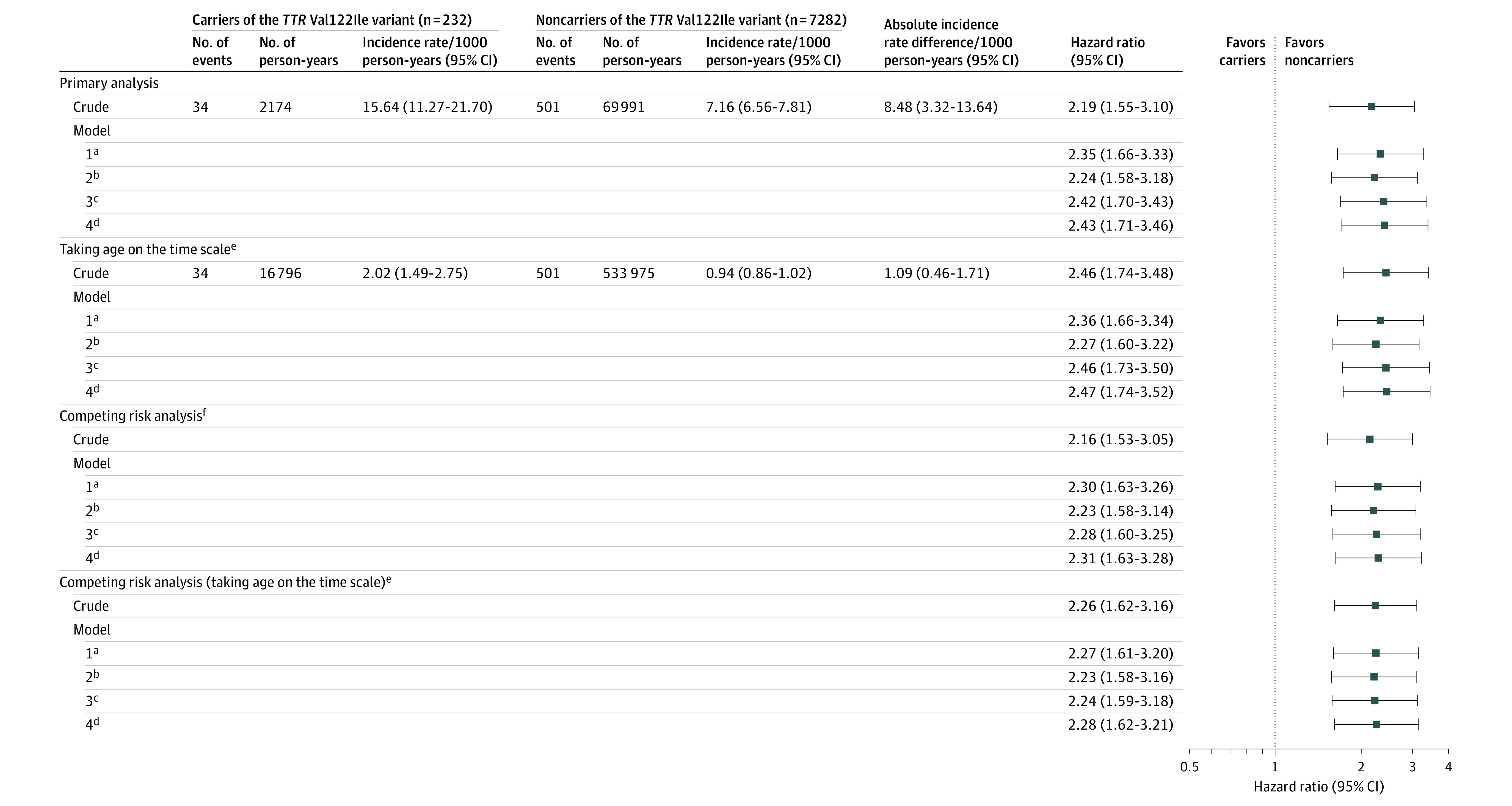
Figure 2.. Risk of Heart Failure Among TTR Val122Ile Variant Carriers
P<.001 for all model comparisons. aIncludes age, sex, body mass index, and 10 principal components of African ancestry to account for population stratification. Systematic ancestral differences (population stratification) can contribute to differences in allele distribution between those developing and not developing the study outcomes. These differences may result in false genetic associations. The principal components capture this population stratification. Adjustment of the models for the principal components ensures that the reported associations are not resulting from the underlying population stratification. Age was not included when taken in the definition of time scale. bIncludes model 1 plus prevalent and incident coronary heart disease (time varying). cIncludes model 2 plus systolic blood pressure, smoking status, estimated glomerular filtration rate, alcohol use (number of drinks/week), history of atrial fibrillation, diabetes status, dyslipidemia, physical activity frequency, history of stroke, and left ventricular hypertrophy. dIncludes model 3 plus region of residence, income level, education level, health insurance status, and the neighborhood deprivation measure. eImplies that the time to event in the model was the age of the participant, with the participant being censored at the age of occurrence of the event. In this approach, the participants enter the observation period at the age when they were recruited in the study cohort and exit at the age at which they are censored (due to the occurrence of an event, death, or lost to follow-up). fAccounts for non–heart failure–related deaths as a competing event.
Figure 3.
Figure 3.. Risk of Heart Failure Mortality, Cardiovascular Mortality, and All-Cause Mortality Among Black Individuals Stratified by TTR Val122Ile Variant Status
For the individuals who were TTR Val122Ile carriers, the median follow-up duration was 11.1 years (IQR, 5.5-13.4 years) for heart failure mortality (panel A), 11.3 years (IQR, 5.7-13.5 years) for cardiovascular mortality (panel B), and 11.9 years (IQR, 5.8-14.7 years) for all-cause mortality (panel C). For the individuals who were TTR Val122Ile noncarriers, the median follow-up duration was 11.2 years (IQR, 6.0-13.5 years) for heart failure mortality (panel A), 11.3 years (IQR, 6.4-13.5 years) for cardiovascular mortality (panel B), and 11.7 years (IQR, 6.5-15.0 years) for all-cause mortality (panel C). Among the 2 homozygous individuals, one died due to noncardiovascular causes and the other participant is still alive. The x-axis represents the age at which the study participant was censored in the respective groups. The age at censoring is the sum of age at recruitment and the follow-up duration. The number at risk represents the participants at the given age who are at risk of developing a censoring event (outcome, death, or lost to follow-up).
Figure 4.
Figure 4.. Risk of Heart Failure Mortality, Cardiovascular Mortality, and All-Cause Mortality Among TTR Val122Ile Variant Carriers
P<.05 for all model comparisons. aIncludes age, sex, body mass index, and 10 principal components of African ancestry to account for population stratification. Systematic ancestral differences (population stratification) can contribute to differences in allele distribution between those developing and not developing the study outcomes. These differences may result in false genetic associations. The principal components capture this population stratification. Adjustment of the models for the principal components ensures that the reported associations are not resulting from the underlying population stratification. bIncludes model 1 plus prevalent coronary heart disease, systolic blood pressure, smoking status, estimated glomerular filtration rate, alcohol use (number of drinks/week), history of atrial fibrillation, diabetes status, dyslipidemia, physical activity frequency, history of stroke, and left ventricular hypertrophy. cIncludes model 2 plus region of residence, income level, education level, health insurance status, and the neighborhood deprivation measure.

Comment in

References

    1. Rosenblum H, Castano A, Alvarez J, Goldsmith J, Helmke S, Maurer MS. TTR (transthyretin) stabilizers are associated with improved survival in patients with TTR cardiac amyloidosis. Circ Heart Fail. 2018;11(4):e004769. doi:10.1161/CIRCHEARTFAILURE.117.004769 - DOI - PMC - PubMed
    1. Ruberg FL, Berk JL. Transthyretin (TTR) cardiac amyloidosis. Circulation. 2012;126(10):1286-1300. doi:10.1161/CIRCULATIONAHA.111.078915 - DOI - PMC - PubMed
    1. Rapezzi C, Quarta CC, Riva L, et al. . Transthyretin-related amyloidoses and the heart: a clinical overview. Nat Rev Cardiol. 2010;7(7):398-408. doi:10.1038/nrcardio.2010.67 - DOI - PubMed
    1. Jacobson DR, Alexander AA, Tagoe C, Buxbaum JN. Prevalence of the amyloidogenic transthyretin (TTR) V122I allele in 14 333 African-Americans. Amyloid. 2015;22(3):171-174. doi:10.3109/13506129.2015.1051219 - DOI - PubMed
    1. Buxbaum JN, Ruberg FL. Transthyretin V122I (pV142I)* cardiac amyloidosis: an age-dependent autosomal dominant cardiomyopathy too common to be overlooked as a cause of significant heart disease in elderly African Americans. Genet Med. 2017;19(7):733-742. doi:10.1038/gim.2016.200 - DOI - PMC - PubMed

MeSH terms

Supplementary concepts