. 2022 May;101(5):101838.
doi: 10.1016/j.psj.2022.101838. Epub 2022 Mar 10.

The effects of feed restriction, time of day, and time since feeding on behavioral and physiological indicators of hunger in broiler breeder hens

Affiliations

The effects of feed restriction, time of day, and time since feeding on behavioral and physiological indicators of hunger in broiler breeder hens

Laura M Dixon et al. Poult Sci. 2022 May.

Abstract

Broiler breeder chickens are commercially feed restricted to slow their growth and improve their health and production, however, there is research demonstrating that this leads to chronic hunger resulting in poor welfare. A challenge in these studies is to account for possible daily rhythms or the effects of time since last meal on measures relating hunger. To address this, we used 3 feed treatments: AL (ad libitum fed), Ram (restricted, fed in the morning), and Rpm (restricted, fed in the afternoon) to control for diurnal effects. We then conducted foraging motivation tests and collected home pen behavior and physiological samples at 4 times relative to feeding throughout a 24-h period. The feed treatment had the largest influence on the data, with AL birds weighing more, having lower concentrations of plasma NEFA, and mRNA expression of AGRP and NPY alongside higher expression of POMC in the basal hypothalamus than Ram or Rpm birds (P < 0.001). R birds were more successful at and had a shorter latency to complete the motivation test, and did more walking and less feeding than AL birds in the home pen (P < 0.01). There was little effect of time since last meal on many measures (P > 0.05) but AGRP expression was highest in the basal hypothalamus shortly after a meal (P < 0.05), blood plasma NEFA was higher in R birds just before feeding (P < 0.001) and glucose was higher in Ram birds just after feeding (P < 0.001), and the latency to complete the motivation test was shortest before the next meal (P < 0.05). Time of day effects were mainly found in the difference in activity levels in the home pen when during lights on and lights off periods. In conclusion, many behavioral and physiological hunger measures were not significantly influenced by time of day or time since the last meal. For the measures that do change, future studies should be designed so that sampling is balanced in such a way as to minimize bias due to these effects.

Keywords: behavior; broiler breeder; hunger; physiology; welfare.


Figures

Figure 1
Figure 1
The allocation of birds to pens, treatments and rooms for both batches of the experiment.
Figure 2
Figure 2
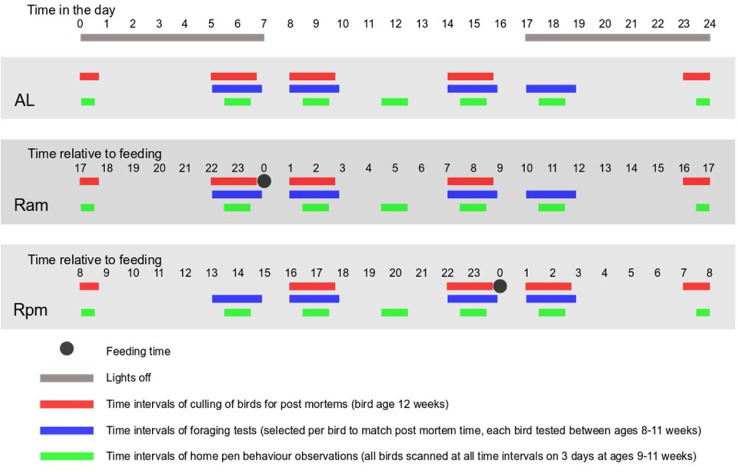
The treatment structure for the experiment, showing time relative to feeding and actual time of day when measurements took place for the 3 feed treatments. Birds were culled for PMs during ∼2-h intervals starting at 1, 7, 16, and 22 h relative to feeding. Observation times for AL were chosen to match those for Ram. These time intervals were chosen in order to have 1 soon after feeding, 1 just before feeding, and 2 intermediate, and so that 3 of 4 intervals also coincided at the same times in the day. Foraging tests took place for each bird at the same time in the day that the bird was to be culled for post mortem, apart from those culled around midnight for which foraging tests were instead at 17:00–19:00 (Ram) or 5:00–7:00 (Rpm). (Foraging motivation tests were not carried out at midnight as the birds would have been asleep for a few hours and previous experience suggests they would not perform in the motivation test). Home pen scan sessions were chosen to also coincide with the time in the day birds were culled for post mortem, plus the addition of 1 session in the middle of the day. Each 1-h session contained 10 scans during lights on and 5 scans during lights off. Foraging tests took place over 3 wk per batch with different birds being tested each week, and then home pen observations took place for all birds over one 24-h period at the end of each of these weeks, when birds were undisturbed, apart from for feeding.
Figure 3
Figure 3
Back-transformed crop content weight (A), crop content score (B), plasma NEFA levels (C) and plasma glucose levels (D) for each feed treatment at the 4 sampling times relative to last feed (hours). Data are back-transformed means ± SEMs estimated from LMMs. * indicates a significant difference between AL and R treatments. ** indicates a significant difference between Ram and Rpm treatments. ‡ indicates a significant difference between AL/Rpm and Ram treatments. Ω indicates a significant difference between AL and Rpm treatments. ¥ indicates a significant difference between AL/Ram and Rpm
Figure 4
Figure 4
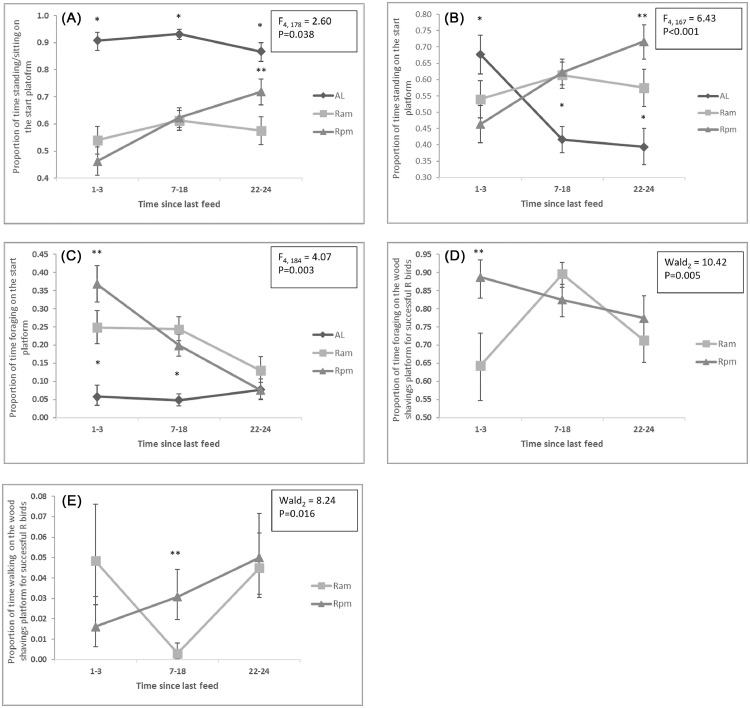
Back-transformed means and SEM for the proportion of the test time spent standing/sitting (A), standing only (B) and foraging (C) on the start platform and for the proportion of the test time spent foraging (D) and walking (E) for the successful R birds on the wood shavings platform at the 3 sampling times relative to last feed (hours). Data are back-transformed means ± SEMs estimated from LMMs. * indicates a significant difference between AL and R treatments. ** indicates a significant difference between Ram and Rpm treatments.
Figure 5
Figure 5
Back-transformed means of the time spent feeding (A), foraging (B), drinking (C), preening (D), walking (E), and inactive (F) during the lights on period in the home pen. Data are back-transformed means±SEMs estimated from GLMMs. * indicates a significant difference between AL and R treatments. ** indicates a significant difference between Ram and Rpm treatments. ‡ indicates a significant difference between AL/Rpm and Ram treatments.
Figure 6
Figure 6
Back-transformed means of the time spent preening (A), walking (B), active (C), and inactive (D) during the lights off period in the home pen. Data are back-transformed means ± SEMs estimated from GLMMs. * indicates a significant difference between AL and R treatments. ** indicates a significant difference between Ram and Rpm treatments.  Ω indicates a significant difference between AL and Rpm treatments. ‡ indicates a significant difference between AL/Rpm and Ram treatments.
Figure 7
Figure 7
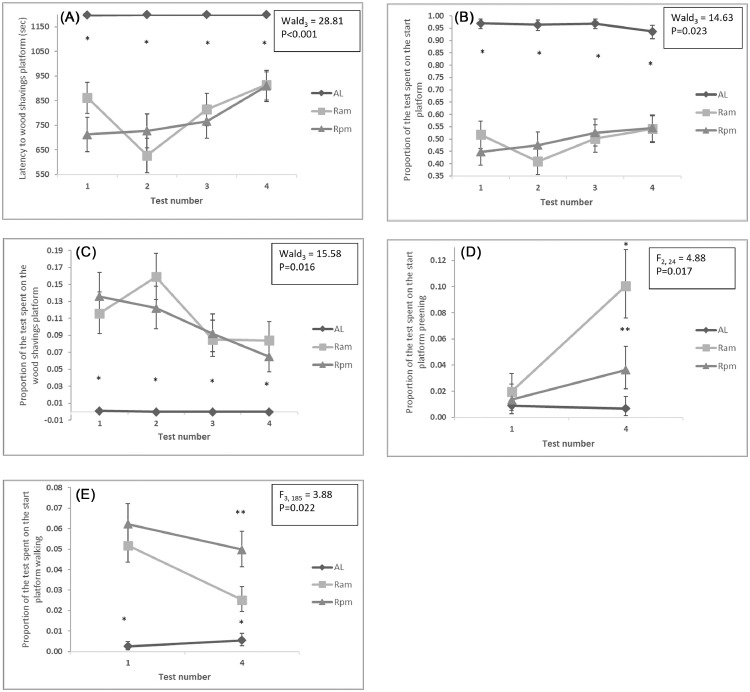
Back-transformed means of the latency to reach the wood shaving platform (A), the proportion of the test time spent on the start platform (B) and the proportion of the test time spent on the wood shavings platform (C) over the 4 tests and the proportion of the test time spent preening (D) and walking (E) on the start platform over tests 1 and 4. Data are back-transformed means ± SEMs from LMMs. * indicates a significant difference between AL and R treatments. ** indicates a significant difference between Ram and Rpm treatments.

References

    1. Appleby M.C., Mench J.A., Hughes B.O. CABI Publishing; Wallingford, UK: 2004. Poultry Behaviour and Welfare.
    1. Apps M.A.J., Grima L.L., Manohar S., Husain M. The role of cognitive effort in subjective reward devaluation and risky decision-making. Sci. Rep. 2015;5:1–11. - PMC - PubMed
    1. Arrazola A., Mosco E., Widowski T.M., Guerin M.T., Kiarie E.G., Torrey S. The effect of alternative feeding strategies during rearing on the behaviour of broiler breeder pullets. Appl. Anim. Behav. Sci. 2020;224
    1. Aviagen. 2013. Ross 308 Parent stock management handbook. Accessed Feb. 2014. http://en.aviagen.com/brands/ross/products/ross-308.
    1. Blokhuis H.J. Rest in poultry. Appl. Anim. Behav. Sci. 1984;12:289–303.

Substances