


A Modified Procedure to Diagnose Erectile Dysfunction Using the International Index of Erectile Function (IIEF-6) Combined With the Premature Ejaculation Diagnosis Tool (PEDT) via an Internet Survey
- PMID: 35378439
- PMCID: PMC9177868
- DOI: 10.1016/j.esxm.2022.100506
A Modified Procedure to Diagnose Erectile Dysfunction Using the International Index of Erectile Function (IIEF-6) Combined With the Premature Ejaculation Diagnosis Tool (PEDT) via an Internet Survey
Abstract
Background: The reliability of the International Index of Erectile Function (IIEF-5) in diagnosing erectile dysfunction (ED) is significantly decreased for the population with premature ejaculation (PE).
Aim: We aimed to illustrate a better way of diagnosing ED among the general population through a web survey study.
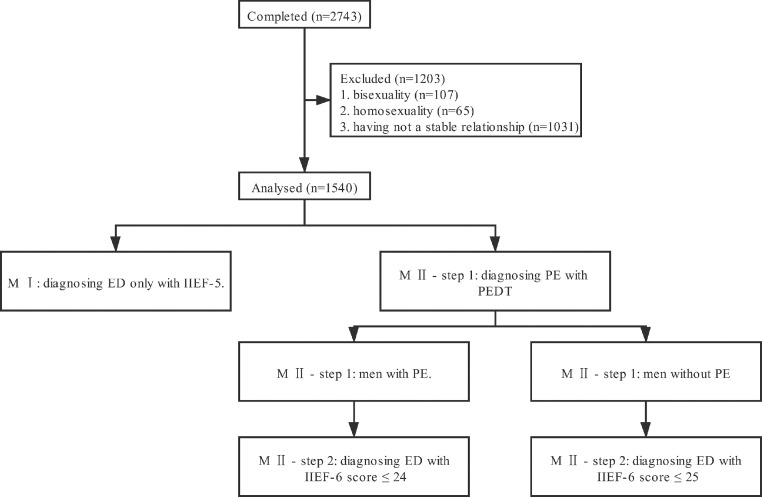
Methods: We collected online surveys from 2,746 men between the ages of 18 and 65. Two methods were used to determine the prevalence of ED, and these 2 methods were compared. Additionally, we divided our sample into 2 equally sized groups by median age and repeated the analyses for each group. In Method Ⅰ (M Ⅰ), men with an IIEF-5 score ≤ 21 were diagnosed with ED. In Method Ⅱ (M Ⅱ), PE was defined as a PEDT score ≥ 9, and no-PE was defined as a PEDT score ≤ 8. We used an IIEF-6 score cutoff of ≤ 24 among the PE population and a cutoff of ≤ 25 among the no-PE population to diagnose ED.
Main outcome measures: We examined the results from the IIEF-5, PEDT, and IIEF-6.
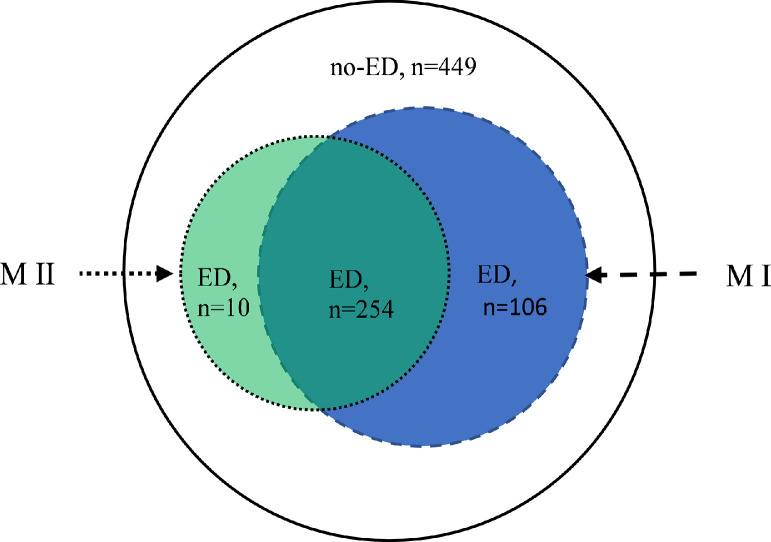
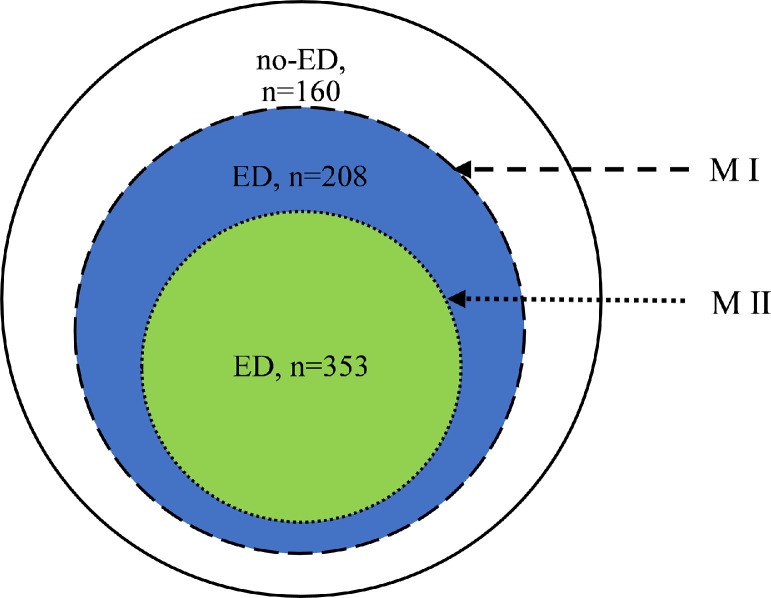
Results: Of the 2,746 men, 1,540 were in a stable heterosexual relationship, and the prevalence of ED among these men was determined. The prevalence of ED, as measured by Method Ⅰ, was significantly higher than that measured by Method Ⅱ. The kappa coefficients between the 2 methods were 0.595, 0.704, and 0.430 for the overall, no-PE, and PE populations, respectively. The internal consistency of the IIEF-5 for the PE population increased if Question 5 (intercourse satisfaction) was removed. Similar trends were observed for the groups, and there were no substantial differences.
Clinical implications: Our research suggests that before using the erectile function assessment scale to evaluate erectile function, ejaculatory function should be assessed with the PEDT.
Strengths and limitations: This was the first study to highlight the importance of evaluating ejaculatory function using the PEDT before diagnosing ED via an internet survey. There may have been recruitment bias because our study was an internet survey.
Conclusion: Establishing the prevalence of ED by using a combination of the IIEF-6 and PEDT was more reliable than using the IIEF-5 alone. Further validation of the modified procedure, especially regarding the effects of age on the results, in future studies is required. Wang C, Zhang H, Liu Z, et al. A Modified Procedure to Diagnose Erectile Dysfunction Using the International Index of Erectile Function (IIEF-6) Combined With the Premature Ejaculation Diagnosis Tool (PEDT) via an Internet Survey. Sex Med 2022;10:100506.
Keywords: Erectile Dysfunction; IIEF-5; IIEF-6; Premature Ejaculation Diagnostic Tool (PEDT).
Copyright © 2022 International Society for Sexual Medicine. Published by Elsevier Inc. All rights reserved.
Figures
References
-
- Kessler A, Sollie S, Challacombe B, et al. The global prevalence of erectile dysfunction: a review. BJU Int. 2019;124:587–599. - PubMed
-
- Goldstein I, Goren A, Li VW, et al. Epidemiology update of erectile dysfunction in eight countries with high burden. Sex Med Rev. 2020;8:48–58. - PubMed
-
- Fisher WA, Eardley I, McCabe M, et al. Erectile dysfunction (ED) is a shared sexual concern of couples I: couple conceptions of ED. J Sex Med. 2009;6:2746–2760. - PubMed
-
- Fisher WA, Rosen RC, Eardley I, et al. Sexual experience of female partners of men with erectile dysfunction: the female experience of men's attitudes to life events and sexuality (FEMALES) study. J Sex Med. 2005;2:675–684. - PubMed
