Review
. 2022 Apr;54(4):414-425.
doi: 10.1038/s12276-022-00750-y. Epub 2022 Apr 4.

Mitotic protein kinase-driven crosstalk of machineries for mitosis and metastasis

Affiliations
Review

Mitotic protein kinase-driven crosstalk of machineries for mitosis and metastasis

Chang-Hyeon Kim et al. Exp Mol Med. 2022 Apr.

Abstract

Accumulating evidence indicates that mitotic protein kinases are involved in metastatic migration as well as tumorigenesis. Protein kinases and cytoskeletal proteins play a role in the efficient release of metastatic cells from a tumor mass in the tumor microenvironment, in addition to playing roles in mitosis. Mitotic protein kinases, including Polo-like kinase 1 (PLK1) and Aurora kinases, have been shown to be involved in metastasis in addition to cell proliferation and tumorigenesis, depending on the phosphorylation status and cellular context. Although the genetic programs underlying mitosis and metastasis are different, the same protein kinases and cytoskeletal proteins can participate in both mitosis and cell migration/invasion, resulting in migratory tumors. Cytoskeletal remodeling supports several cellular events, including cell division, movement, and migration. Thus, understanding the contributions of cytoskeletal proteins to the processes of cell division and metastatic motility is crucial for developing efficient therapeutic tools to treat cancer metastases. Here, we identify mitotic kinases that function in cancer metastasis as well as tumorigenesis. Several mitotic kinases, namely, PLK1, Aurora kinases, Rho-associated protein kinase 1, and integrin-linked kinase, are considered in this review, as an understanding of the shared machineries between mitosis and metastasis could be helpful for developing new strategies to treat cancer.


Conflict of interest statement

The authors declare no competing interests.

Figures
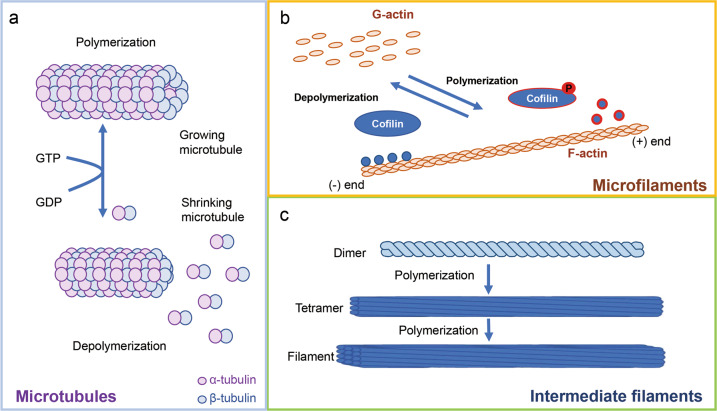
Fig. 1
Fig. 1. Three types of cytoskeletal filaments.
a Polymerization and depolymerization of microtubules through GDP/GTP exchange of α- and β-tubulin heterodimers. b Polymerization and depolymerization of microfilaments through phosphorylation of cofilin. G-actin, monomeric actin form; F-actin, polymeric actin form. c Assembly of intermediate filaments (e.g., vimentin, desmin, laminin, keratin, and neurofilaments) via polymer formation.
Fig. 2
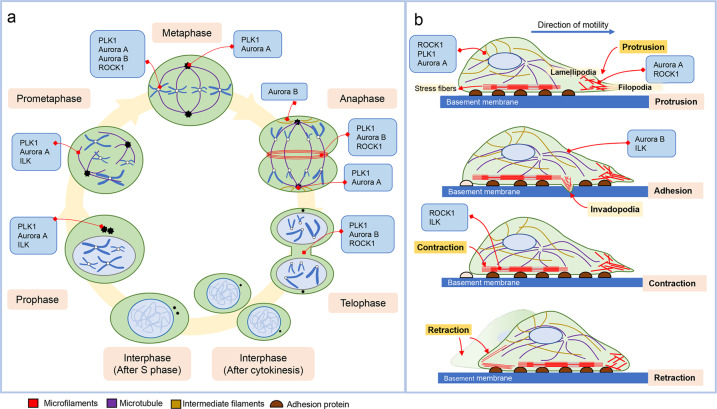
Fig. 2. Locations of cytoskeletal filaments and mitotic protein kinases during cell division and cell migration.
a During cell division, the mitotic kinases Aurora A/B, PLK1, ROCK1, and ILK are found in several locations, such as the kinetochore, spindle pole, or central spindle, where cytoskeletal filaments are present for mitotic dynamics. b The locations of cytoskeletal filaments and mitotic kinases (Aurora A/B, PLK1, ROCK1, and ILK) during the four processes of cell migration: protrusion (lamellipodia and filopodia), adhesion, contraction, and retraction.
Fig. 3
Fig. 3. Phosphorylation of cytoskeletal filaments and/or related molecules by mitotic protein kinases during cell division.
During cell division, the mitotic kinases Aurora A/B, PLK1, ROCK1, and ILK interact with and phosphorylate several mitotic substrates regulating cytoskeletal filaments for microtubule nucleation in prophase, spindle assembly in prometaphase and metaphase, and contractile ring formation in late mitosis.
Fig. 4
Fig. 4. Regulation of cytoskeletal filaments and/or related molecules by mitotic protein kinases during metastasis.
a Transcriptional and b cytoskeletal regulation by mitotic protein kinases through phosphorylation during cell migration and invasion of metastatic cancer cells.

References

    1. Hu C, et al. ROCK1 promotes migration and invasion of non‑small‑cell lung cancer cells through the PTEN/PI3K/FAK pathway. Int. J. Oncol. 2019;55:833–844. - PMC - PubMed
    1. Peng Y, et al. ROCK isoforms differentially modulate cancer cell motility by mechanosensing the substrate stiffness. Acta Biomater. 2019;88:86–101. - PubMed
    1. Rizki A, Mott JD, Bissell MJ. Polo-like kinase 1 is involved in invasion through extracellular matrix. Cancer Res. 2007;67:11106–11110. - PMC - PubMed
    1. Wu J, Ivanov AI, Fisher PB, Fu Z. Polo-like kinase 1 induces epithelial-to-mesenchymal transition and promotes epithelial cell motility by activating CRAF/ERK signaling. Elife. 2016;5:e10734. - PMC - PubMed
    1. D’assoro A, et al. The mitotic kinase Aurora-A promotes distant metastases by inducing epithelial-to-mesenchymal transition in ERα+ breast cancer cells. Oncogene. 2014;33:599–610. - PMC - PubMed

Publication types