. 2022 Jul 22;209(1):46-63.
doi: 10.1093/cei/uxac030.

Antibodies as biomarkers for cancer risk: a systematic review

Affiliations

Antibodies as biomarkers for cancer risk: a systematic review

Maria J Monroy-Iglesias et al. Clin Exp Immunol. .

Abstract

Increasing evidence has linked the humoral immune response with the development of various cancers. Therefore, there is growing interest in investigating the predictive value of antibodies to assess overall and tissue site-specific cancer risk. Given the large amount of antibody types and the broad scope of the search (i.e. cancer risk), the primary aim of this systematic review was to present an overview of the most researched antibodies (i.e. immunoglobulin (Ig) isotypes (IgG, IgM, IgA, and IgE), tumour and self-antigen-reactive antibodies, infection-related antibodies) in relation to overall and site-specific cancer risk. We identified various antibody types that have been associated with the risk of cancer. While no significant associations were found for IgM serum levels, studies found an inconsistent association among IgE, IgA, and IgG serum levels in relation to cancer risk. When evaluating antibodies against infectious agents, most studies reported a positive link with specific cancers known to be associated with the specific agent recognized by serum antibodies (i.e. helicobacter pylori and gastric cancer, hepatitis B virus and hepatocellular carcinoma, and human papillomavirus and cervical cancer). Several reports identified autoantibodies, as single biomarkers (e.g. anti-p53, anti-MUC1, and anti-CA125) but especially in panels of multiple autoantibodies, to have potential as diagnostic biomarkers for specific cancer types. Overall, there is emerging evidence associating certain antibodies to cancer risk, especially immunoglobulin isotypes, tumour-associated antigen-specific, and self-reactive antibodies. Further experimental studies are necessary to assess the efficacy of specific antibodies as markers for the early diagnosis of cancer.

Keywords: antibodies; biomarkers; cancer; early detection; immunoglobulin; tumor -associated antigens.


Figures

Graphical Abstract
Graphical Abstract
Figure 1:
Figure 1:
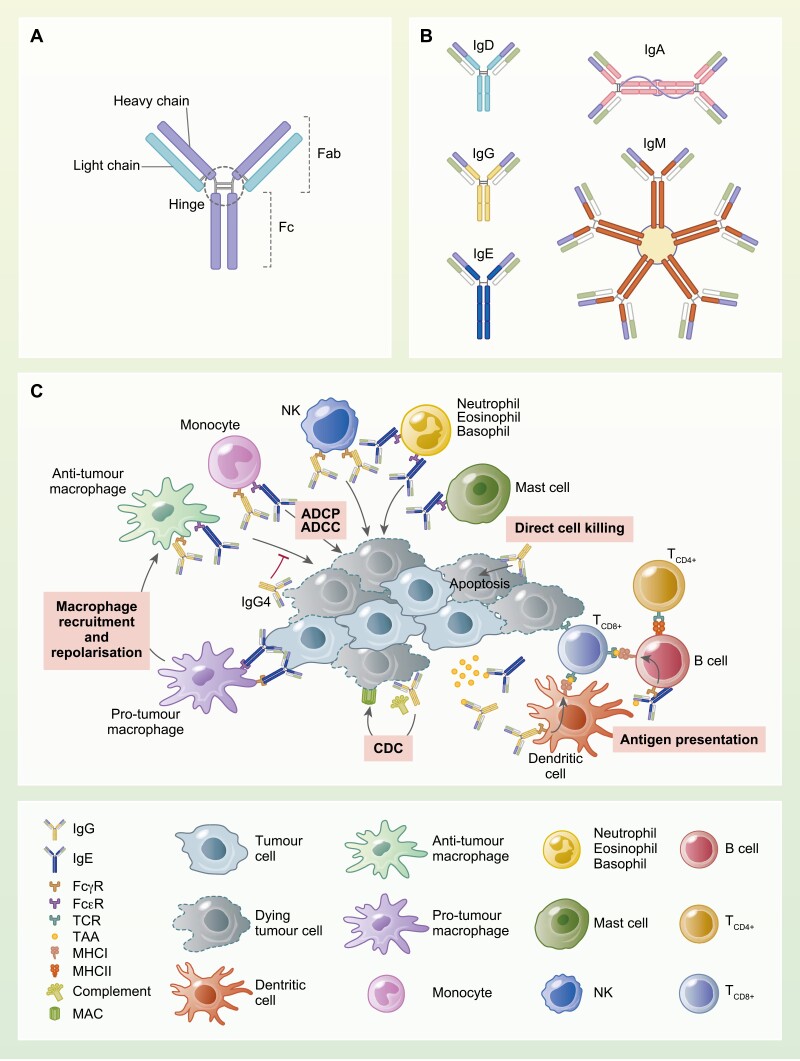
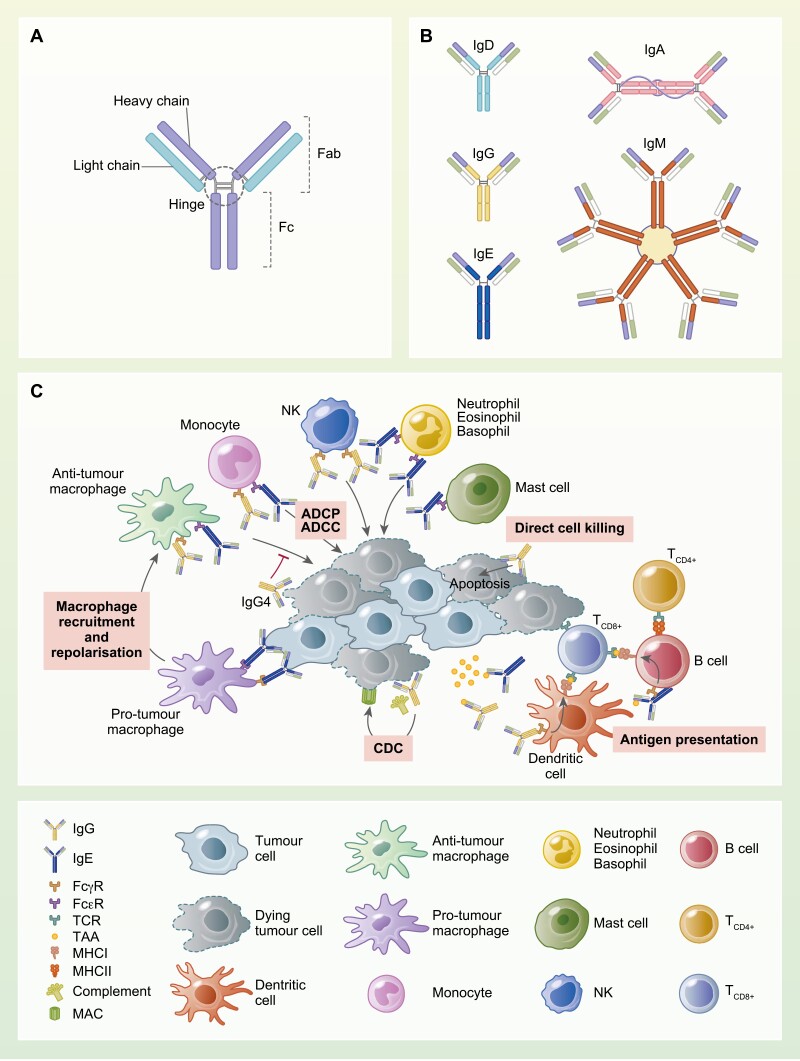
(A) Schematic representing antibody structure with heavy and light chains, and Fab, hinge, and Fc regions. (B) Heavy chain constant regions of different isotype are labelled in: light blue (IgD), yellow (IgG), blue (IgE), pink (IgA), red (IgM); IgM and IgA J chain is in blue. (C) Antibody-mediated anti-tumour or pro-tumour effector functions. Antibodies can exert several anti-tumour effector functions: mediating ADCC, ADCP, and CDC. Antibodies engaged with FcRs on immune effector cells and bound to tumour-derived antigens to form immune complexes, can (a) repolarize immune cells such as NK cells and pro-tumour macrophages into pro-inflammatory, anti-tumour phenotypes and (b) facilitate antigen internalization, processing, and presentation to activate T cells. Antibodies can also exert direct cell killing, via antigen neutralization and blocking of downstream signalling, resulting in block of tumour growth and induction of apoptosis. Some IgG subclasses, such as IgG4, can exert pro-tumour functions. IgG4 has poor capacity to fix complement and lower ability to bind activating FcγRs and therefore lower ability to trigger effector functions compared to IgG1, and relatively high affinity for the inhibitory receptor FcγRIIb, resulting in negative immune effector cell activating signals, potentially blocking IgG1 mediated effector functions. See online supplementary material for a colour version of this figure.
Figure 2
Figure 2
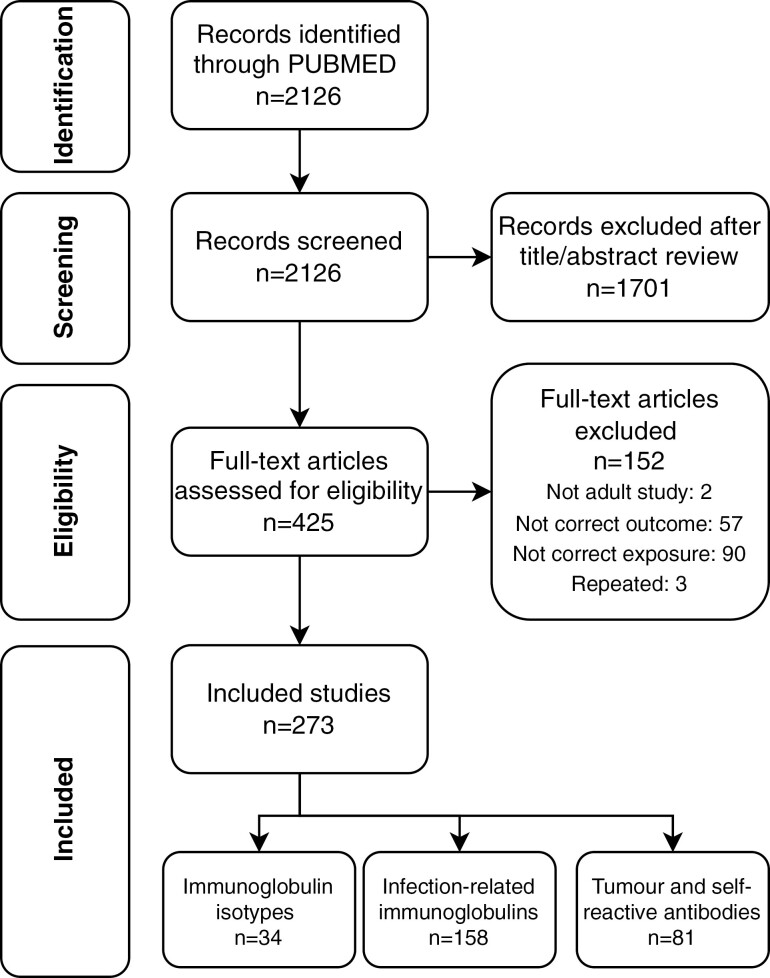
PRISMA diagram representing the systematic review strategy.
Figure 3
Figure 3
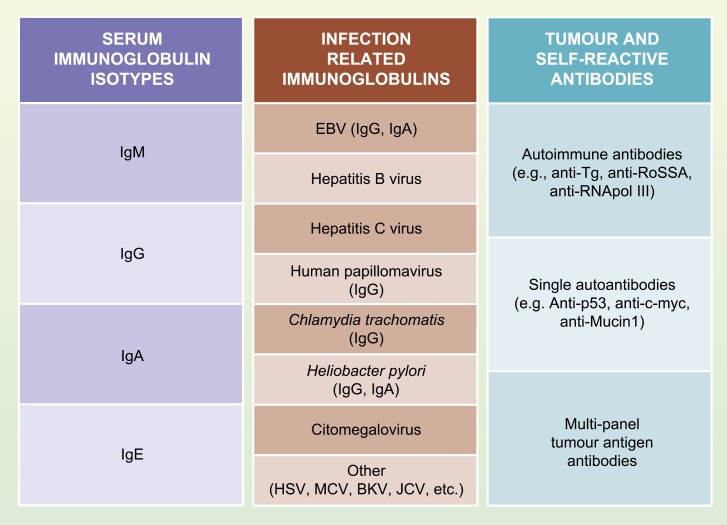
Overview of antibodies associated with cancer risk described in the review.

References

    1. Scott AM, Wolchok JD, Old LJ.. Antibody therapy of cancer. Nat Rev Cancer 2012, 12, 278–87. doi:10.1038/nrc3236. - DOI - PubMed
    1. Schroeder HW Jr, Cavacini L.. Structure and function of immunoglobulins. J Allergy Clin Immunol 2010, 125, S41–52. doi:10.1016/j.jaci.2009.09.046. - DOI - PMC - PubMed
    1. Shade KT, Conroy ME, Anthony RM.. IgE glycosylation in health and disease. Curr Top Microbiol Immunol 2019, 423, 77–93. doi:10.1007/82_2019_151. - DOI - PMC - PubMed
    1. Ren S, Zhang Z, Xu C, Guo L, Lu R, Sun Y, et al. . Distribution of IgG galactosylation as a promising biomarker for cancer screening in multiple cancer types. Cell Res 2016, 26, 963–66. doi:10.1038/cr.2016.83. - DOI - PMC - PubMed
    1. Peppas I, George G, Sollie S, Josephs DH, Hammar N, Walldius G, et al. . Association of serum immunoglobulin levels with solid cancer: a systematic review and meta-analysis. Cancer Epidemiol Biomarkers Prev 2020, 29, 527–38. doi:10.1158/1055-9965.EPI-19-0953. - DOI - PubMed

Publication types