


Masked face identification is improved by diagnostic feature training
- PMID: 35380315
- PMCID: PMC8980792
- DOI: 10.1186/s41235-022-00381-x
Masked face identification is improved by diagnostic feature training
Abstract
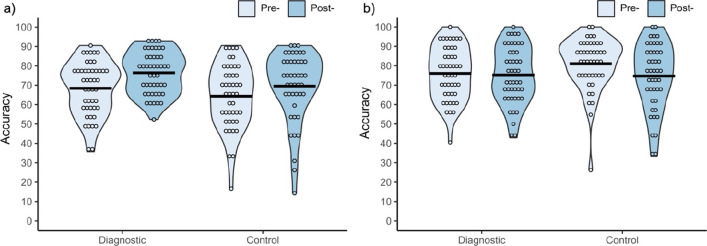
To slow the spread of COVID-19, many people now wear face masks in public. Face masks impair our ability to identify faces, which can cause problems for professional staff who identify offenders or members of the public. Here, we investigate whether performance on a masked face matching task can be improved by training participants to compare diagnostic facial features (the ears and facial marks)-a validated training method that improves matching performance for unmasked faces. We show this brief diagnostic feature training, which takes less than two minutes to complete, improves matching performance for masked faces by approximately 5%. A control training course, which was unrelated to face identification, had no effect on matching performance. Our findings demonstrate that comparing the ears and facial marks is an effective means of improving face matching performance for masked faces. These findings have implications for professions that regularly perform face identification.
Keywords: COVID-19; Face matching; Face recognition; Facial image comparison; Knowledge elicitation; Masks.
© 2022. The Author(s).
Conflict of interest statement
The authors declare that they have no competing interests.
Figures


References
-
- #Masks4All. (2021). What countries require masks in public or recommend masks? Retrieved from https://masks4all.co/what-countries-require-masks-in-public/.
-
- Alenezi HM, Bindemann M. The effect of feedback on face-matching accuracy. Applied Cognitive Psychology. 2013;27(6):735–753. doi: 10.1002/acp.2968. - DOI
-
- Babwin, D., & Dazio, S. (2020, 16 May). Coronavirus masks a boon for crooks who hide their faces. AP News. Retrieved from https://apnews.com/f97b4914b4159dec0c98359fac123d52.
Publication types
MeSH terms
LinkOut - more resources
Full Text Sources
Medical