


Effect of FT218, a Once-Nightly Sodium Oxybate Formulation, on Disrupted Nighttime Sleep in Patients with Narcolepsy: Results from the Randomized Phase III REST-ON Trial
- PMID: 35380374
- PMCID: PMC8994715
- DOI: 10.1007/s40263-022-00904-6
Effect of FT218, a Once-Nightly Sodium Oxybate Formulation, on Disrupted Nighttime Sleep in Patients with Narcolepsy: Results from the Randomized Phase III REST-ON Trial
Abstract
Background: Sodium oxybate has been recognized as a gold standard for the treatment of disrupted nighttime sleep due to narcolepsy. Its short half-life and immediate-release formulation require patients to awaken 2.5-4 h after their bedtime dose to take a second dose. A novel extended-release, once-nightly sodium oxybate formulation (ON-SXB; FT218) is under US Food and Drug Administration review for the treatment of adults with narcolepsy.
Objective: A phase III trial of ON-SXB in individuals with narcolepsy type 1 (NT1) or 2 (NT2) [the REST-ON trial; NCT02720744] has been conducted and the primary results reported elsewhere. Secondary objectives from REST-ON were to assess the efficacy of ON-SXB on disrupted nighttime sleep; the results of this analysis are reported here.
Methods: In the double-blind, phase III REST-ON trial, patients aged ≥ 16 years were randomly assigned 1:1 to ON-SXB (1 week, 4.5 g; 2 weeks, 6 g; 5 weeks, 7.5 g; 5 weeks, 9 g) or placebo. Secondary endpoints included polysomnographic measures of sleep stage shifts and nocturnal arousals and patient-reported assessments of sleep quality and refreshing nature of sleep at 6, 7.5, and 9 g; post hoc analyses included changes in time spent in each sleep stage, delta power, and assessments in stimulant-use subgroups for prespecified endpoints.
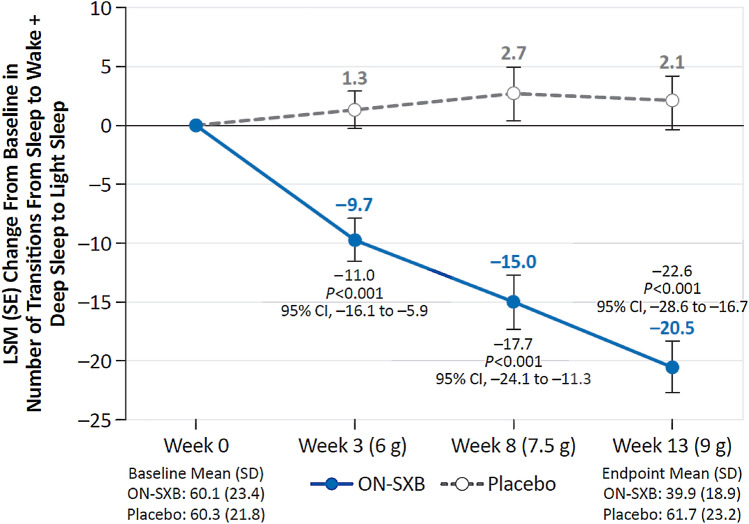
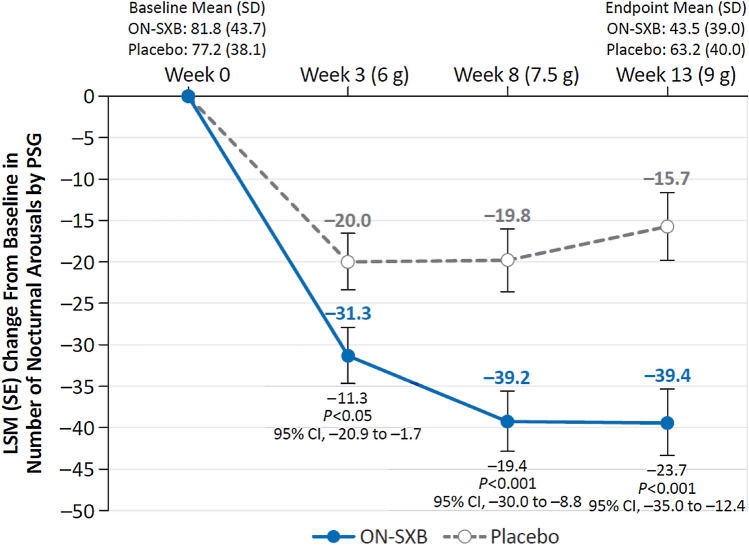
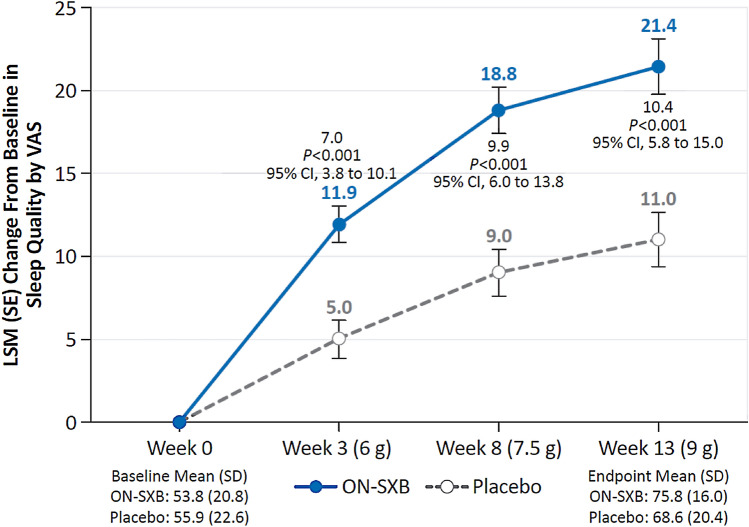
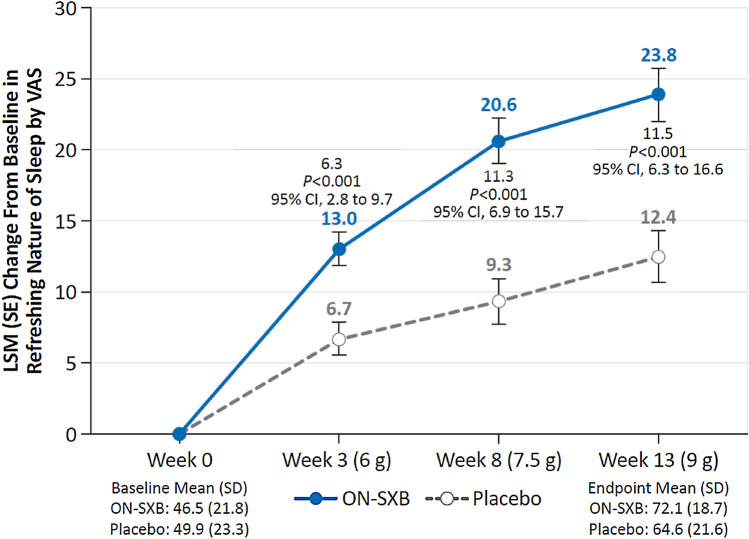
Results: In total, 190 participants (n = 97, ON-SXB; n = 93, placebo) were included in the efficacy analyses. All three ON-SXB doses demonstrated a clinically meaningful, statistically significant decrease vs placebo in the number of transitions to wake/N1 from N1, N2, and rapid eye movement (REM) stages (all doses p < 0.001) and the number of nocturnal arousals (p < 0.05 ON-SXB 6 g; p < 0.001 7.5 and 9 g). Sleep quality and refreshing nature of sleep were significantly improved with all three ON-SXB doses vs placebo (p < 0.001). Post hoc analyses revealed a significant reduction in time spent in N1 (p < 0.05 ON-SXB 6 g; p < 0.001 7.5 and 9 g) and REM (all p < 0.001) and increased time spent in N3 with ON-SXB vs placebo (all p < 0.001), with a significant increase in delta power (p < 0.01 ON-SXB 6 g; p < 0.05 7.5 g; p < 0.001 9 g) and increased REM latency (ON-SXB 7.5 g vs placebo; p < 0.05). Significant improvements in disrupted nighttime sleep were observed regardless of concomitant stimulant use.
Conclusions: The clinically beneficial, single nighttime dose of ON-SXB significantly improved disrupted nighttime sleep in patients with narcolepsy.
Clinical trial registration: ClinicalTrials.gov NCT02720744.
© 2022. Avadel Pharmaceuticals.
Conflict of interest statement
TR is a consultant for Jazz Pharmaceuticals, Takeda Pharmaceutical Co., Orexo, Avadel Pharmaceuticals, Eisai, Merck & Co., and Idorsia. YD has served as a consultant or on advisory boards for Avadel Pharmaceuticals, Jazz Pharmaceuticals, UCB, Takeda Pharmaceutical Co., Theranexus, Harmony Biosciences, Bioprojet Pharma, and Idorsia. MJT has served as a consultant or on advisory boards for Axsome Therapeutics, Balance Therapeutics, Eisai, Avadel Pharmaceuticals, Harmony Biosciences, Jazz Pharmaceuticals, NLS Pharmaceuticals, Suven Life Sciences Ltd., and Takeda Pharmaceutical Co. CK is a consultant of Avadel Pharmaceuticals and XW Pharma. BCC is a member of the speakers bureaus and has received honoraria from Jazz Pharmaceuticals, Eisai, and Harmony Biosciences. He is an advisor and has received consulting fees and honoraria from Jazz Pharmaceuticals, Eisai, Harmony Biosciences, and Avadel Pharmaceuticals. He is a member of the speakers bureau for Merck & Co. Inc., Jazz Pharmaceuticals, Eisai, and Harmony Biosciences. RB is a shareholder in WaterMark Medical and Healthy Humming, LLC; serves on the board of directors for the National Sleep Foundation and WaterMark Medical; is a consultant for Jazz Pharmaceuticals, Takeda Pharmaceutical Co., Avadel Pharmaceuticals, and Oventus; has received industry-funded research grants from Avadel Pharmaceuticals, BrescoTec, Bayer, Idorsia, Suven Life Sciences Ltd, Jazz Pharmaceuticals, Balance, Vanda, Merck & Co., Eisai, Philips, FRESCA Medical, Takeda Pharmaceutical Co., LivaNova, Roche, and Sommetrics; and has served on speakers bureaus for Jazz Pharmaceuticals, Eisai, and Harmony Biosciences. RR received research grant funding by Avadel Pharmaceuticals to conduct the current study. He has also received research grant support from Jazz Pharmaceuticals, Eisai, Merck & Co., Apnimed, Inc., Idorsia, Biohaven, and Suven Life Sciences Ltd. He has participated in advisory boards for Jazz Pharmaceuticals, Eisai, and Harmony Biosciences. DS is an employee of Avadel Pharmaceuticals. JD is a consultant to, stockholder, and former employee of Avadel Pharmaceuticals.
Figures
References
Publication types
MeSH terms
Substances
Associated data
LinkOut - more resources
Full Text Sources
Medical
Miscellaneous
