. 2022 Apr 5;27(4):272-284.
doi: 10.1093/oncolo/oyab048.

The Essentials of Multiomics

Affiliations

The Essentials of Multiomics

John L Marshall et al. Oncologist. .

Abstract

Within the last decade, the science of molecular testing has evolved from single gene and single protein analysis to broad molecular profiling as a standard of care, quickly transitioning from research to practice. Terms such as genomics, transcriptomics, proteomics, circulating omics, and artificial intelligence are now commonplace, and this rapid evolution has left us with a significant knowledge gap within the medical community. In this paper, we attempt to bridge that gap and prepare the physician in oncology for multiomics, a group of technologies that have gone from looming on the horizon to become a clinical reality. The era of multiomics is here, and we must prepare ourselves for this exciting new age of cancer medicine.

Keywords: artificial intelligence; cancer; digital pathology; genomics; machine learning; multiomics; proteomics; transcriptomics.


Figures

Figure 1.
Figure 1.
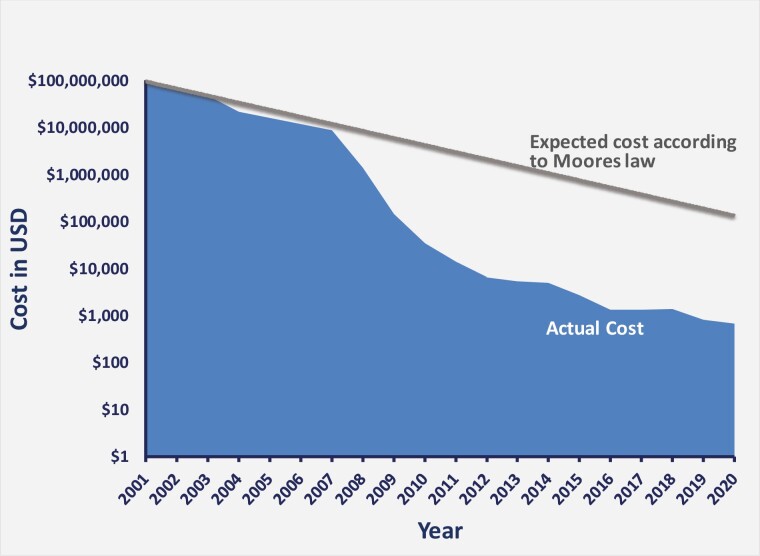
The decreasing cost of human genome sequencing over the last 20 years. The beginning of this millennium has seen the cost (in US Dollars) of sequencing per human genome decrease at a much greater rate than that predicted by Moore’s law—shown on a logarithmic scale using data generated by the National Human Genome Research Institute. The decline in cost began outpacing that expected from Moore’s Law at the beginning of 2008 when sequencing technology transitioned to next-generation sequencing (NGS) from Sanger sequencing.
Figure 2.
Figure 2.
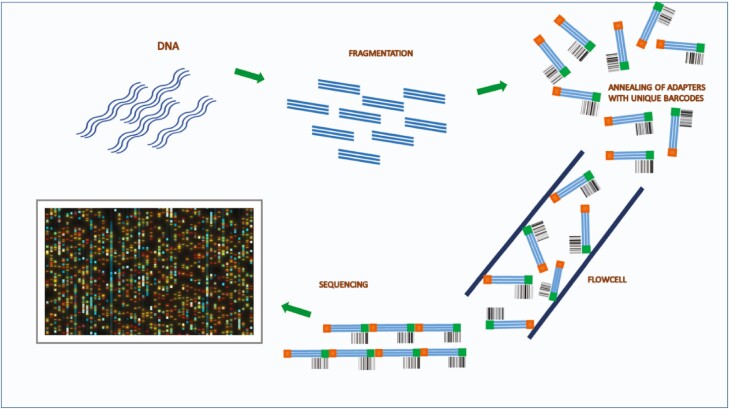
Next-generation sequencing (NGS). The first step of NGS is library preparation. A library is a collection of DNA fragments from the sample of interest with adapters (common short sequences with unique barcodes) annealed to their 5ʹ and 3ʹ ends. The adapters allow DNA fragments to attach to the sequencing flowcell, and their unique barcodes enable sample identification.
Figure 3.
Figure 3.
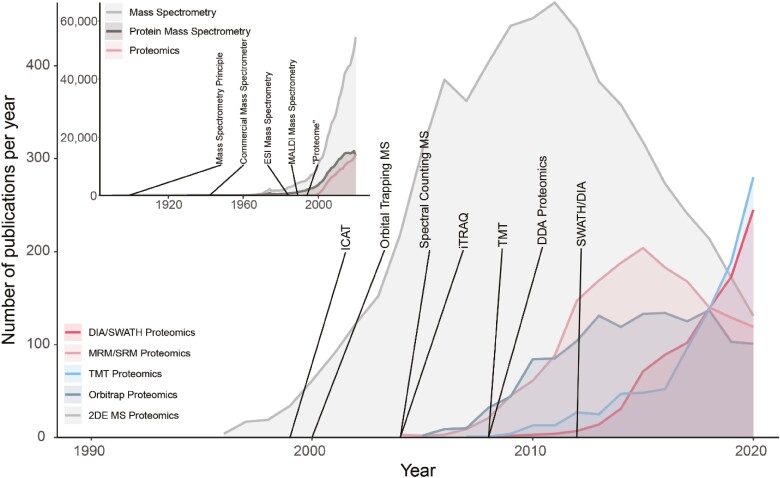
The recent success of proteomics approaches is linked to the availability of next-generation mass spectrometers. The number of publications per year for different proteomics-related approaches was obtained from PubMed. (Inset) The term “proteome” was coined nearly a decade after the invention of the mass spectrometry (MS) principle. Since the advent of electron-spray ionization and matrix-assisted laser desorption ionization commercial mass spectrometers, the use of MS continues to increase, including the application of MS for protein investigation and, more specifically, proteomics. Main: Early adoption of MS-based proteomic techniques was dominated by 2D electrophoresis (gray), followed by targeted analysis using multiple/single reaction monitoring (MRM/SRM, pink). Since 2010, modern and comprehensive proteomic techniques such as tandem mass tag (blue) and data-independent acquisition (DIA/SWATH, red) have revolutionized the proteomics field.
Figure 4.
Figure 4.
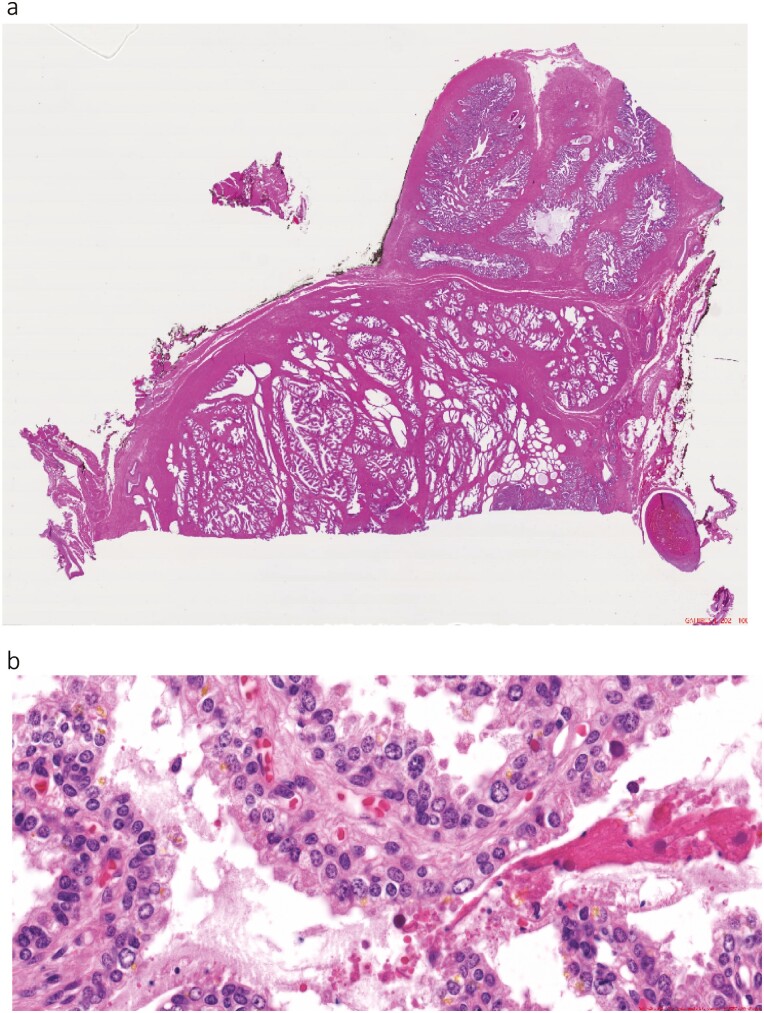
Digital images of prostate cancer. (A) Whole slide, prostate cancer. (B) High resolution of a section of the slide.
Figure 5.
Figure 5.
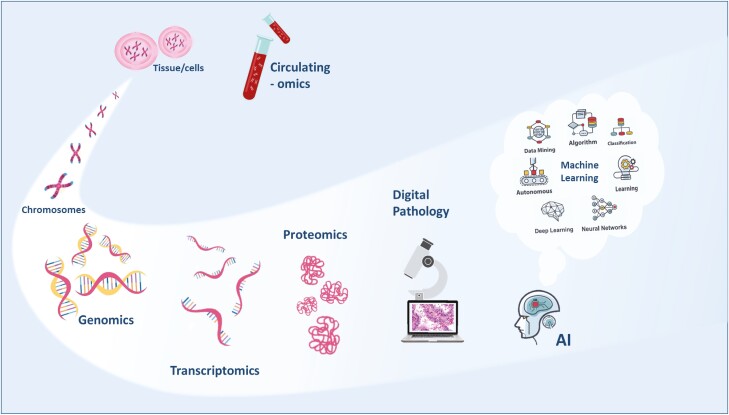
Cancer multiomics.

References

    1. El-Deiry WS, Goldberg RM, Lenz HJ, et al. The current state of molecular testing in the treatment of patients with solid tumors, 2019. CA Cancer J Clin. 2019;69(4):305-343. 10.3322/caac.21560 - DOI - PMC - PubMed
    1. Schwarze K, Buchanan J, Taylor JC, Wordsworth S.. Are whole-exome and whole-genome sequencing approaches cost-effective? A systematic review of the literature. Genet Med. 2018;20(10):1122-1130. 10.1038/gim.2017.247 - DOI - PubMed
    1. Meienberg J, Bruggmann R, Oexle K, Matyas G.. Clinical sequencing: is WGS the better WES? Hum Genet. 2016;135(3):359-362. 10.1007/s00439-015-1631-9 - DOI - PMC - PubMed
    1. Qin D. Next-generation sequencing and its clinical application. Cancer Biol Med. 2019;16(1):4-10. 10.20892/j.issn.2095-3941.2018.0055 - DOI - PMC - PubMed
    1. Genome UK. The future of healthcare. In available on our website at www.gov.uk/government/publications.