


Individual and community-level factors associated with animal source food consumption among children aged 6-23 months in Ethiopia: Multilevel mixed effects logistic regression model
- PMID: 35381049
- PMCID: PMC8982870
- DOI: 10.1371/journal.pone.0265899
Individual and community-level factors associated with animal source food consumption among children aged 6-23 months in Ethiopia: Multilevel mixed effects logistic regression model
Abstract
Background: Diversified diet in childhood has irreplaceable role for optimal growth. However, multi-level factors related to low animal source food consumption among children were poorly understood in Ethiopia, where such evidences are needed for decision making.
Objectives: To investigate the magnitude and individual- and community-level predictors of animal source food (ASF) consumption among children aged 6-23 months in Ethiopia.
Methods: We utilized a cross-sectional pooled data from 2016/19 Ethiopia Demographic and Health Surveys. A stratified two-stage cluster design was employed to select households with survey weights were applied to account for complex sample design. We fitted mixed-effects logit regression models on 4,423 children nested within 645 clusters. The fixed effect models were fitted and expressed as adjusted odds ratio with their 95% confidence intervals and measures of variation were explained by intra-class correlation coefficients, median odds ratio and proportional change in variance. The deviance information criterion and Akaike information Criterion were used as model fitness criteria.
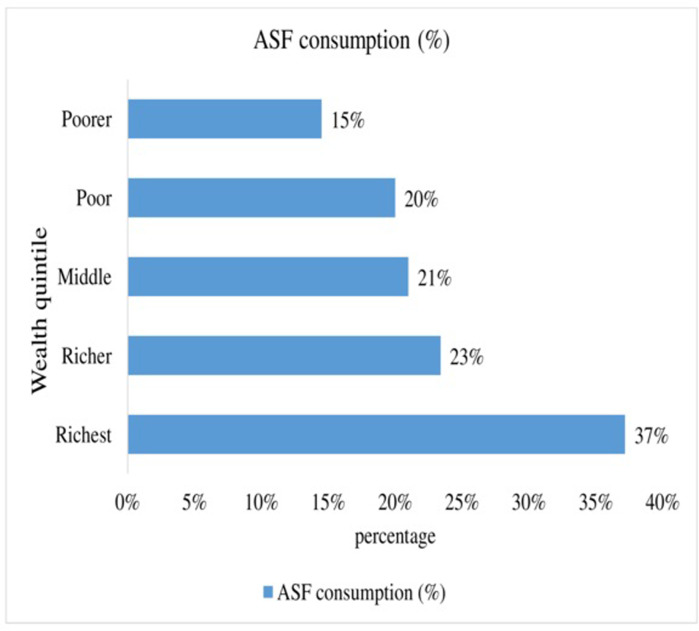
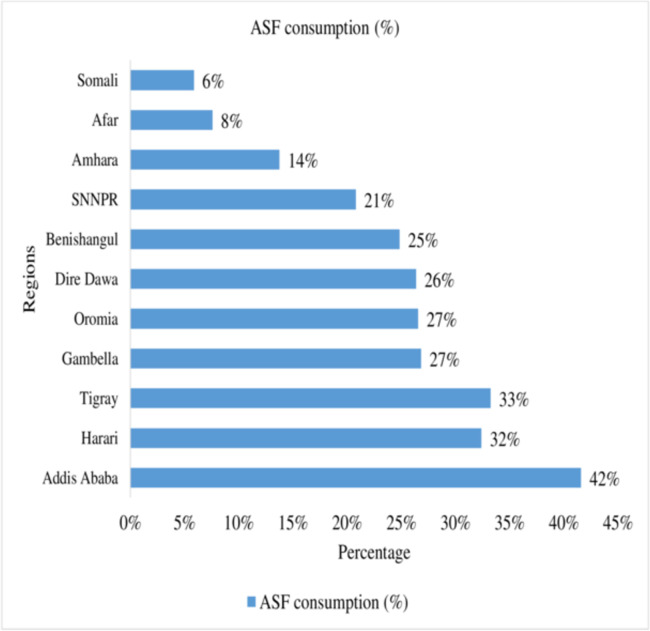
Result: in Ethiopia, only 22.7% (20.5%-23.9%) of children aged 6-23 months consumed ASF. Younger children aged 6-8 months (AOR = 3.1; 95%CI: 2.4-4.1), home delivered children (AOR = 1.8; 1.4-2.3), from low socioeconomic class (AOR = 2.43; 1.7-3.5); low educational level of mothers (AOR = 1.9; 95%CI: 1.48-2.45) and children from multiple risk pregnancy were significant predictors of low animal source consumption at individual level. While children from high community poverty level (AOR = 1.53; 1.2-1.95); rural residence (AOR = 2.2; 95%CI: 1.7-2.8) and pastoralist areas (AOR = 5.4; 3.4-8.5) significantly predict animal source food consumption at community level. About 38% of the variation of ASF consumption is explained by the combined predictors at the individual and community-level while 17.8% of the variation is attributed to differences between clusters.
Conclusions: This study illustrates that the current ASF consumption among children is poor and a multiple interacting individual- and community level factors determine ASF consumption. In designing and implementing nutritional interventions addressing diversified diet consumption shall give a due consideration and account for these potential predictors of ASF consumption.
Conflict of interest statement
The authors declare that they have no competing interest.
Figures
References
-
- Central Statistical Agency of Ethiopia (CSA), Mini Ethiopia Demographic and Health Survey, in Ethiopia Demographic and Health Survey, ICF, Editor 2019, Central Statistical Agency: Addis Ababa, Ethiopia.
MeSH terms
LinkOut - more resources
Full Text Sources
