


Prospective Evaluation of Autonomic Dysfunction in Post-Acute Sequela of COVID-19
- PMID: 35381331
- PMCID: PMC8976261
- DOI: 10.1016/j.jacc.2022.03.357
Prospective Evaluation of Autonomic Dysfunction in Post-Acute Sequela of COVID-19
Abstract
Background: Patients with post-acute sequela of COVID-19 (PASC) often report symptoms of orthostatic intolerance and autonomic dysfunction. Numerous case reports link postural orthostatic tachycardia syndrome (POTS) to PASC. No prospective analysis has been performed.
Objectives: This study performed head-up tilt table (HUTT) testing in symptomatic patients with PASC to evaluate for orthostatic intolerance suggestive of autonomic dysfunction.
Methods: We performed a prospective, observational evaluation of patients with PASC complaining of poor exertional tolerance, tachycardia with minimal activity or positional change, and palpitations. Exclusion criteria included pregnancy, pre-PASC autonomic dysfunction or syncope, or another potential explanation of PASC symptoms. All subjects underwent HUTT.
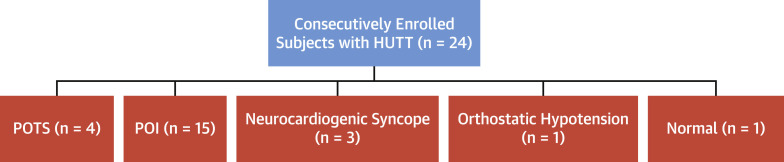
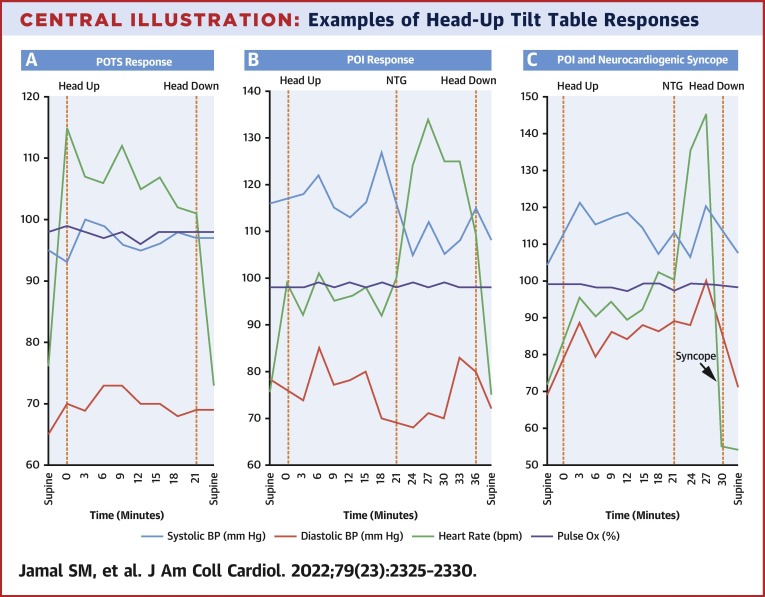
Results: Twenty-four patients with the described PASC symptoms were included. HUTT was performed a mean of 5.8 ± 3.5 months after symptom onset. Twenty-three of the 24 had orthostatic intolerance on HUTT, with 4 demonstrating POTS, 15 provoked orthostatic intolerance (POI) after nitroglycerin, 3 neurocardiogenic syncope, and 1 orthostatic hypotension. Compared with those with POTS, patients with POI described significantly earlier improvement of symptoms.
Conclusions: This prospective evaluation of HUTT in patients with PASC revealed orthostatic intolerance on HUTT suggestive of autonomic dysfunction in nearly all subjects. Those with POI may be further along the path of clinical recovery than those demonstrating POTS.
Keywords: head-up tilt table (HUTT); neurocardiogenic syncope; orthostatic hypotension; orthostatic intolerance; postural orthostatic tachycardic syndrome (POTS).
Copyright © 2022 American College of Cardiology Foundation. Published by Elsevier Inc. All rights reserved.
Conflict of interest statement
Funding Support and Author Disclosures The authors have reported that they have no relationships relevant to the contents of this paper to disclose.
Figures

Comment in
-
Autonomic Dysfunction as a Consequence of COVID-19 Infection: A New Twist on an Old Problem.J Am Coll Cardiol. 2022 Jun 14;79(23):2331-2332. doi: 10.1016/j.jacc.2022.04.007. J Am Coll Cardiol. 2022. PMID: 35680184 Free PMC article.
-
POTS May Be Underestimated in Post-COVID Assessments.J Am Coll Cardiol. 2022 Sep 27;80(13):e103. doi: 10.1016/j.jacc.2022.04.068. J Am Coll Cardiol. 2022. PMID: 36137679 Free PMC article. No abstract available.
-
Reply: POTS May Be Underestimated in Post-COVID Assessments.J Am Coll Cardiol. 2022 Sep 27;80(13):e105. doi: 10.1016/j.jacc.2022.08.720. J Am Coll Cardiol. 2022. PMID: 36137680 Free PMC article. No abstract available.
References
Publication types
MeSH terms
LinkOut - more resources
Full Text Sources
Medical
