


The psychological impact of Covid-19 pandemic on people with Multiple Sclerosis: A meta-analysis
- PMID: 35381533
- PMCID: PMC8956358
- DOI: 10.1016/j.msard.2022.103774
The psychological impact of Covid-19 pandemic on people with Multiple Sclerosis: A meta-analysis
Abstract
Background: Covid-19 pandemic caused relevant psychological consequences in the general population. Since people with Multiple Sclerosis (pwMS) are usually at higher risk of psychological distress than age-matched healthy controls (HC), a meta-analytic study was conducted, aimed at evaluating i) differences between pwMS and HC in the psychological variables during the pandemic, ii) differences in the levels of anxiety, depression, stress, sleep disturbances and quality of life before and during the Covid-19 pandemic in pwMS.
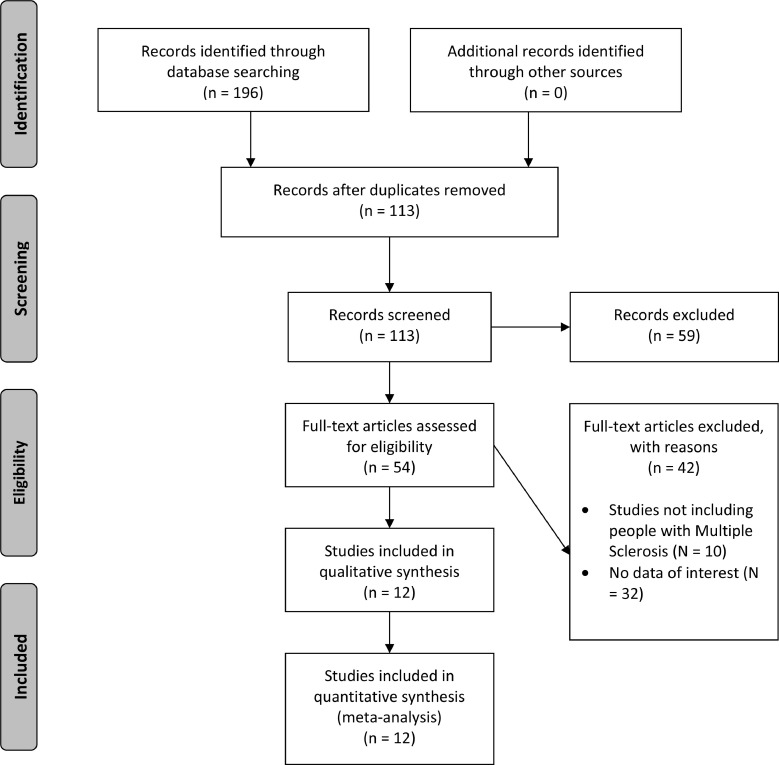
Methods: The literature search on three electronic databases yielded 196 studies (113 after the duplicates removal). Seven studies compared psychological variables between pwMS and HC during the pandemic, while seven studies evaluated the pre- vs during the pandemic differences in pwMS. The following outcomes were selected: depression, anxiety, physical QoL, mental QoL, stress, sleep quality/disturbances. Mean weighted effect sizes (ES) were calculated using Hedges'g, via Prometa3 software.
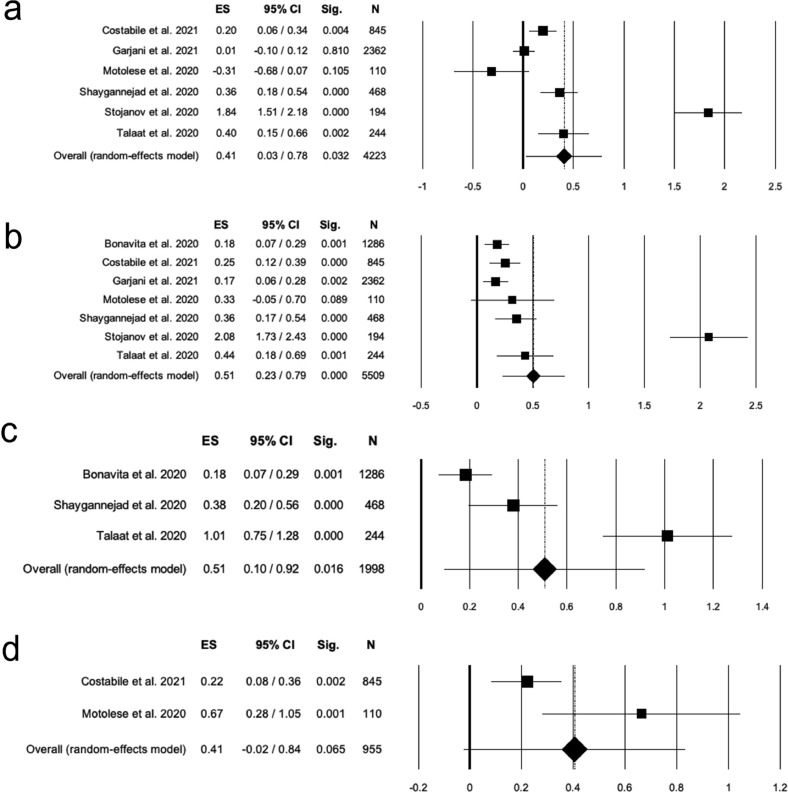
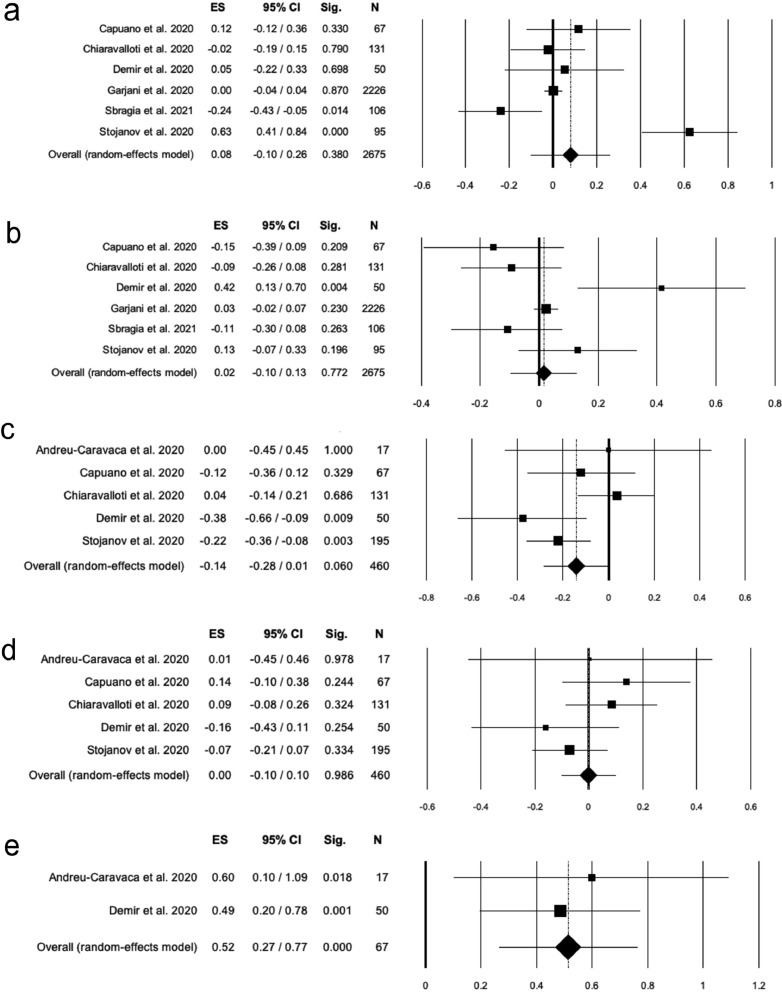
Results: During the pandemic, pwMS showed higher levels of depression (g = 0.51, p=.001), anxiety (g = 0.41, p=.032), and stress (g = 0.51, p=.016) compared to HC. The comparison on psychological outcomes before and during the pandemic in pwMS revealed no significant increase during the pandemic on levels of anxiety (g = 0.08, p=.380), depression (g = 0.02, p=.772), mental QoL (g= -0.14, p=.060), physical QoL (g = 0.00, p=.986), whereas sleep quality deteriorated during the pandemic (g = 0.52, p<.001).
Conclusions: In agreement with pre-pandemic literature, pwMS showed higher levels of psychological distress than HC also during the Covid-19 pandemic. Contrariwise, longitudinal studies revealed that, in pwMS, the only psychological-associated variable that worsened significantly was the sleep quality, but this outcome was evaluated only in two studies. Future studies will have to assess/evaluate the long-term psychological consequences of the pandemic on pwMS.
Keywords: Anxiety; Covid-19; Depression; Multiple sclerosis; QoL; Sleep.
Copyright © 2022 Elsevier B.V. All rights reserved.
Conflict of interest statement
MA, RC, AdA, DB and GS have no disclosures. AB has received speaker honoraria and/or compensation for consulting service from Biogen, Merck and Genzyme. GT has received compensation for consulting services and/or speaking activities from Biogen, Novartis, Merck, Genzyme, Roche, Teva; and receives research support from Biogen Idec, Merck Serono, and Fondazione Italiana Sclerosi Multipla. AG received honoraria for speaking and travel grants from Merck, Genzyme, Teva, Mylan, Roche and Novartis.
Figures
References
-
- Al-Rahimi J.S., Nass N.M., Hassoubah S.A., Wazqar D.Y., Alamoudi S.A. Levels and predictors of fear and health anxiety during the current outbreak of COVID-19 in immunocompromised and chronic disease patients in Saudi Arabia: a cross-sectional correlational study. PLoS ONE. 2021;16 doi: 10.1371/journal.pone.0250554. - DOI - PMC - PubMed
-
- Andreu-Caravaca L., Ramos-Campo D., Manonelles P., Abellán-Aynés O., Chung L.H., Rubio-Arias J.Á. Effect of COVID-19 home confinement on sleep monitorization and cardiac autonomic function in people with multiple sclerosis: a prospective cohort study. Physiol. behav. 2021;237 doi: 10.1016/j.physbeh.2021.113392. - DOI - PMC - PubMed
Publication types
MeSH terms
LinkOut - more resources
Full Text Sources
Medical
