


mRNA Vaccine Effectiveness Against Coronavirus Disease 2019 Hospitalization Among Solid Organ Transplant Recipients
- PMID: 35385875
- PMCID: PMC9047160
- DOI: 10.1093/infdis/jiac118
mRNA Vaccine Effectiveness Against Coronavirus Disease 2019 Hospitalization Among Solid Organ Transplant Recipients
Abstract
Background: The study objective was to evaluate 2- and 3-dose coronavirus disease 2019 (COVID-19) mRNA vaccine effectiveness (VE) in preventing COVID-19 hospitalization among adult solid organ transplant (SOT) recipients.
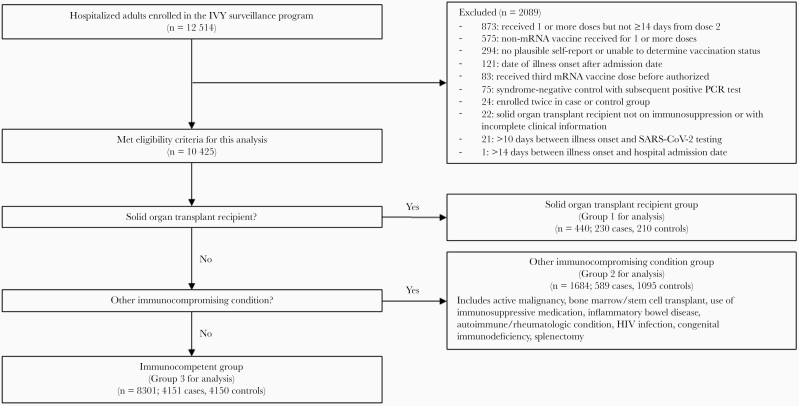
Methods: We conducted a 21-site case-control analysis of 10 425 adults hospitalized in March to December 2021. Cases were hospitalized with COVID-19; controls were hospitalized for an alternative diagnosis (severe acute respiratory syndrome coronavirus 2-negative). Participants were classified as follows: SOT recipient (n = 440), other immunocompromising condition (n = 1684), or immunocompetent (n = 8301). The VE against COVID-19-associated hospitalization was calculated as 1-adjusted odds ratio of prior vaccination among cases compared with controls.
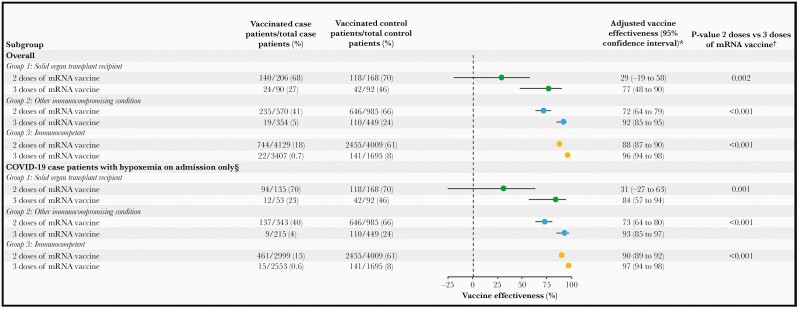
Results: Among SOT recipients, VE was 29% (95% confidence interval [CI], -19% to 58%) for 2 doses and 77% (95% CI, 48% to 90%) for 3 doses. Among patients with other immunocompromising conditions, VE was 72% (95% CI, 64% to 79%) for 2 doses and 92% (95% CI, 85% to 95%) for 3 doses. Among immunocompetent patients, VE was 88% (95% CI, 87% to 90%) for 2 doses and 96% (95% CI, 83% to 99%) for 3 doses.
Conclusions: Effectiveness of COVID-19 mRNA vaccines was lower for SOT recipients than immunocompetent adults and those with other immunocompromising conditions. Among SOT recipients, vaccination with 3 doses of an mRNA vaccine led to substantially greater protection than 2 doses.
Keywords: COVID-19; SARS-CoV-2; immunocompromised; solid organ transplantation; vaccine effectiveness.
© The Author(s) 2022. Published by Oxford University Press for the Infectious Diseases Society of America. All rights reserved. For permissions, e-mail: journals.permissions@oup.com.
Conflict of interest statement
Potential conflicts of interest. All authors have completed and submitted the International Committee of Medical Journal Editors form for disclosure of potential conflicts of interest. J. H. K. reports grant support from National Institutes of Health (NIH)/National Institute of Allergy and Infectious Diseases (1K23 AI137321-01A1). M. G. reports grant support from CDC, CDC-Abt, CDC-Westat, and Janssen and a role as the Co-Chair of the Infectious Diseases and Immunization Committee, Texas Pediatric Society, Texas Chapter of American Academy of Pediatrics (AAP). H. K. T. reports a grant from CDC. A. A. G. reports grant support from CDC, NIH, US Department of Defense (DOD), AbbVie, and Faron Pharmaceuticals. T. M. reports payments as a panelist for the Society of Hospital Medicine Updates in Heart Failure (August 25, 2021) and as a board member of the Scott & White Clinic Physicians Board of Directors. D. J. D. reports grant support from NIH/National Institute of General Medical Sciences (T32GM135169). J. D. C. reports grants from the NIH and DOD. K. W. G. reports grant support as a NECTAR Executive Committee member ACTIV-4HT. D. C. F. reports consultant fees from Cytovale and membership on a Medpace Data Safety Monitoring Board (DSMB). D. N. H. reports a contract from CDC and grant support from National Heart, Lung, and Blood Institute (NHLBI) for participation in the ACTIV4d-Host Tissue Trial. M. C. E. reports talks on nutrition in COVID pneumonia at ASPEN conference sponsored by Abbott Laboratories. M. N. G. reports grant support from the CDC, funding from NHLBI and Agency for Healthcare Research and Quality (AHRQ), and fees from Endpoint for participating on a scientific advisory panel, payment for Medicine Grand Rounds at Westchester Medical Center, travel support for attending the ATS Board of Directors meeting, and participation on a DSMB for Regeneron and REPLINISH trial. N. J. J. reports grants from the NIH, DOD, and Medic One Foundation, payment for expert testimony from the Washington Department of Health, participation on DSMBs for Opticyte Inc., Multi-Center, Randomized Control Trial to Study the Effectiveness of Hyperbaric Oxygen for COVID-19 patients with Moderate to Severe Hypoxemia (NCT04619719), and Remote Ischemic Conditioning to Enhance Resuscitation (RICE) Pilot (NCT04265807), and participation as Chair of the ACEP Critical Care Section. I. D. P. reports grants from the CDC, NIH, Janssen Pharmaceuticals, and Intermountain Research & Medical Foundation, institutional fees from Asahi Kasei Pharma and from Regeneron Pharmaceuticals. S. M. B. reports grants from the CDC, NIH, and DOD, fees from Hamilton ventilators for chairing a DSMB, and personal fees from New York University for service on a DSMB. E. T. M. reports a grant from Merck outside the submitted work. A. K. reports grants from the NIH, Ely Lily, United Therapeutics, Johnson & Johnson, BOA Medical, and 4D Medical. A. D. reports funding as the Center PI for PETAL network through NHLBI grant and for participation on a steering committee for ALung technologies. J. G. W. reports grant support from NIH/NHLBI for ACTIV-3 and ACTIV-4 trials and membership on the American Board of Internal Medicine Critical Care Exam Committee. S. Y. C. reports payment as a speaker for La Jolla Pharmaceuticals and consultant fees for PureTech Health and Kiniska Pharmaceuticals. H. M. B. reports grants from the CDC. A. S. L. reports grants from the CDC, NIH, and Burroughs Wellcome Fund, consultant fees from Sanofi, and fees from Roche for membership on a trial steering committee. N. H. reports grants from the CDC, NIH, Sanofi, and Quidel and honoraria for speaking at Continuing Medical Education event at AAP. J. D. C. reports grant support from the CDC. C. G. G. reports consultant fees from Pfizer, Merck, and Sanofi-Pasteur and grants from Campbell Alliance/Syneos Health, CDC, NIH, US Food and Drug Administration, AHRQ, and Sanofi. T. W. R. reports grants from the NIH, DOD, and AbbVie, personal fees from Cumberland Pharmaceuticals as the Director of Medical Affairs, consultant fees from Cytovale, Inc., personal fees from Sanofi, Inc. for serving as a DSMB board member, a role as the Immediate Past President of the American Society of Parenteral and Enteral Nutrition (ASPEN), and stock from Cumberland Pharmaceuticals for consulting work. C J. L. reports grants/contracts from the CDC, NIH, DOD, bioMerieux, Endpoint LLC, Entegrion, Inc., and AbbVie, a patent issued to Cincinnati Children’s Hospital Medical Center for risk stratification in sepsis and septic shock, participation on DSMBS for Study Principal Investigators, roles on the Executive Committee, Immediate Past President, Member, Board of Directors for the Association of Clinical and Translational Science, and stock options in Bioscape Digita. W. H. S. reports grant funding from the CDC for this work. All authors have submitted the ICMJE Form for Disclosure of Potential Conflicts of Interest. Conflicts that the editors consider relevant to the content of the manuscript have been disclosed.
Figures
References
-
- Self WH, Tenforde MW, Rhoads JP, et al. Comparative effectiveness of Moderna, Pfizer-BioNTech, and Janssen (Johnson & Johnson) vaccines in preventing COVID-19 hospitalizations among adults without immunocompromising conditions - United States, March-August 2021. MMWR Morb Mortal Wkly Rep 2021; 70:1337–43. - PMC - PubMed
-
- Tang P, Hasan MR, Chemaitelly H, et al. BNT162b2 and mRNA-1273 COVID-19 vaccine effectiveness against the SARS-CoV-2 delta variant in Qatar. Nat Med 2021; 27:2136–43. - PubMed
-
- Haas EJ, Angulo FJ, McLaughlin JM, et al. Impact and effectiveness of mRNA BNT162b2 vaccine against SARS-CoV-2 infections and COVID-19 cases, hospitalisations, and deaths following a nationwide vaccination campaign in Israel: an observational study using national surveillance data. Lancet 2021; 397:1819–29. - PMC - PubMed
Publication types
MeSH terms
Substances
Grants and funding
LinkOut - more resources
Full Text Sources
Medical
Miscellaneous
