


How are large-scale One Health initiatives targeting infectious diseases and antimicrobial resistance evaluated? A scoping review
- PMID: 35386427
- PMCID: PMC8978269
- DOI: 10.1016/j.onehlt.2022.100380
How are large-scale One Health initiatives targeting infectious diseases and antimicrobial resistance evaluated? A scoping review
Abstract
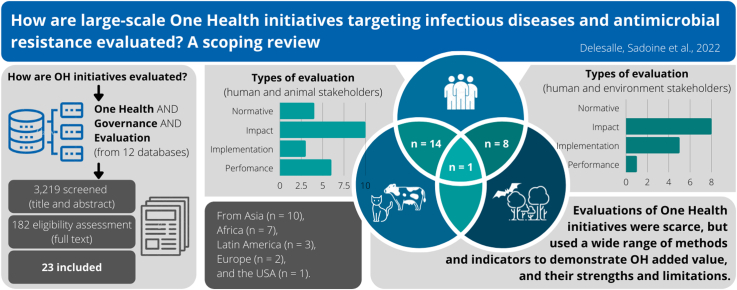
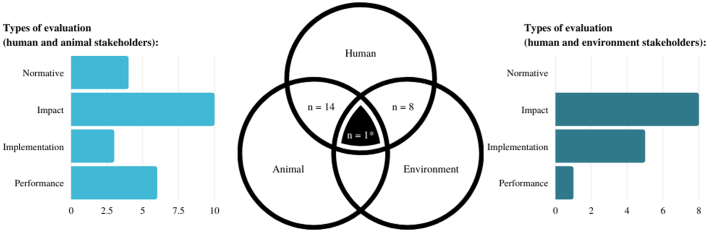
While One Health initiatives are gaining in popularity, it is unclear if and how they are evaluated when implementation at scale is intended. The main purpose of this scoping review was to describe how One Health initiatives targeting infectious diseases and antimicrobial resistance at a large scale are evaluated. Secondary objectives included identifying the main facilitators and barriers to the implementation and success of these initiatives, and how their impacts were assessed. Twenty-three studies evaluating One Health initiatives were eligible. Most studies included the human (n = 22) and animal (n = 15) sectors; only four included the environment sector. The types of evaluated initiative (non-exclusive) included governance (n = 5), knowledge (n = 6), protection (n = 17), promotion (n = 16), prevention (n = 9), care (n = 8), advocacy (n = 10) and capacity (n = 10). Studies used normative (n = 4) and evaluative (n = 20) approaches to assess the One Health initiatives, the latter including impact (n = 19), implementation (n = 8), and performance (n = 7) analyses. Structural and economic, social, political, communication and coordination-related factors, as well as ontological factors, were identified as both facilitators and barriers for successful One Health initiatives. These results identified a wide range of evaluation methods and indicators used to demonstrate One Health's added values, strengths, and limitations: the inherent complexity of the One Health approach leads to the use of multiple types of evaluation. The strengths and remaining gaps in the evaluation of such initiative highlight the relevance of comprehensive, mixed-method, context-sensitive evaluation frameworks to inform and support the implementation of One Health initiatives by stakeholders in different governance settings.
Keywords: AMR, antimicrobial resistance; Evaluation; Global health; Infectious diseases; Multisectoral; NEOH, Network for Evaluation of One Health; OH, One Health; OHHLEP, One Health High Level Expert Panel; One health; Participatory; WFPHA, World Federation of Public Health Associations.
© 2022 The Authors.
Figures
References
-
- One Health High Level Expert Panel . 2021. Tripartite and UNEP support OHHLEP’s definition of “One Health,”.https://www.who.int/news/item/01-12-2021-tripartite-and-unep-support-ohh... (accessed February 8, 2022)
Publication types
LinkOut - more resources
Full Text Sources
