


Role of tau deposition in early cognitive decline in Down syndrome
- PMID: 35386473
- PMCID: PMC8976157
- DOI: 10.1002/dad2.12256
Role of tau deposition in early cognitive decline in Down syndrome
Abstract
Introduction: Drawing on the amyloid/tau/neurodegeneration (AT[N]) model, the study examined whether the tau positron emission tomography (PET) biomarker [18F]AV-1451 was associated with episodic memory problems beyond what was predicted by the amyloid beta (Aβ) PET in Down syndrome (DS).
Methods: Data from 123 non-demented adults with DS (M = 47 years, standard deviation = 6.34) were analyzed. The Cued Recall Test assessed episodic memory. Tau PET standardized update value ratio (SUVR) was assessed across Braak regions as continuous and binary (high tau [TH] vs. low tau [TL]) variable. Global PET Aβ SUVR was assessed as binary variable (Aβ- vs. Aβ+).
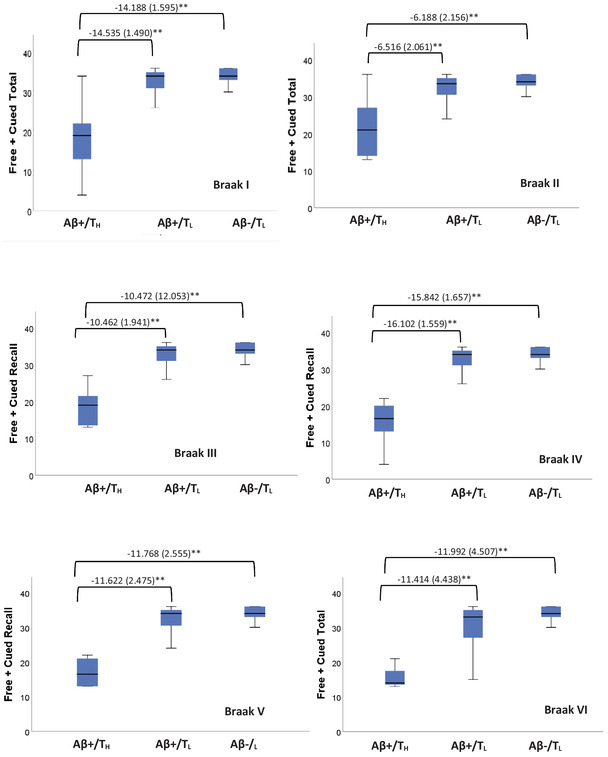
Results: In models adjusting for controls, tau SUVR was negatively associated with episodic memory performance in the Aβ+ but not Aβ- group. The Aβ+/TH group evidenced significantly worse episodic memory than the Aβ+/TL group.
Discussion: Similar to late-onset and autosomal dominant Alzheimer's disease (AD), high tau was an indicator of early prodromal AD in DS.
Keywords: Alzheimer's disease; Down syndrome; amyloid; memory; positron emission tomography; tau.
© 2022 The Authors. Alzheimer's & Dementia: Diagnosis, Assessment & Disease Monitoring published by Wiley Periodicals, LLC on behalf of Alzheimer's Association.
Conflict of interest statement
GE Healthcare holds a license agreement with the University of Pittsburgh for the [11C]PiB PET technology involved in this study. Dr. William Klunk is a co‐inventor of [11C]PiB and has financial interest in this license agreement. GE Healthcare did not provide financial support for this study nor did it have a role in designing the study, interpreting results, or manuscript writing. No other authors have relationships, activities, or interests to disclose related to this manuscript.
Figures
References
Grants and funding
LinkOut - more resources
Full Text Sources