. 2022 Apr 5;4(2):lqac029.
doi: 10.1093/nargab/lqac029. eCollection 2022 Jun.

High quality genome assembly of the anhydrobiotic midge provides insights on a single chromosome-based emergence of extreme desiccation tolerance

Affiliations

High quality genome assembly of the anhydrobiotic midge provides insights on a single chromosome-based emergence of extreme desiccation tolerance

Yuki Yoshida et al. NAR Genom Bioinform. .

Abstract

Non-biting midges (Chironomidae) are known to inhabit a wide range of environments, and certain species can tolerate extreme conditions, where the rest of insects cannot survive. In particular, the sleeping chironomid Polypedilum vanderplanki is known for the remarkable ability of its larvae to withstand almost complete desiccation by entering a state called anhydrobiosis. Chromosome numbers in chironomids are higher than in other dipterans and this extra genomic resource might facilitate rapid adaptation to novel environments. We used improved sequencing strategies to assemble a chromosome-level genome sequence for P. vanderplanki for deep comparative analysis of genomic location of genes associated with desiccation tolerance. Using whole genome-based cross-species and intra-species analysis, we provide evidence for the unique functional specialization of Chromosome 4 through extensive acquisition of novel genes. In contrast to other insect genomes, in the sleeping chironomid a uniquely high degree of subfunctionalization in paralogous anhydrobiosis genes occurs in this chromosome, as well as pseudogenization in a highly duplicated gene family. Our findings suggest that the Chromosome 4 in Polypedilum is a site of high genetic turnover, allowing it to act as a 'sandbox' for evolutionary experiments, thus facilitating the rapid adaptation of midges to harsh environments.


Figures

Figure 1.
Figure 1.
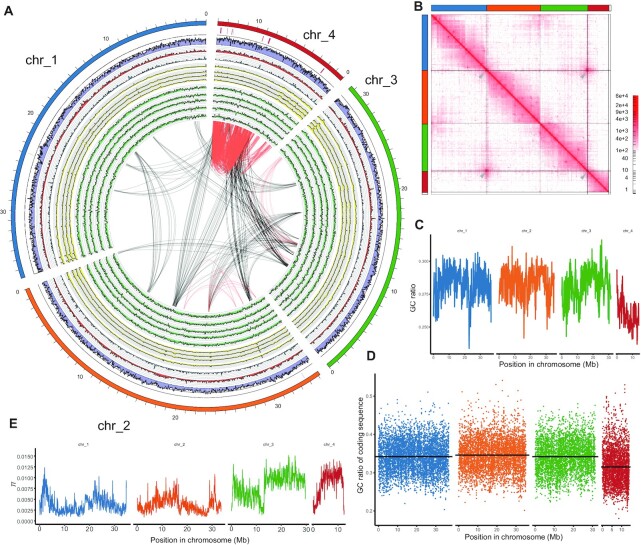
Chromosome-scale genome assembly of Polypedilum vanderplanki. (A) Circos plot of the four chromosomes. From the outer rim, ARId regions, AT% (purple), gene count for each 50 Kbp window (red), non-coding gene count for each 50 kb window (blue), genome coverage of Illumina DNA-Seq (SRR12736661, SRR12736660, SRR12736662, SRR12736659, yellow), RNA-Seq coverage (DRR024752, DRR024753, DRR024754, DRR024755, DRR024756, green), collinear blocks calculated with MCScanX (black: inter-chromosomal, red: intra-chromosomal). Colors used for each chromosome are inherited in subsequent figures. Individual figures are indicated on Additional Figure S1 (B) Contact map of Hi-C reads. Hi-C reads were mapped to the genome assembly and KR transformed contact frequencies at 250kbp were visualized as a contact map with Jucier. Gray arrowheads indicate possible telomeric regions. (C) GC ratio of 100 kb windows. (D) GC ratio of the coding sequence from the longest isoform for each gene. The black lines indicate the chromosome average (chr_1: 34.20%, chr_2: 34.60%, chr_3: 34.17%, chr_4: 31.50%). (E) Pairwise nucleotide diversity (π) of 50 kb windows. An increase in π diversity can be observed in the latter half of Chromosome 3 and most of Chromosome 4.
Figure 2.
Figure 2.
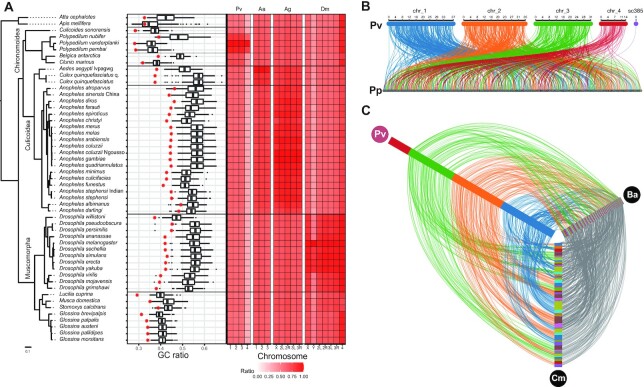
Chromosome 4 lacks synteny blocks with other Diptera. (A) GC ratios and gene conservation ratios between Dipteran species. Conservation ratio and GC ratio (genome and single copy genes) were plotted against a phylogenetic tree using 1,014 single copy orthologs from Orthofinder clustering of longest isoforms. Homologs were determined by reciprocal diamond blastp searches and conservation ratios were counted for each chromosome of P. vanderplanki, A. aegypti, A. gambiae and D. melanogaster. A red asterisk indicates genome-level GC ratio. Only autosome and sex chromosomes are visualized (unplaced scaffolds are skipped). (B, C) Detection of collinear blocks between [b] the two Polypedilum species (P. vanderplanki and P. pembai) and (C) the family Chironomidae (B. antarctica, C. marinus and P. vanderplanki). Amino acid sequences of longest isoforms were submitted for diamond blastp searches and collinear blocks were detected and visualized with McScanX and synvisio. Links are colored according to the chromosome color used in Figure 1A.
Figure 3.
Figure 3.
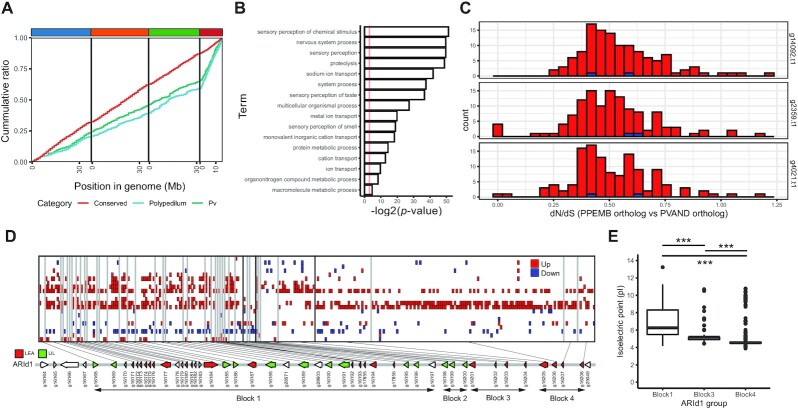
Functional and non-functional multi-copy ortholog groups. (A) The cumulative number of genes specific to P. vanderplanki, specific to the genus Polypedilum, and conserved within Diptera (Conserved), along the genome. Clade specificity was determined by gene counts of OrthoFinder ortholog groups. (B) Gene ontology enrichment analysis of Polypedilum-specific genes on Chromosome 4. Only terms in the Biological Process category are shown. (C) dN/dS values between the three P. pembai orthologs (g14092.t1, g2359.t1, g4021.t1) and P. vanderplanki orthologs. Coding sequences were aligned with MAFFT, and dN/dS values were calculated with codeml. (D) Differential expression information of LEA protein gene orthologs in ARId1. Conditions identified as differentially expressed (from top row : (1) Heat 42°C T1; (2) Heat 42°C T24, (3) Paraquat T1; (4) Paraquat T24, (5) Mannitol T3; (6) Mannitol T24; (7) NaCl T1; (8) NaCl T3; (9) NaCl T24; (10) Trehalose T1; (11) Trehalose T3; (12) PreCondTre T0vsT12; (13) PreCondTre T12vsT24; (14) PreCondTre T24vsT36; (15) PreCondTre T36vsT48; (16) PreCondTre T48 versus Rehydration T0; (17) Rehydration T0 versusT3; (18) Rehydration T3vsT12; (19) Rehydration T12vsT24; (20) Rehydration T24vsT72) are indicated in colors (up-regulated : red, down-regulated : blue). (E) The pI values of proteins deduced from Lea orthologs in each Block. *** p-value < 0.001

References

    1. Pinder L.C.V. Biology of freshwater chironomidae. Annu. Rev. Entomol. 1986; 31:1–23.
    1. Armitage P.D., Cranston P.S., Pinder L.C.V. The Chironomidae. 1995; Springer, Dordrecht, Netherlands.
    1. Hinton H.E. Cryptobiosis in the larva of Polypedilum vanderplanki Hint. (Chironomidae). J. Insect Physiol. 1960; 5:286–300.
    1. Watanabe M., Kikawada T., Minagawa N., Yukuhiro F., Okuda T. Mechanism allowing an insect to survive complete dehydration and extreme temperatures. J. Exp. Biol. 2002; 205:2799–2802. - PubMed
    1. Watanabe M., Kikawada T., Okuda T. Increase of internal ion concentration triggers trehalose synthesis associated with cryptobiosis in larvae of Polypedilum vanderplanki. J. Exp. Biol. 2003; 206:2281–2286. - PubMed