Global and regional estimates of maternal near miss: a systematic review, meta-analysis and experiences with application
- PMID: 35387768
- PMCID: PMC8987675
- DOI: 10.1136/bmjgh-2021-007077
Global and regional estimates of maternal near miss: a systematic review, meta-analysis and experiences with application
Abstract
Introduction: Maternal near miss (MNM) is a useful means to examine quality of obstetric care. Since the introduction of the WHO MNM criteria in 2011, it has been tested and validated, and is being used globally. We sought to systematically review all available studies using the WHO MNM criteria to develop global and regional estimates of MNM frequency and examine its application across settings.
Methods: We conducted a systematic review by implementing a comprehensive literature search from 2011 to 2018 in six databases with no language restrictions. The predefined data collection tool included sections on study characteristics, frequency of near-miss cases and study quality. Meta-analysis was performed by regional groupings. Reported adaptations, modifications and remarks about application were extracted.
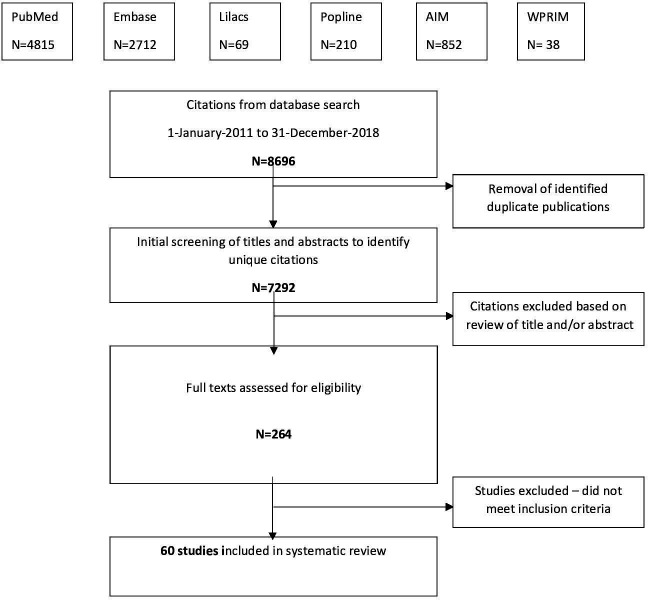
Results: 7292 articles were screened by title and abstract, and 264 articles were retrieved for full text review for the meta-analysis. An additional 230 articles were screened for experiences with application of the WHO MNM criteria. Sixty studies with near-miss data from 56 countries were included in the meta-analysis. The pooled global near-miss estimate was 1.4% (95% CI 0.4% to 2.5%) with regional variation in MNM frequency. Of the 20 studies that made adaptations to the criteria, 19 were from low-resource settings where lab-based criteria were adapted due to resource limitations.
Conclusions: The WHO MNM criteria have enabled the comparison of global and sub-national estimates of MNM frequency. There has been good uptake in low-resource countries but contextual adaptations are necessary.
Keywords: maternal health; maternal mortality; quality of care.
© Author(s) (or their employer(s)) 2022. Re-use permitted under CC BY-NC. No commercial re-use. See rights and permissions. Published by BMJ.
Conflict of interest statement
Competing interests: None declared.
References
-
- UNICEF, UNFPA WHO, et al. Maternal mortality: levels and trends 2000 to 2017: estimates by who, UNICEF, UNFPA, world bank group and the United nations population division. Geneva: World Health Organization, 2019.
Publication types
MeSH terms
Grants and funding
LinkOut - more resources
Full Text Sources
Medical
Miscellaneous