. 2023 Feb 7;131(1):33-44.
doi: 10.1093/aob/mcac051.

Polyploidy on islands - concerted evolution and gene loss amid chromosomal stasis

Affiliations

Polyploidy on islands - concerted evolution and gene loss amid chromosomal stasis

Prashant Joshi et al. Ann Bot. .

Abstract

Background and aims: Polyploidy is an important process that often generates genomic diversity within lineages, but it can also cause changes that result in loss of genomic material. Island lineages, while often polyploid, typically show chromosomal stasis but have not been investigated in detail regarding smaller-scale gene loss. Our aim was to investigate post-polyploidization genome dynamics in a chromosomally stable lineage of Malvaceae endemic to New Zealand.

Methods: We determined chromosome numbers and used fluorescence in situ hybridization to localize 18S and 5S rDNA. Gene sequencing of 18S rDNA, the internal transcribed spacers (ITS) with intervening 5.8S rDNA, and a low-copy nuclear gene, GBSSI-1, was undertaken to determine if gene loss occurred in the New Zealand lineage following polyploidy.

Key results: The chromosome number for all species investigated was 2n = 42, with the first published report for the monotypic Australian genus Asterotrichion. The five species investigated all had two 5S rDNA signals localized interstitially on the long arm of one of the largest chromosome pairs. All species, except Plagianthus regius, had two 18S rDNA signals localized proximally on the short arm of one of the smallest chromosome pairs. Plagianthus regius had two additional 18S rDNA signals on a separate chromosome, giving a total of four. Sequencing of nuclear ribosomal 18S rDNA and the ITS cistron indicated loss of historical ribosomal repeats. Phylogenetic analysis of a low-copy nuclear gene, GBSSI-1, indicated that some lineages maintained three copies of the locus, while others have lost one or two copies.

Conclusions: Although island endemic lineages show chromosomal stasis, with no additional changes in chromosome number, they may undergo smaller-scale processes of gene loss and concerted evolution ultimately leading to further genome restructuring and downsizing.

Keywords: Plagianthus alliance; 18S rDNA; GBSSI; ITS; Malvaceae; chromosome number; concerted evolution; fluorescence in situ hybridization; gene fractionation; polyploid; rDNA.


Figures

Fig. 1.
Fig. 1.
rDNA evolution and phylogenetic outcomes in an allopolyploid. (A) Allopolyploids are expected to inherit rDNA loci from each parent; in this case a hexaploid (6x) will inherit a 35S and a 5S locus from each of its three parents. Initially it will be expected to maintain each of those sites upon allopolyploid formation. Over time, some of these loci may be lost via concerted evolution and the original parental signatures can be lost from the genome. (B) Allopolyploids show reticulate evolution with two or more lineages merging together into the new allopolyploid lineage. Here an allopolyploid lineage forms from Species A and Species B creating a new allopolyploid. (C) As each nuclear gene is duplicated in an allopolyploid (in this case a tetraploid), the expectation is that the polyploid would retain a gene copy (homeologue) from each of its parental lineages. In the phylogeny these gene copies are informative about the lineage that contributed to the allopolyploid genome. (D) If concerted evolution or gene loss occurs for the locus under study, then only one parental locus will appear in the phylogeny.
Fig. 2.
Fig. 2.
Distribution of 5S and 18S–26S rDNA sequences on somatic chromosomes of five species of the Plagianthus alliance. DAPI-stained (greyscale) metaphase cell of Asterotrichion discolor (A), Hoheria populnea (C), H. angustifolia (E), Plagianthus divaricatus (G) and P. regius (I) and the same cells with FISH signals of 5S (red) and 18S–26S (green) rDNA sequences in B, D, F, H and J, respectively, where chromosomes are counterstained with DAPI (blue). Decondensed nucleolar organizing regions (NORs) visible in FISH preparations are denoted with green dotted lines in A, C, E, G and I. Green arrows denote condensed parts of NOR-carrying chromosomes while pink arrows indicate chromosomes mapping 5S rDNA loci.
Fig. 3.
Fig. 3.
Phylogenetic tree derived from RAxML and Bayesian analysis of nuclear ribosomal ITS sequences for the Plagianthus alliance. Lecanophora chubutensis was the designated outgroup. An asterisk indicates clades with > 80 % maximum-likelihood bootstrap support values and > 0.95 Bayesian posterior probabilities.
Fig. 4.
Fig. 4.
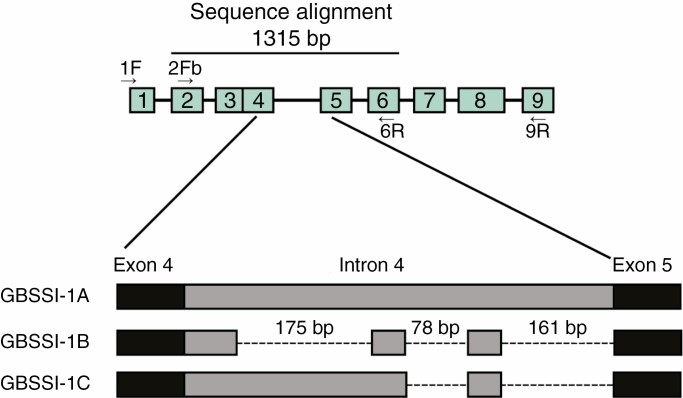
Schematic of diagnostic indel patterning of intron 4 of GBSSI-1 for the Plagianthus alliance. The pattern proved to be diagnostic for each copy of GBSSI-1 retrieved from the group under study and was utilized to assign putative homology amongst cloned sequences.
Fig. 5.
Fig. 5.
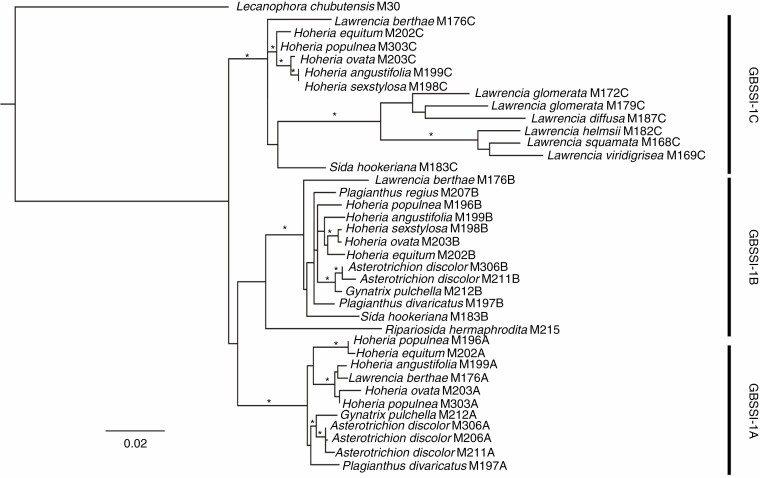
Phylogenetic tree derived from RAxML and Bayesian analysis of granule-bound starch synthase (GBSSI-1) sequences for the Plagianthus alliance. Lecanophora chubutensis was the designated outgroup. An asterisk indicates clades with > 80 % maximum-likelihood bootstrap support values and > 0.95 Bayesian posterior probabilities.
Fig. 6.
Fig. 6.
Neighbor-net splitsgraph of GBSSI-1 sequences based on uncorrected P-distances for the Plagianthus alliance.

References

    1. Alix K, Gérard PR, Schwarzacher T, Heslop-Harrison JS. 2017. Polyploidy and interspecific hybridization: partners for adaptation, speciation and evolution in plants. Annals of Botany 120: 183–194. - PMC - PubMed
    1. Alvarez I, Wendel JF. 2003. Ribosomal ITS sequences and plant phylogenetic inference. Molecular Phylogenetics & Evolution 29: 417–434. - PubMed
    1. Ansari HA, Ellison NW, Bassett SA, Hussain SW, Bryan GT, Williams WM. 2016. Fluorescence chromosome banding and FISH mapping in perennial ryegrass, Lolium perrene L. BMC Genomics 17: 977. doi:10.1186/s12864-016-3231-z. - DOI - PMC - PubMed
    1. Ansari HA, Ellison NW, Reader SM, et al. 1999. Molecular cytogenetic organization of 5S and 18S-26S rDNA loci in white clover (Trifolium repens L.) and related species. Annals of Botany 83: 199–206.
    1. Ansari H, Ellison N, Williams W. 2008. Molecular and cytogenetic evidence for an allotetraploid origin of Trifolium dubium (Leguminosae). Chromosoma 117: 159–167. - PubMed