When Functional Impairment Develops Early: Perspectives from Middle-Aged Adults
- PMID: 35391621
- PMCID: PMC9849615
- DOI: 10.1007/s11606-022-07541-1
When Functional Impairment Develops Early: Perspectives from Middle-Aged Adults
Abstract
Background: Difficulty performing basic daily activities such as bathing and dressing ("functional impairment") affects more than 15% of middle-aged people, and this proportion is increasing. Little is known about the experiences and needs of individuals who develop functional impairment in middle age.
Objective: To examine the experiences and needs of adults who developed functional impairment in middle age.
Design: Qualitative study using semi-structured interviews.
Participants: Forty patients aged 50-64 years who developed functional impairment in middle age, recruited from four primary care clinics in San Francisco.
Approach: Interviews included open-ended questions about participants' daily life, ability to perform activities of daily living (ADLs), and needs related to functional impairment. We analyzed interviews using qualitative thematic analysis.
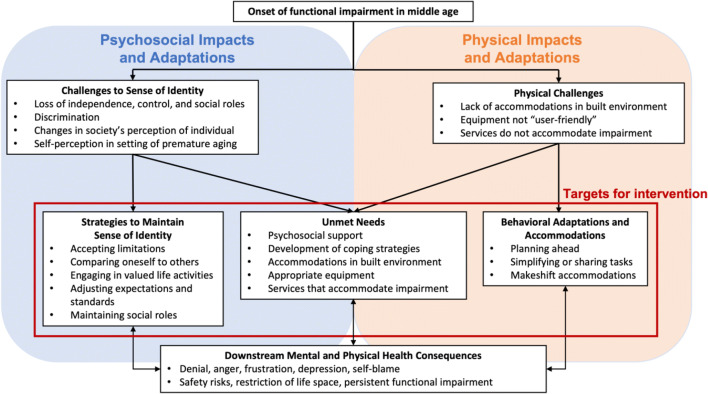
Key results: Interviews revealed several themes related to the psychosocial and physical impacts of developing functional impairment in middle age. Participants noted that losses associated with functional impairment, such as loss of independence, control, and social roles, caused conflict in their sense of identity. To cope with these losses, participants used strategies including acceptance, social comparison, adjusting standards, and engaging in valued life activities. Participants reflected on the intersection of their functional impairment with the aging process, noting that their impairments seemed premature compared to the more "natural" aging process in older adults. In terms of physical impacts, participants described how a lack of accommodations in the built environment exacerbated their impairments. While participants used behavioral strategies to overcome these challenges, unmet needs remained, resulting in downstream physical and psychological impacts including safety risks, falls, frustration, and fear.
Conclusions: Unmet psychosocial and physical needs were common among middle-aged adults with functional impairment and led to negative downstream effects. Eliciting and addressing unmet needs may help mitigate downstream health consequences for this growing population, optimizing function and quality of life.
Keywords: functional impairment; middle-aged adults; premature aging.
© 2022. The Author(s), under exclusive licence to Society of General Internal Medicine.
Conflict of interest statement
The authors declare that they do not have a conflict of interest.
Figures