


The Presence of the Temporal Horn Exacerbates the Vulnerability of Hippocampus During Head Impacts
- PMID: 35392406
- PMCID: PMC8980591
- DOI: 10.3389/fbioe.2022.754344
The Presence of the Temporal Horn Exacerbates the Vulnerability of Hippocampus During Head Impacts
Abstract
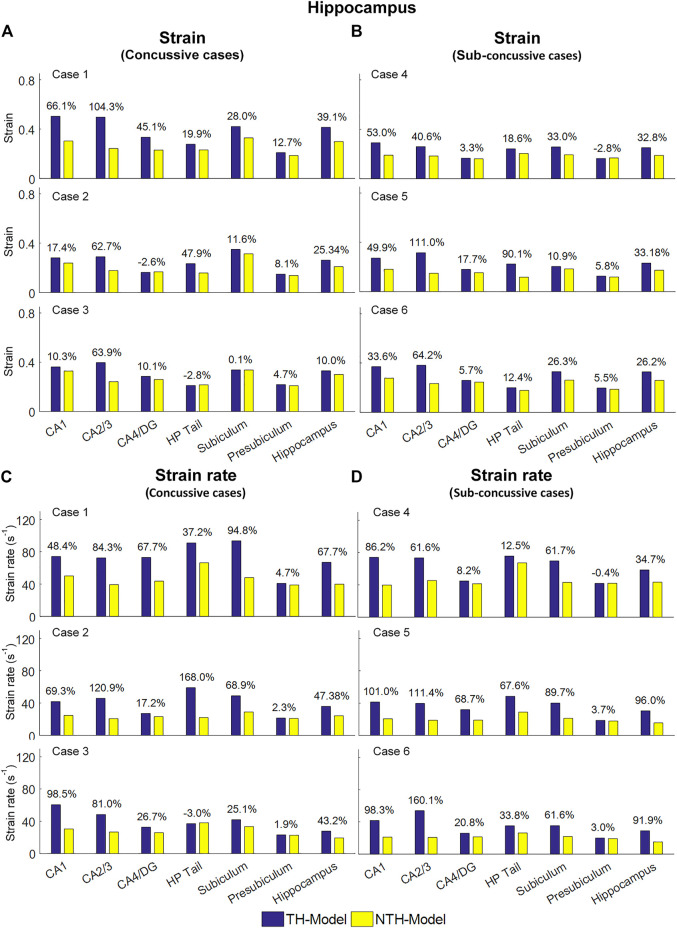
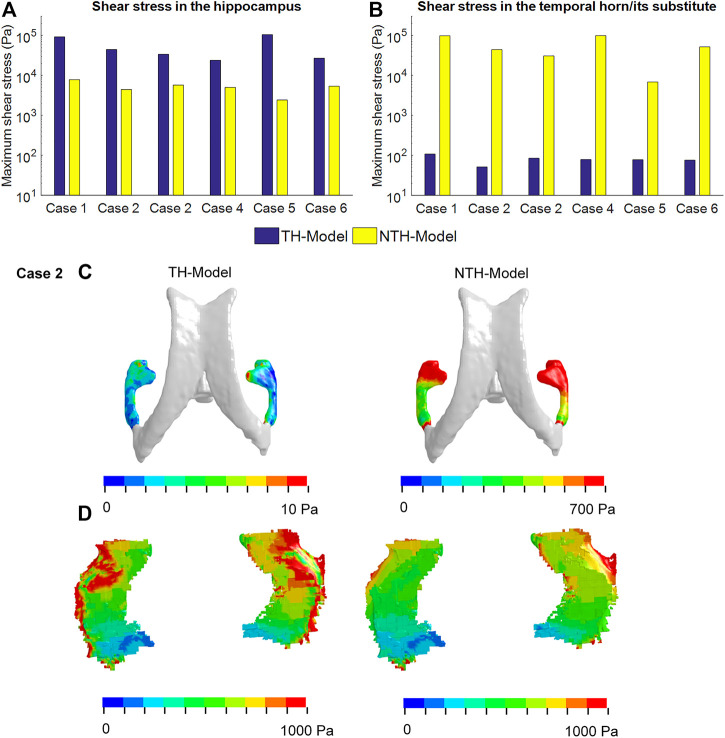
Hippocampal injury is common in traumatic brain injury (TBI) patients, but the underlying pathogenesis remains elusive. In this study, we hypothesize that the presence of the adjacent fluid-containing temporal horn exacerbates the biomechanical vulnerability of the hippocampus. Two finite element models of the human head were used to investigate this hypothesis, one with and one without the temporal horn, and both including a detailed hippocampal subfield delineation. A fluid-structure interaction coupling approach was used to simulate the brain-ventricle interface, in which the intraventricular cerebrospinal fluid was represented by an arbitrary Lagrangian-Eulerian multi-material formation to account for its fluid behavior. By comparing the response of these two models under identical loadings, the model that included the temporal horn predicted increased magnitudes of strain and strain rate in the hippocampus with respect to its counterpart without the temporal horn. This specifically affected cornu ammonis (CA) 1 (CA1), CA2/3, hippocampal tail, subiculum, and the adjacent amygdala and ventral diencephalon. These computational results suggest that the presence of the temporal horn exacerbate the vulnerability of the hippocampus, highlighting the mechanobiological dependency of the hippocampus on the temporal horn.
Keywords: brain-ventricle interface; finite element analysis; fluid-structure interaction; hippocampal injury; temporal horn; traumatic brain injury.
Copyright © 2022 Zhou, Li, Domel, Dennis, Georgiadis, Liu, Raymond, Grant, Kleiven, Camarillo and Zeineh.
Conflict of interest statement
The authors declare that the research was conducted in the absence of any commercial or financial relationships that could be construed as a potential conflict of interest.
Figures
References
-
- Amaral D., Andersen P., O'keefe J., Morris R. (2007). The hippocampus Book. Oxford, United Kingdom: Oxford University Press.
-
- Baldwin S. A., Gibson T., Callihan C. T., Sullivan P. G., Palmer E., Scheff S. W. (1997). Neuronal Cell Loss in the CA3 Subfield of the hippocampus Following Cortical Contusion Utilizing the Optical Disector Method for Cell Counting. J. Neurotrauma 14, 385–398. 10.1089/neu.1997.14.385 - DOI - PubMed
LinkOut - more resources
Full Text Sources
Miscellaneous
