


Prehospital synergy: Tranexamic acid and blood transfusion in patients at risk for hemorrhage
- PMID: 35393385
- PMCID: PMC9233003
- DOI: 10.1097/TA.0000000000003620
Prehospital synergy: Tranexamic acid and blood transfusion in patients at risk for hemorrhage
Abstract
Background: Growing evidence supports improved survival with prehospital blood products. Recent trials show a benefit of prehospital tranexamic acid (TXA) administration in select subgroups. Our objective was to determine if receiving prehospital packed red blood cells (pRBC) in addition to TXA improved survival in injured patients at risk of hemorrhage.
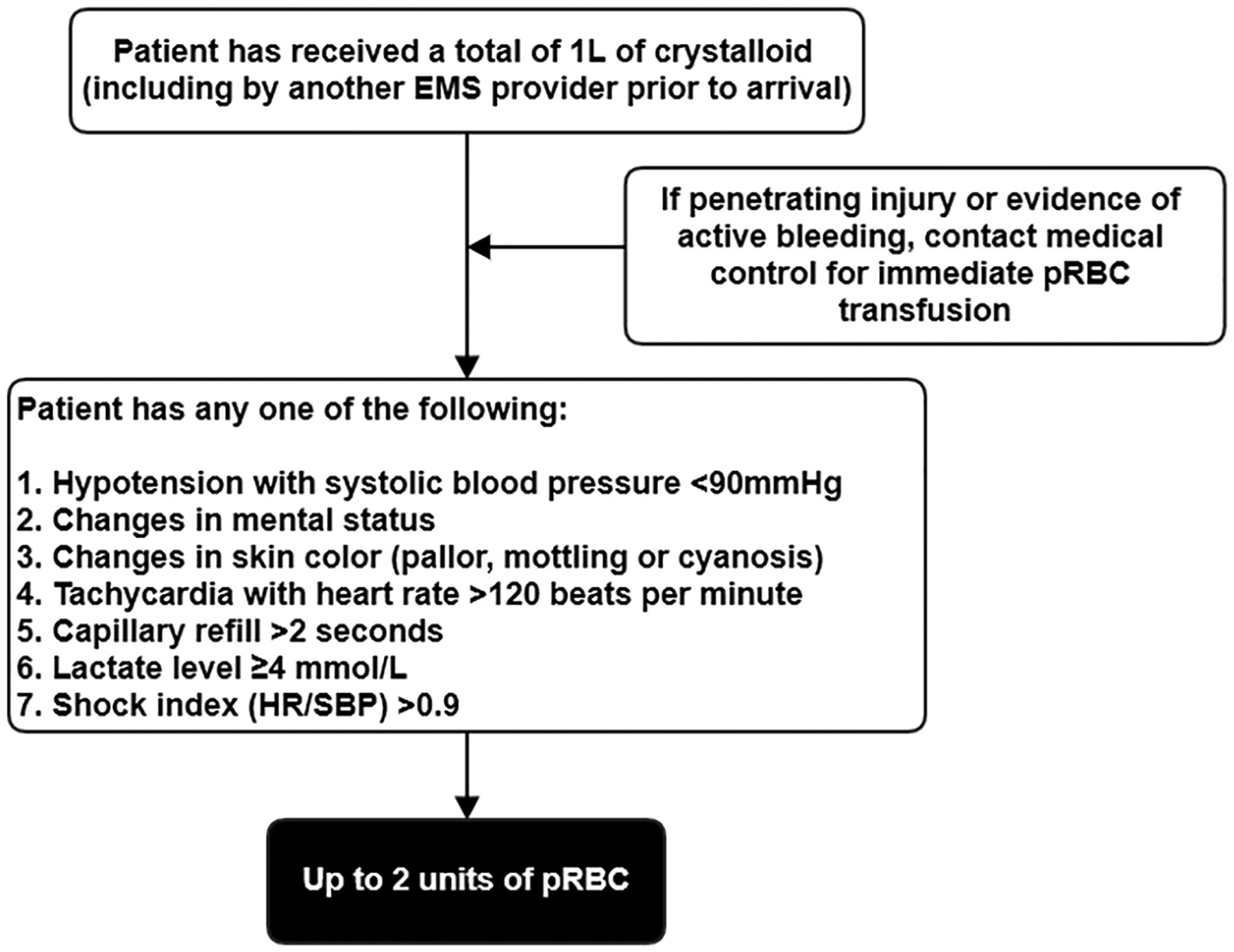
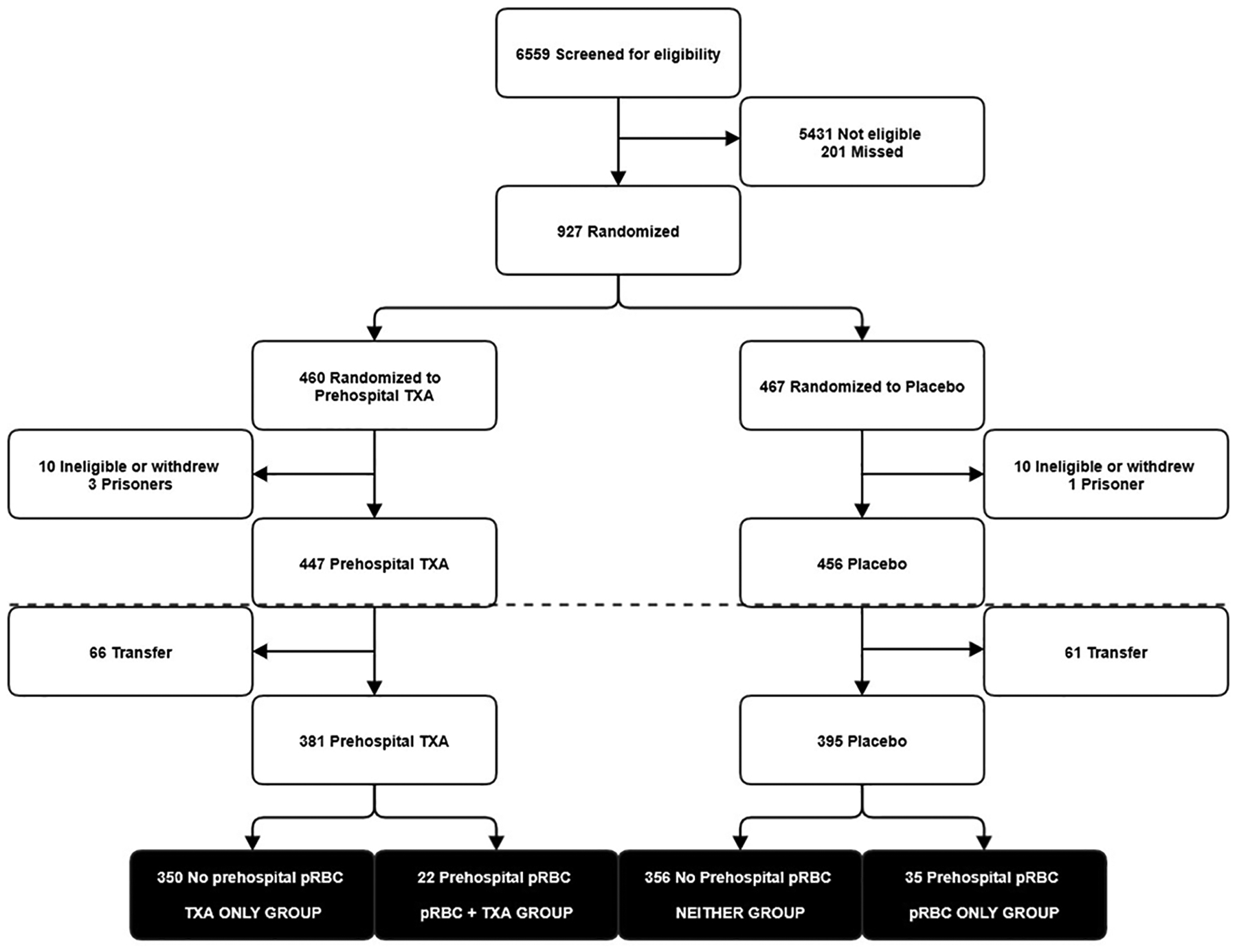
Methods: We performed a secondary analysis of all scene patients from the Study of Tranexamic Acid during Air and ground Medical Prehospital transport trial. Patients were randomized to prehospital TXA or placebo. Some participating EMS services utilized pRBC. Four resuscitation groups resulted: TXA, pRBC, pRBC+TXA, and neither. Our primary outcome was 30-day mortality and secondary outcome was 24-hour mortality. Cox regression tested the association between resuscitation group and mortality while adjusting for confounders.
Results: A total of 763 patients were included. Patients receiving prehospital blood had higher Injury Severity Scores in the pRBC (22 [10, 34]) and pRBC+TXA (22 [17, 36]) groups than the TXA (12 [5, 21]) and neither (10 [4, 20]) groups (p < 0.01). Mortality at 30 days was greatest in the pRBC+TXA and pRBC groups at 18.2% and 28.6% compared with the TXA only and neither groups at 6.6% and 7.4%, respectively. Resuscitation with pRBC+TXA was associated with a 35% reduction in relative hazards of 30-day mortality compared with neither (hazard ratio, 0.65; 95% confidence interval, 0.45-0.94; p = 0.02). No survival benefit was observed in 24-hour mortality for pRBC+TXA, but pRBC alone was associated with a 61% reduction in relative hazards of 24-hour mortality compared with neither (hazard ratio, 0.39; 95% confidence interval, 0.17-0.88; p = 0.02).
Conclusion: For injured patients at risk of hemorrhage, prehospital pRBC+TXA is associated with reduced 30-day mortality. Use of pRBC transfusion alone was associated with a reduction in early mortality. Potential synergy appeared only in longer-term mortality and further work to investigate mechanisms of this therapeutic benefit is needed to optimize the prehospital resuscitation of trauma patients.
Level of evidence: Therapeutic/Care Management; Level III.
Copyright © 2022 Wolters Kluwer Health, Inc. All rights reserved.
Conflict of interest statement
There are no conflicts of interest for the current study.
Figures
References
-
- Drake SA, Holcomb JB, Yang Y, Thetford C, Myers L, Brock M, et al. Establishing a Regional Trauma Preventable/Potentially Preventable Death Rate. Ann Surg. 2018. - PubMed
-
- Holcomb JB. Transport Time and Preoperating Room Hemostatic Interventions Are Important: Improving Outcomes After Severe Truncal Injury. Crit Care Med. 2018;46:447–453. - PubMed
-
- Floccard B, Rugeri L, Faure A, Saint Denis M, Boyle EM, Peguet O, et al. Early coagulopathy in trauma patients: an on-scene and hospital admission study. Injury. 2012;43:26–32. - PubMed
-
- Spielmann S, Kerner T, Ahlers O, Keh D, Gerlach M, Gerlach H. Early detection of increased tumour necrosis factor alpha (TNFα) and soluble TNF receptor protein plasma levels after trauma reveals associations with the clinical course. Acta Anaesthesiol Scand. 2001;45:364–370. - PubMed
-
- Bickell WH, Wall MJ Jr., Pepe PE, Martin RR, Ginger VF, Allen MK, et al. Immediate versus delayed fluid resuscitation for hypotensive patients with penetrating torso injuries. N Engl J Med. 1994;331:1105–1109. - PubMed
Publication types
MeSH terms
Substances
Grants and funding
LinkOut - more resources
Full Text Sources
Medical
Research Materials
