


Exploring documentation in Person-centred care: A content analysis of care plans
- PMID: 35393772
- PMCID: PMC9540033
- DOI: 10.1111/opn.12461
Exploring documentation in Person-centred care: A content analysis of care plans
Abstract
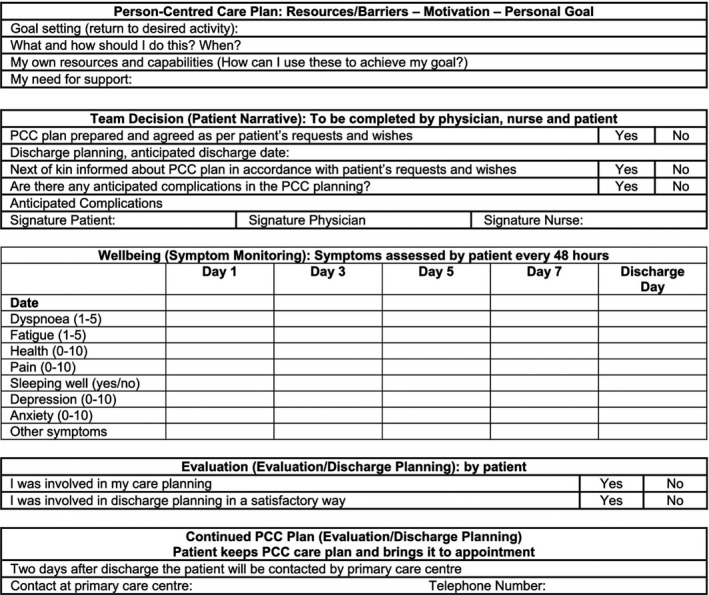
Background: Person-centred care is a growing imperative in healthcare, but the documentation of person-centred care is challenging. According to the Gothenburg Framework of Person-centred Care, care should be documented in continuously revised care plans and based on patients' personally formulated goals and resources to secure a continuous partnership.
Objectives: This study aimed to examine care plans produced within a randomised controlled trial that tested a person-centred care intervention in older people with acute coronary syndrome. Nurses with training in the theory and practice of person-centred care had written the care plans.
Methods: We conducted a secondary analysis of care plans developed in a randomised controlled trial for assessing person-centred care in patients with acute coronary syndrome (Myocardial Infarct [MI] or unstable angina pectoris). The study sample included 84 patients, with three care plans for each patient from inpatient (T1), outpatient (T2) and primary care (T3), that is, a total of 252 care plans. We conducted a descriptive quantitative content analysis of the care plans to examine the reported patients' life-world and medical/health resources and goals.
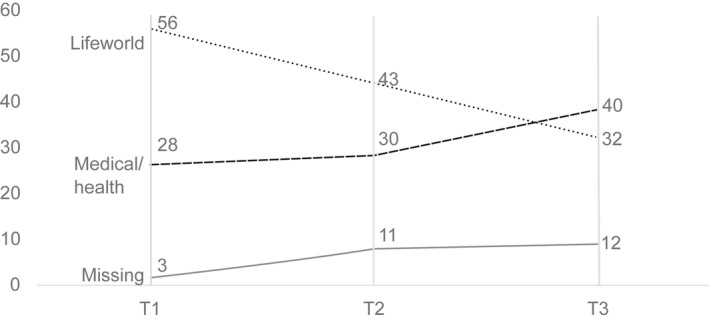
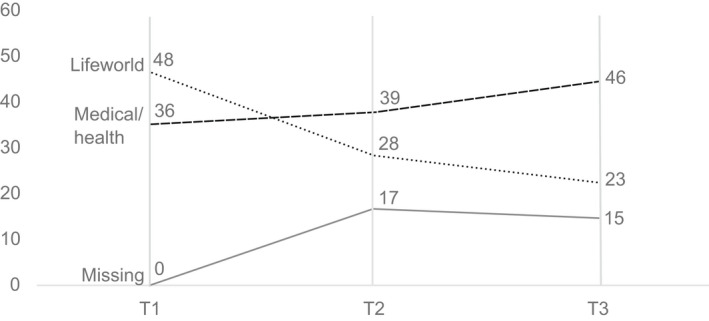
Results: The analysis illustrates the differences and overlaps between life-world and medical/health goals and resources. The documented goals and resources change over time: life-world goals and resources decreased with time as medical/health goals and resources documentation increased.
Conclusions: This paper illustrates that in the setting of a randomised controlled trial, nurses with training in person-centred care recorded fewer life-world and more medical/health goals over time. Placing life-world goals at the top of the goal hierarchy enables alignment with medical/health goals. Further research should explore whether the goals and resources documented in care plans accurately reflect patients' wishes as they transition along the care chain.
Trial registration: Swedish registry, Researchweb.org, ID NR 65 791.
Keywords: chronic illness; goal setting; person-centred care; qualitative content analsysis; qualitative research.
© 2022 The Authors. International Journal of Older People Nursing published by John Wiley & Sons Ltd.
Conflict of interest statement
The authors have no conflict of interest to declare.
Figures
References
-
- Barry, C. A. , Stevenson, F. A. , Britten, N. , Barber, N. , & Bradley, C. P. (2001). Giving voice to the lifeworld. More humane, more effective medical care? A qualitative study of doctor‐patient communication in general practice. Social science & medicine, 53(4), 487–505. 10.1016/s0277-9536(00)00351-8 - DOI - PubMed
-
- Berntsen, G. K. R. , Gammon, D. , Steinsbekk, A. , Salamonsen, A. , Foss, N. , Ruland, C. , & Fønnebø, V. (2015). How do we deal with multiple goals for care within an individual patient trajectory? A document content analysis of health service research papers on goals for care. British Medical Journal Open, 5(12), e009403. 10.1136/bmjopen-2015-009403 - DOI - PMC - PubMed
Publication types
MeSH terms
LinkOut - more resources
Full Text Sources
