


Obesity II: Establishing causal links between chemical exposures and obesity
- PMID: 35395240
- PMCID: PMC9124454
- DOI: 10.1016/j.bcp.2022.115015
Obesity II: Establishing causal links between chemical exposures and obesity
Erratum in
-
Corrigendum to "Obesity II: Establishing causal links between chemical exposures and obesity" [Biochem. Pharmacol. 199 (2022) 115015].Biochem Pharmacol. 2022 Aug;202:115144. doi: 10.1016/j.bcp.2022.115144. Epub 2022 Jun 14. Biochem Pharmacol. 2022. PMID: 35714447 No abstract available.
Abstract
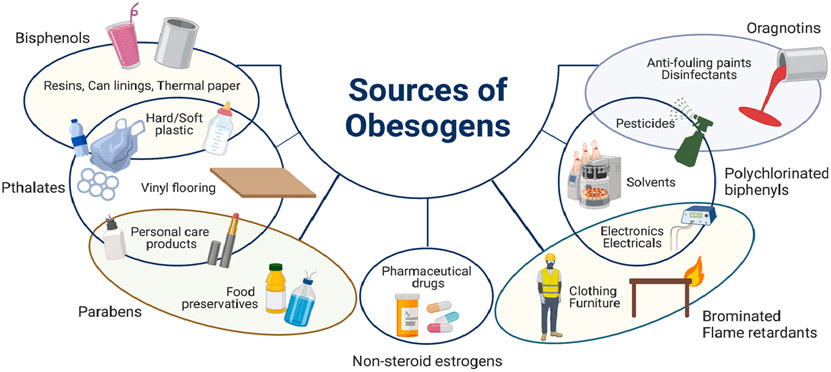
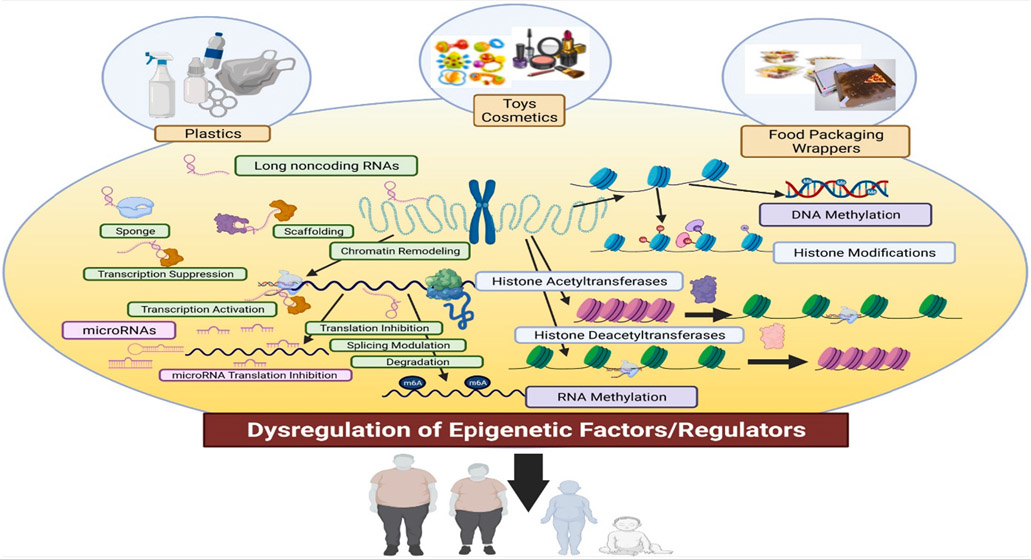
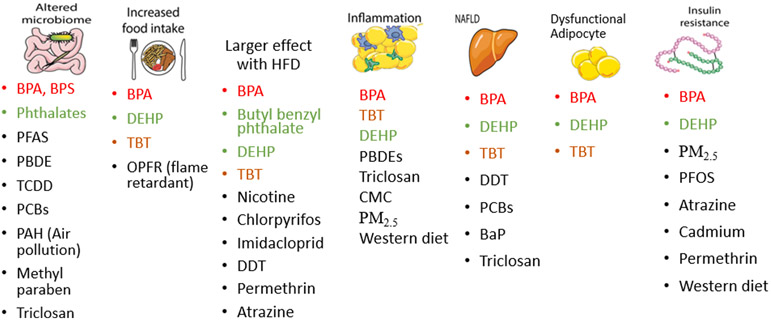
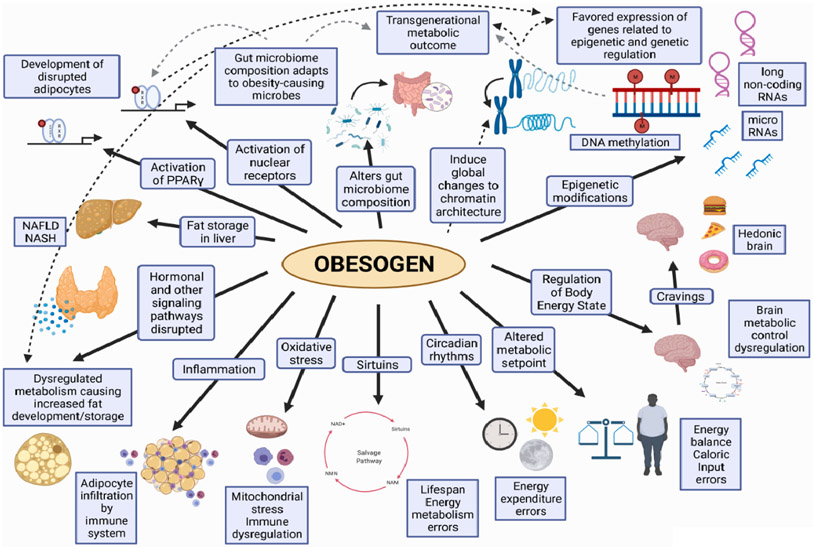
Obesity is a multifactorial disease with both genetic and environmental components. The prevailing view is that obesity results from an imbalance between energy intake and expenditure caused by overeating and insufficient exercise. We describe another environmental element that can alter the balance between energy intake and energy expenditure: obesogens. Obesogens are a subset of environmental chemicals that act as endocrine disruptors affecting metabolic endpoints. The obesogen hypothesis posits that exposure to endocrine disruptors and other chemicals can alter the development and function of the adipose tissue, liver, pancreas, gastrointestinal tract, and brain, thus changing the set point for control of metabolism. Obesogens can determine how much food is needed to maintain homeostasis and thereby increase the susceptibility to obesity. The most sensitive time for obesogen action is in utero and early childhood, in part via epigenetic programming that can be transmitted to future generations. This review explores the evidence supporting the obesogen hypothesis and highlights knowledge gaps that have prevented widespread acceptance as a contributor to the obesity pandemic. Critically, the obesogen hypothesis changes the narrative from curing obesity to preventing obesity.
Keywords: Adipocyte differentiation; Endocrine disruptor; Obesity; Obesogen; Weight gain.
Copyright © 2022 Elsevier Inc. All rights reserved.
Figures
References
-
- Ng M, Fleming T, Robinson M, Thomson B, Graetz N, Margono C, Mullany EC, Biryukov S, Abbafati C, Abera SF, Abraham JP, Abu-Rmeileh NM, Achoki T, AlBuhairan FS, Alemu ZA, Alfonso R, Ali MK, Ali R, Guzman NA, Ammar W, Anwari P, Banerjee A, Barquera S, Basu S, Bennett DA, Bhutta Z, Blore J, Cabral N, Nonato IC, Chang JC, Chowdhury R, Courville KJ, Criqui MH, Cundiff DK, Dabhadkar KC, Dandona L, Davis A, Dayama A, Dharmaratne SD, Ding EL, Durrani AM, Esteghamati A, Farzadfar F, Fay DF, Feigin VL, Flaxman A, Forouzanfar MH, Goto A, Green MA, Gupta R, Hafezi-Nejad N, Hankey GJ, Harewood HC, Havmoeller R, Hay S, Hernandez L, Husseini A, Idrisov BT, Ikeda N, Islami F, Jahangir E, Jassal SK, Jee SH, Jeffreys M, Jonas JB, Kabagambe EK, Khalifa SE, Kengne AP, Khader YS, Khang YH, Kim D, Kimokoti RW, Kinge JM, Kokubo Y, Kosen S, Kwan G, Lai T, Leinsalu M, Li Y, Liang X, Liu S, Logroscino G, Lotufo PA, Lu Y, Ma J, Mainoo NK, Mensah GA, Merriman TR, Mokdad AH, Moschandreas J, Naghavi M, Naheed A, Nand D, Narayan KM, Nelson EL, Neuhouser ML, Nisar MI, Ohkubo T, Oti SO, Pedroza A, Prabhakaran D, Roy N, Sampson U, Seo H, Sepanlou SG, Shibuya K, Shiri R, Shiue I, Singh GM, Singh JA, Skirbekk V, Stapelberg NJ, Sturua L, Sykes BL, Tobias M, Tran BX, Trasande L, Toyoshima H, van de Vijver S, Vasankari TJ, Veerman JL, Velasquez-Melendez G, Vlassov VV, Vollset SE, Vos T, Wang C, Wang X, Weiderpass E, Werdecker A, Wright JL, Yang YC, Yatsuya H, Yoon J, Yoon SJ, Zhao Y, Zhou M, Zhu S, Lopez AD, Murray CJ, Gakidou E, Global, regional, and national prevalence of overweight and obesity in children and adults during 1980–2013: a systematic analysis for the Global Burden of Disease Study 2013, Lancet 384 (9945) (2014) 766–781. - PMC - PubMed
-
- Blüher M, Obesity: global epidemiology and pathogenesis, Nat. Rev. Endocrinol 15 (5) (2019) 288–298. - PubMed
-
- Williams EP, Mesidor M, Winters K, Dubbert PM, Wyatt SB, Overweight and Obesity: Prevalence, Consequences, and Causes of a Growing Public Health Problem, Current obesity reports 4 (3) (2015) 363–370. - PubMed
Publication types
MeSH terms
Substances
Grants and funding
- R01 ES031139/ES/NIEHS NIH HHS/United States
- P30 ES025128/ES/NIEHS NIH HHS/United States
- P30 ES030283/ES/NIEHS NIH HHS/United States
- P30 DK063720/DK/NIDDK NIH HHS/United States
- R15 ES026791/ES/NIEHS NIH HHS/United States
- P30 ES005022/ES/NIEHS NIH HHS/United States
- P01 ES028942/ES/NIEHS NIH HHS/United States
- T32 ES011564/ES/NIEHS NIH HHS/United States
- R21 ES031510/ES/NIEHS NIH HHS/United States
- R01 ES032189/ES/NIEHS NIH HHS/United States
- P20 GM103641/GM/NIGMS NIH HHS/United States
- R01 MH123544/MH/NIMH NIH HHS/United States
- P30 ES027792/ES/NIEHS NIH HHS/United States
- R01 ES028879/ES/NIEHS NIH HHS/United States
- R35 ES028373/ES/NIEHS NIH HHS/United States
- P42 ES023716/ES/NIEHS NIH HHS/United States
- P30 CA023108/CA/NCI NIH HHS/United States
- R21 ES030786/ES/NIEHS NIH HHS/United States
- P01 AT003961/AT/NCCIH NIH HHS/United States
- R01 ES023316/ES/NIEHS NIH HHS/United States
- R21 ES030884/ES/NIEHS NIH HHS/United States
- R00 ES030405/ES/NIEHS NIH HHS/United States
- R15 ES026370/ES/NIEHS NIH HHS/United States
- P30 DK020595/DK/NIDDK NIH HHS/United States
