. 2022 Jul;16(7):1798-1808.
doi: 10.1038/s41396-022-01233-8. Epub 2022 Apr 8.

Active lithoautotrophic and methane-oxidizing microbial community in an anoxic, sub-zero, and hypersaline High Arctic spring

Affiliations

Active lithoautotrophic and methane-oxidizing microbial community in an anoxic, sub-zero, and hypersaline High Arctic spring

Elisse Magnuson et al. ISME J. 2022 Jul.

Abstract

Lost Hammer Spring, located in the High Arctic of Nunavut, Canada, is one of the coldest and saltiest terrestrial springs discovered to date. It perennially discharges anoxic (<1 ppm dissolved oxygen), sub-zero (~-5 °C), and hypersaline (~24% salinity) brines from the subsurface through up to 600 m of permafrost. The sediment is sulfate-rich (1 M) and continually emits gases composed primarily of methane (~50%), making Lost Hammer the coldest known terrestrial methane seep and an analog to extraterrestrial habits on Mars, Europa, and Enceladus. A multi-omics approach utilizing metagenome, metatranscriptome, and single-amplified genome sequencing revealed a rare surface terrestrial habitat supporting a predominantly lithoautotrophic active microbial community driven in part by sulfide-oxidizing Gammaproteobacteria scavenging trace oxygen. Genomes from active anaerobic methane-oxidizing archaea (ANME-1) showed evidence of putative metabolic flexibility and hypersaline and cold adaptations. Evidence of anaerobic heterotrophic and fermentative lifestyles were found in candidate phyla DPANN archaea and CG03 bacteria genomes. Our results demonstrate Mars-relevant metabolisms including sulfide oxidation, sulfate reduction, anaerobic oxidation of methane, and oxidation of trace gases (H2, CO2) detected under anoxic, hypersaline, and sub-zero ambient conditions, providing evidence that similar extant microbial life could potentially survive in similar habitats on Mars.


Conflict of interest statement

The authors declare no competing interests.

Figures
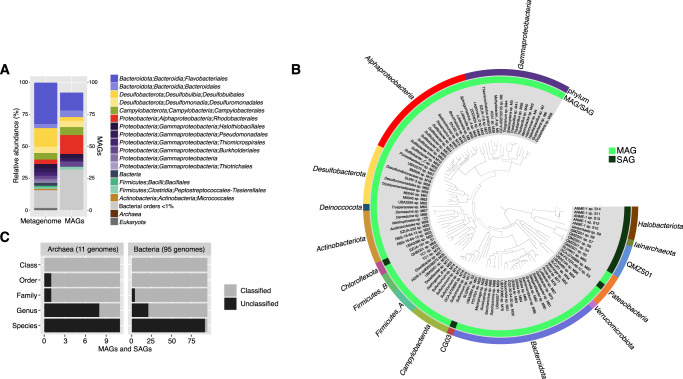
Fig. 1
Fig. 1. Taxonomic diversity and novelty in MAGs and SAGs.
A Comparison of metagenome taxonomic composition to MAG frequency by order. Metagenome taxonomic composition was determined with phyloFlash, based on classification of metagenomic reads mapping to the SILVA small subunit ribosomal database. B Phylogenomic tree of high- and medium-quality MAGs and SAGs. The tree was constructed in Anvi’o with FastTree using the Bacteria_71 collection of single-copy genes and midpoint-rooted with FigTree. C Level of taxonomic novelty of the MAGs and SAGs by rank. The number of classified and unclassified genomes at each taxonomic level was determined according to its rank assignment and taxonomic placement by GTDB-tk.
Fig. 2
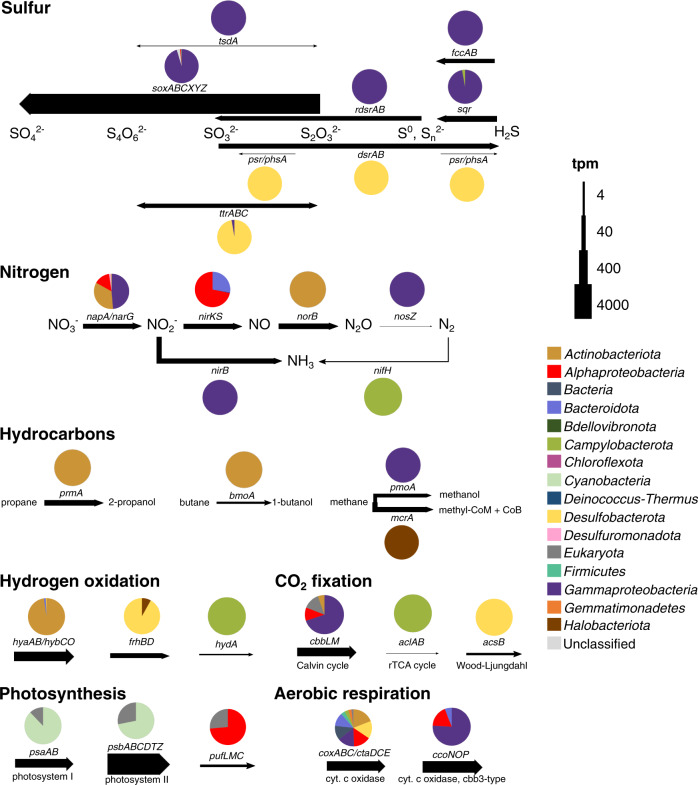
Fig. 2. Key metabolic genes expressed in the LH spring sediment.
Arrow width represents relative expression of genes in transcripts per million reads (tpm). Pie charts represent the phylogenetic classification of relative expression based on the presence of the expressed gene in MAGs or SAGs or phylogenetic classification of the gene for unbinned genes. Complete distribution of tpm in MAGs, SAGs, and unbinned genes can be found in Table S7.
Fig. 3
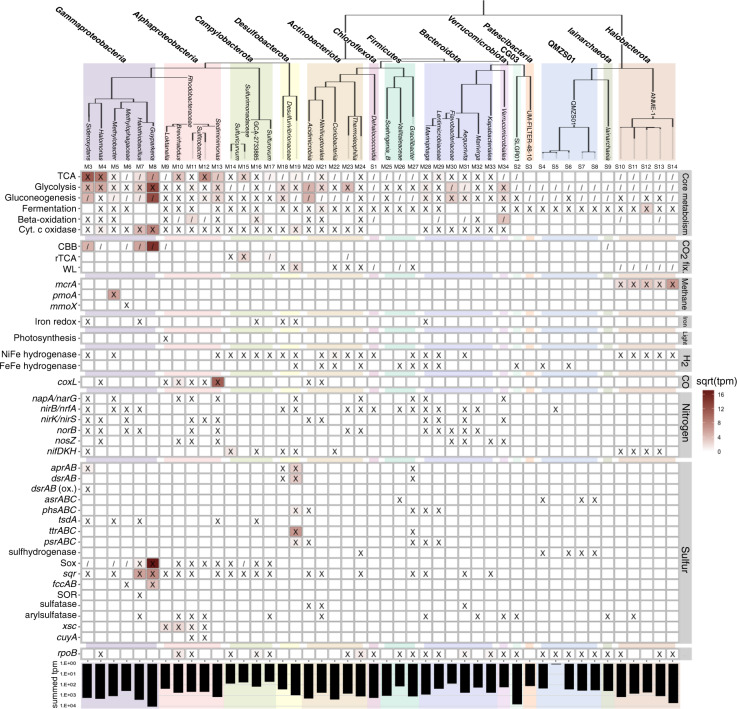
Fig. 3. Metabolic potential and gene expression in high-quality MAGs and medium-quality SAGs.
The identification number for each genome is noted above each column. An ‘X’ indicates the presence of a gene or pathway within the genome; ‘/’ indicates a partial pathway. A complete list of gene IDs and criteria used for denoting the presence of a complete or partial pathway is found in Tables S12 and S13. The square root of transcripts per million reads (tpm) of metatranscriptome reads mapped to the genome is indicated by a color scale within each square. The summed tpm indicates the total tpm of reads mapped to the genome on a logarithmic scale. A corresponding table for medium-quality MAGs is located in Table S8.
Fig. 4
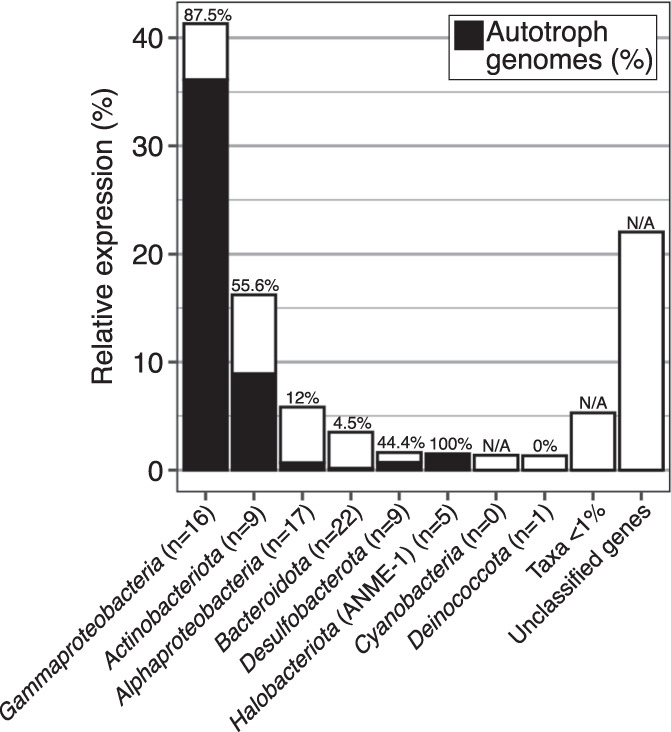
Fig. 4. Percent relative expression by phylum, including both genes in MAGs and SAGs and unbinned genes classified by JGI.
The percentage of autotrophic MAGs and SAGs (containing CO2 fixation genes) in each phylum is indicated in black and noted above each column. The number of MAGs and SAGs in each phylum is indicated in parentheses in each column label. The percentage of relative expression by autotrophic microorganisms was estimated by multiplying the relative expression by the percentage of autotrophic genomes in each taxon.
Fig. 5
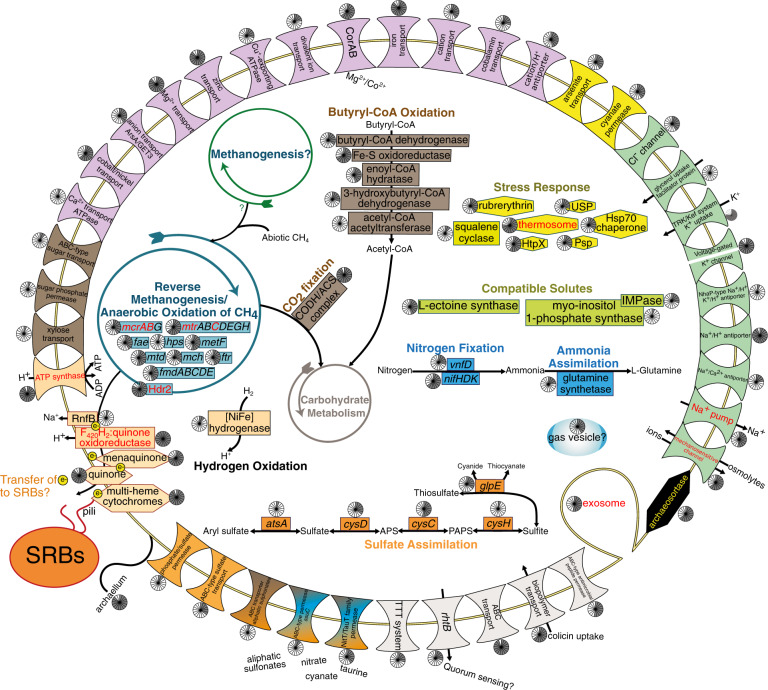
Fig. 5. Metabolic reconstruction of ANME-1 SAGs.
Genome contents were based on a composite of 17 medium- (SAGs S10-S14) and low-quality (SAGs S39-S50) ANME-1 SAGs. Genes with mapped transcripts are denoted by red text. Pie charts indicate the number of SAGs containing each gene (out of 17). A complete list of genes can be found in Table S14.
Fig. 6
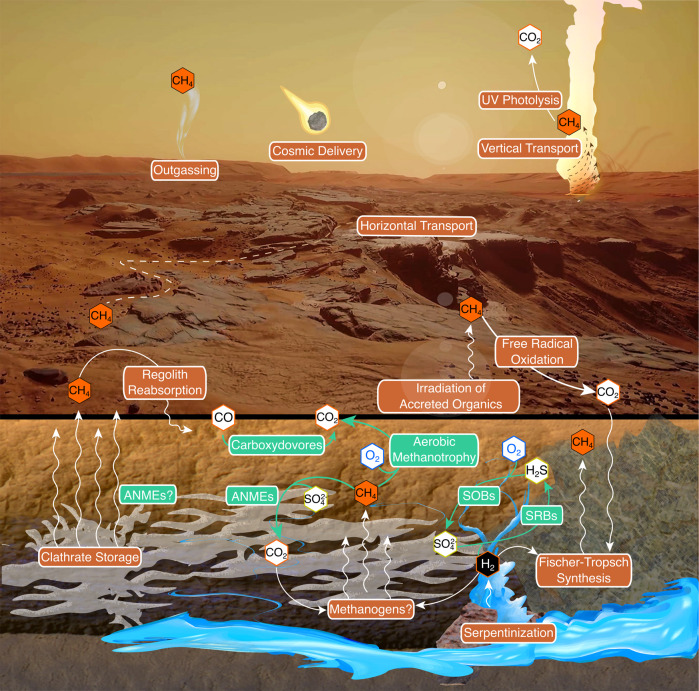
Fig. 6. Model for a hypothetical Martian methane cycle, adapted and reproduced with permission from Harris et al. [92].
Putative methane sources, sinks, and reservoirs are noted in orange. Mars-relevant metabolisms identified in Lost Hammer are noted in green.

References

    1. Pollard W, Omelon C, Andersen D, McKay C. Perennial spring occurrence in the Expedition Fiord area of western Axel Heiberg Island, Canadian High Arctic. Can J Earth Sci. 1999;36:105–20. doi: 10.1139/e98-097. - DOI
    1. Andersen DT. Cold springs in permafrost on Earth and Mars. J Geophys Res. 2002;107:4–1-4-7. doi: 10.1029/2000JE001436. - DOI
    1. Niederberger TD, Perreault NN, Tille S, Lollar BS, Lacrampe-Couloume G, Andersen D, et al. Microbial characterization of a subzero, hypersaline methane seep in the Canadian High Arctic. ISME J. 2010;4:1326–39. doi: 10.1038/ismej.2010.57. - DOI - PubMed
    1. Goordial J, Lamarche-Gagnon G, Lay CY, Whyte L. Left out in the cold: life in cryoenvironments. In: Seckbach J, Oren A, Stan-Lotter H, editors. Polyextremophiles. New York: Springer; 2013. p. 335–64.
    1. Gilichinsky D, Rivkina E, Bakermans C, Shcherbakova V, Petrovskaya L, Ozerskaya S, et al. Biodiversity of cryopegs in permafrost. FEMS Microbiol Ecol. 2005;53:117–28. doi: 10.1016/j.femsec.2005.02.003. - DOI - PubMed

Publication types