Review
. 2022 Apr 8;10(1):34.
doi: 10.1038/s41413-022-00205-0.

The role of sphingosine-1-phosphate in bone remodeling and osteoporosis

Affiliations
Review

The role of sphingosine-1-phosphate in bone remodeling and osteoporosis

Justus M Grewe et al. Bone Res. .

Abstract

Osteoporosis is a systemic bone disease that affects more than 200 million people worldwide and is caused by the disruption of the equilibrium between osteoclastic bone resorption and osteoblastic bone formation. Sphingosine-1-phosphate (S1P) is a natural, bioactive sphingolipid that has been shown to play a major role in cardiovascular and immunological pathologies by regulating biological and cellular processes, including migration, differentiation, proliferation and survival. Recent studies also suggest a central role for S1P in bone diseases, including osteoporosis; however, the effects of S1P, particularly in bone metabolism, remain to be further elucidated. In this review, we summarize the available literature on the role of S1P in bone metabolism with a focus on osteoporosis. On the cellular level, S1P acts as an osteoclast-osteoblast coupling factor to promote osteoblast proliferation and bone formation. Moreover, the recruitment of osteoclast precursors to resorption sites is regulated by the interplay of S1P gradients and S1P receptor expression. From a clinical perspective, increasing evidence suggests that systemically elevated S1P blood levels may serve as an independent risk factor for osteoporosis-related fractures. Taken together, S1P signaling is a potential therapeutic target and may serve as a novel biomarker in patients with systemic bone disease.


Conflict of interest statement

The authors declare no competing interests.

Figures
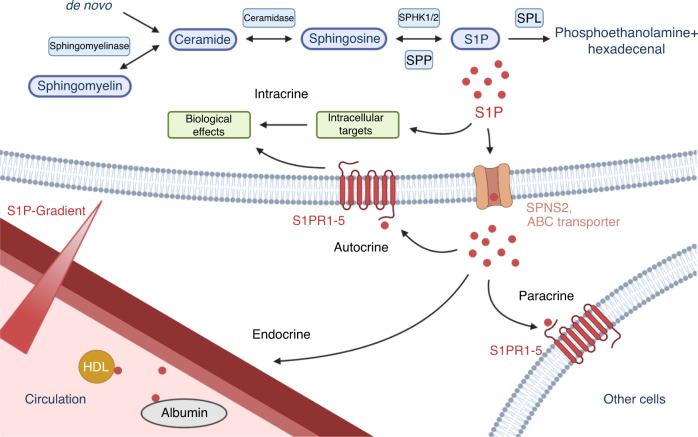
Fig. 1
Fig. 1
Biosynthesis and degradation of sphingosine-1-phosphate and its intracrine, autocrine, paracrine and endocrine signaling. Ceramides are synthesized de novo or by the cleavage of sphingomyelin. Then, cytosolic ceramidase catalyzes the hydrolysis to sphingosine. Sphingosine kinases 1 and 2 (SPHK1/2) catalyze the phosphorylation of sphingosine to its bioactive metabolite, namely, sphingosine-1-phosphate (S1P). The intracellular S1P concentration is tightly regulated by its degradation via S1P phosphatases (SPPs) and S1P lyases (SPLs). Bioactive S1P molecules are released by the ATP-independent Spinster 2 (SPNS2) transporter or the ATP-dependent ABC transporter. Subsequently, S1P may act on the host cell in an intracrine or autocrine manner, in a paracrine manner on neighboring cells, or in an endocrine manner via the blood circulation
Fig. 2
Fig. 2
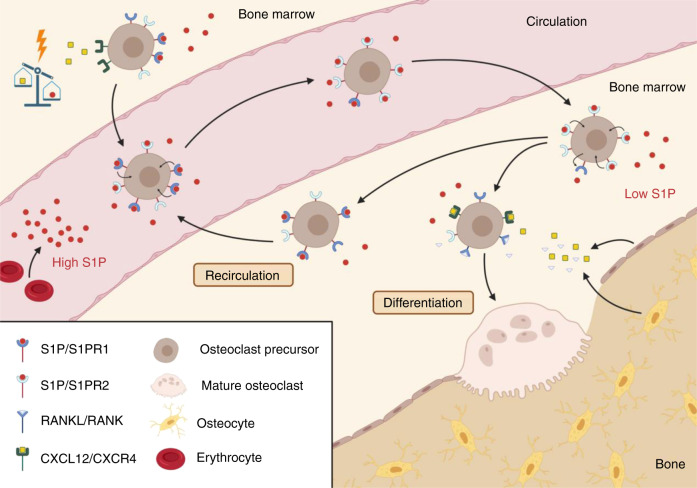
The role of sphingosine-1-phosphate in the recruitment of osteoclast precursors to resorption sites. Under stress conditions, the equilibrium between C-X-C motif chemokine 12 (CXCL12) and sphingosine-1-phosphate (S1P) is shifted in favor of S1P, leading to S1P receptor 1 (S1PR1)-driven chemoattraction of osteoclast precursors toward high S1P levels in the circulation. In a high S1P environment, S1PR1 is internalized, and S1PR2 becomes predominant. Consequently, osteoclast precursors migrate back to the bone marrow through S1PR2-driven chemorepulsion. Activation of S1PR2 decreases S1PR2 expression and increases S1PR1 expression on the cell surface, allowing recirculation into the bloodstream. To prevent recirculation, osteocytes secrete receptor activator of nuclear factor kappa-Β ligand (RANKL) and CXCL12, resulting in the decreased expression of S1PR1 and increased chemoattraction toward bone tissue and enhanced osteoclastogenesis
Fig. 3
Fig. 3
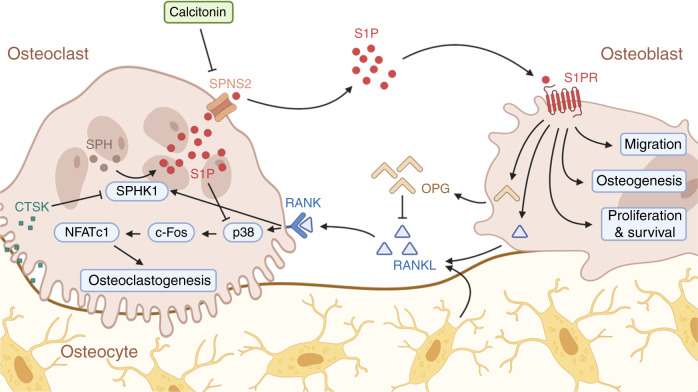
The role of sphingosine-1-phosphate in osteoclast–osteoblast coupling. The binding of receptor activator of nuclear factor kappa-Β ligand (RANKL) to osteoclast precursors leads to osteoclastogenesis, as well as increased sphingosine kinase (SPHK1) expression and activity, resulting in high sphingosine-1-phosphate (S1P) levels. S1P acts in an intracrine manner by inhibiting osteoclastogenesis, and also through paracrine means. By binding to its S1P receptors (S1PR) on osteoblasts, S1P regulates fundamental cellular processes such as migration, osteogenesis, proliferation and survival. Furthermore, S1P affects the ratio of secreted osteoprotegerin (OPG) and RANKL. Intracellular S1P levels in osteoclasts are lowered by a cathepsin K (CTSK)-mediated decrease in SPHK1 expression and are increased by calcitonin-mediated downregulation of Spinster 2 (SPNS2) expression

References

    1. Harvey N, Dennison E, Cooper C. Osteoporosis: impact on health and economics. Nat. Rev. Rheumatol. 2010;6:99–105. doi: 10.1038/nrrheum.2009.260. - DOI - PubMed
    1. Sözen T, Özışık L, Başaran N. An overview and management of osteoporosis. Eur. J. Rheumatol. 2017;4:46–56. doi: 10.5152/eurjrheum.2016.048. - DOI - PMC - PubMed
    1. Johnell O, Kanis J. Epidemiology of osteoporotic fractures. Osteoporos. Int. 2005;16:S3–S7. doi: 10.1007/s00198-004-1702-6. - DOI - PubMed
    1. Borgström F, et al. Costs and quality of life associated with osteoporosis-related fractures in Sweden. Osteoporos. Int. 2006;17:637–650. doi: 10.1007/s00198-005-0015-8. - DOI - PubMed
    1. Ioannidis G, et al. Relation between fractures and mortality: results from the Canadian Multicentre Osteoporosis Study. CMAJ. 2009;181:265–271. doi: 10.1503/cmaj.081720. - DOI - PMC - PubMed