Review
. 2022 Apr 8;10(1):35.
doi: 10.1038/s41413-022-00199-9.

Progression in translational research on spinal cord injury based on microenvironment imbalance

Affiliations
Review

Progression in translational research on spinal cord injury based on microenvironment imbalance

Baoyou Fan et al. Bone Res. .

Abstract

Spinal cord injury (SCI) leads to loss of motor and sensory function below the injury level and imposes a considerable burden on patients, families, and society. Repair of the injured spinal cord has been recognized as a global medical challenge for many years. Significant progress has been made in research on the pathological mechanism of spinal cord injury. In particular, with the development of gene regulation, cell sequencing, and cell tracing technologies, in-depth explorations of the SCI microenvironment have become more feasible. However, translational studies related to repair of the injured spinal cord have not yielded significant results. This review summarizes the latest research progress on two aspects of SCI pathology: intraneuronal microenvironment imbalance and regenerative microenvironment imbalance. We also review repair strategies for the injured spinal cord based on microenvironment imbalance, including medications, cell transplantation, exosomes, tissue engineering, cell reprogramming, and rehabilitation. The current state of translational research on SCI and future directions are also discussed. The development of a combined, precise, and multitemporal strategy for repairing the injured spinal cord is a potential future direction.


Conflict of interest statement

The authors declare no competing interests.

Figures
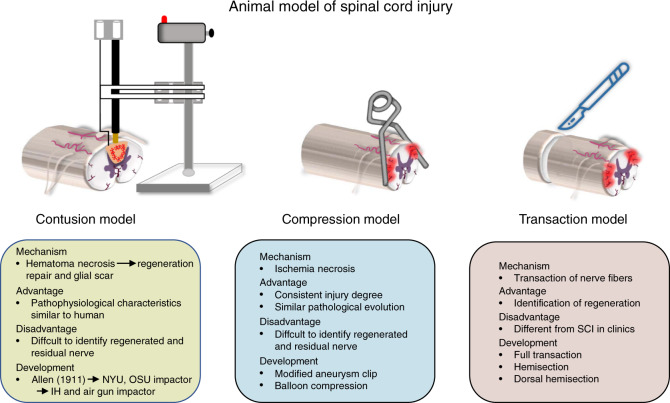
Fig. 1
Fig. 1
Animal models of SCI. This figure illustrates the mechanisms, advantages, disadvantages, and development of the three SCI animal models
Fig. 2
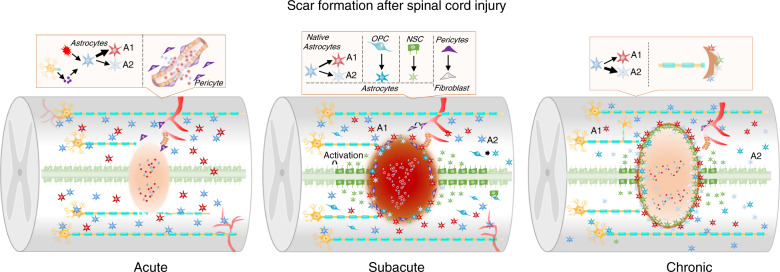
Fig. 2
Scar formation after SCI. This figure shows glial scar and fibrotic scar changes in the acute, subacute, and chronic phases. In the acute phase of SCI, astrocytes are polarized toward the A1 and A2 phenotypes, and pericytes derived from blood vessels migrate into the injury epicenter. In the subacute phase of SCI, a scar is formed by astrocytes derived from native astrocytes, oligodendrocyte progenitor cells (OPCs) and neural stem cells (NSCs). In this stage, fibroblast-derived pericytes seal the scar. In the chronic phase of SCI, the scar is stable, limits inflammation and suppresses the regeneration of axons
Fig. 3
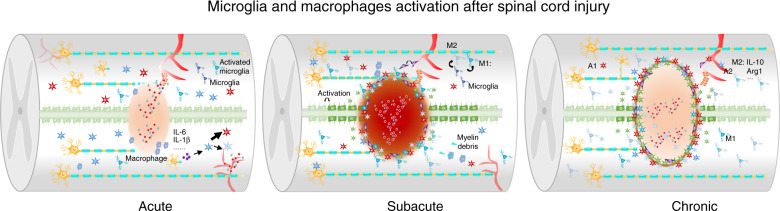
Fig. 3
Microglial and macrophage activation after SCI. This figure shows the changes in microglia and macrophages after SCI. In the acute phase of SCI, microglia are activated by cytokines and factors released from injured neural cells. Macrophages from blood vessels infiltrate injured tissue. In the subacute phase of SCI, M1 microglia and macrophages dominate and exacerbate inflammation by releasing inflammatory factors. Activated microglia and macrophages swallow injured or dead neural cells and myelin. In the chronic phase of SCI, microglia are mainly M2 microglia, which promote regeneration
Fig. 4
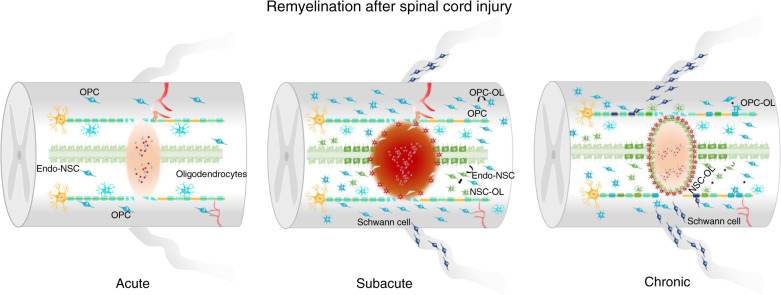
Fig. 4
Remyelination after SCI. This figure shows the changes in remyelination after SCI. In the acute phase of SCI, the number of oligodendrocytes is reduced, and the integrity of myelin is disrupted. In the subacute phase of SCI, OPCs are activated and begin to differentiate into new oligodendrocytes. Additionally, a small number of OPCs can differentiates into Schwann cells. endo-NSCs are activated, and some of them differentiate into oligodendrocytes. In the chronic phase of SCI, newborn oligodendrocytes form myelin around spared or regenerated axons
Fig. 5
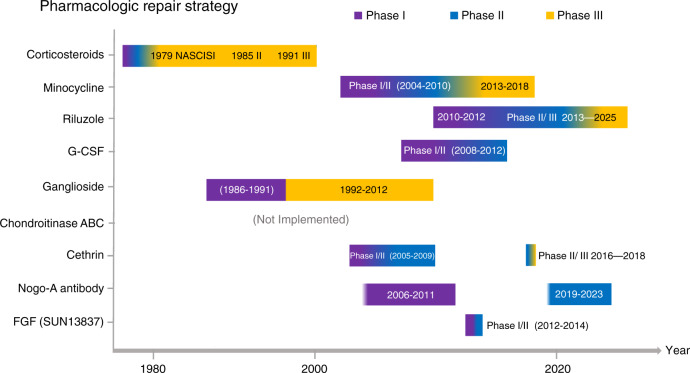
Fig. 5
Research progress on pharmacological strategies for repairing the injured spinal cord. This figure shows clinical trials on medicines for the treatment of SCI, including corticosteroids, minocycline, riluzole, G-CSF, ganglioside, chondroitinase ABC, cethrin, Nogo-A antibodies, and FGF
Fig. 6
Fig. 6
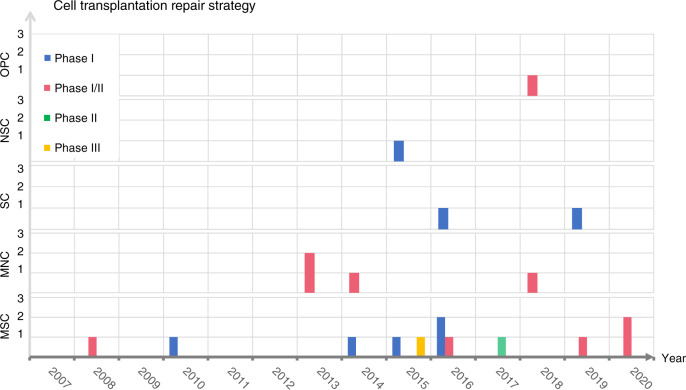
Research progress on cell therapy for spinal cord injury. This figure shows cell therapy clinical trials for SCI that are registered at ClinicalTrials.gov or have been published. This figure shows the timeline of cell therapy research for SCI and the number of clinical trials for different cells

References

    1. Stover SL, DeVivo MJ, Go BK. History, implementation, and current status of the National Spinal Cord Injury Database. Arch. Phys. Med. Rehabil. 1999;80:1365–1371. doi: 10.1016/S0003-9993(99)90246-0. - DOI - PubMed
    1. Parent S, Barchi S, LeBreton M, Casha S, Fehlings MG. The impact of specialized centers of care for spinal cord injury on length of stay, complications, and mortality: a systematic review of the literature. J. Neurotrauma. 2011;28:1363–1370. doi: 10.1089/neu.2009.1151. - DOI - PMC - PubMed
    1. Injury, G. B. D. T. B. & Spinal Cord Injury, C. Global, regional, and national burden of traumatic brain injury and spinal cord injury, 1990–2016: a systematic analysis for the Global Burden of Disease Study 2016. Lancet Neurol. 18, 56–87 (2019). - PMC - PubMed
    1. Organization, W. H. International perspectives on spinal cord injury. Weed Res. 2013;11:314–316.
    1. Kang Y, et al. Epidemiology of worldwide spinal cord injury: a literature review. J. Neurorestoratol. 2017;6:1–9. doi: 10.2147/JN.S143236. - DOI