


Clinical manifestations, treatment options, and comorbidities in COVID-19 relapse patients: A systematic review
- PMID: 35396748
- PMCID: PMC9102618
- DOI: 10.1002/jcla.24402
Clinical manifestations, treatment options, and comorbidities in COVID-19 relapse patients: A systematic review
Abstract
Introduction: Interest revolving around coronavirus disease 2019 (COVID-19) reinfection is escalating rapidly. By definition, reinfection denotes severe acute respiratory syndrome coronavirus 2 (SARS-CoV-2), PCR redetection, and COVID-19 recurrence within three months of the initial symptoms. The main aim of the current systematic review was to evaluate the features of COVID-19 relapse patients.
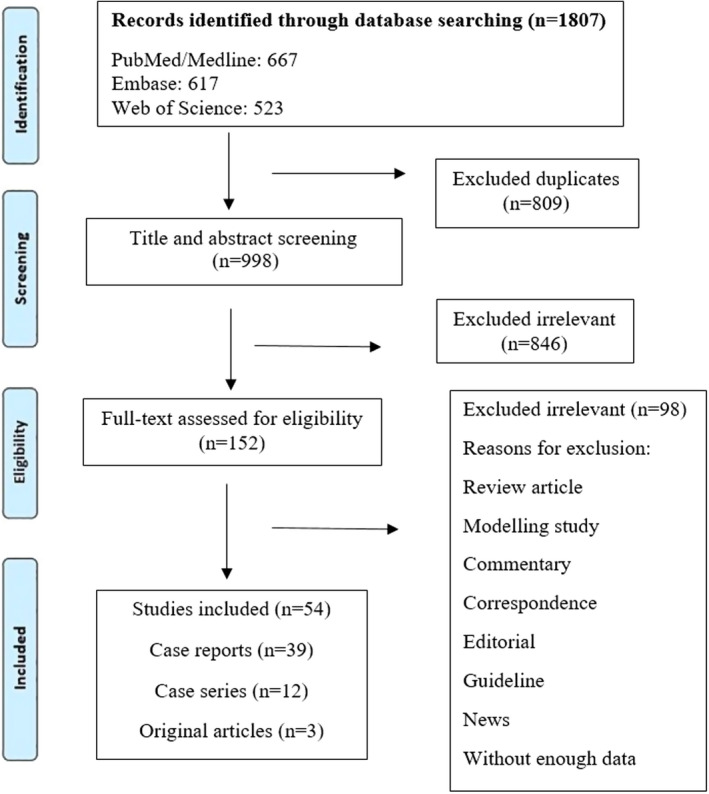
Materials and methods: For this study, we used a string of terms developed by a skilled librarian and through a systematical search in PubMed, Web of Science, and Embase for eligible studies. Clinical surveys of any type were included from January 2019 to March 2021. Eligible studies consisted of two positive assessments separated by a negative result via RT-PCR.
Results: Fifty-four studies included 207 cases of COVID-19 reinfection. Children were less likely to have COVID-19 relapse. However, the most patients were in the age group of 20-40 years. Asthenia (66.6%), headache (66.6%), and cough (54.7%) were prevalent symptoms in the first SARS-CoV-2 infection. Asthenia (62.9%), myalgia (62.9%), and headache (61.1%) were most frequent in the second one. The most common treatment options used in first COVID-19 infection were lopinavir/ritonavir (80%), oxygen support (69.2%), and oseltamivir (66.6). However, for the treatment of second infection, mostly antibiotics (100%), dexamethasone (100%), and remdesivir (80%) were used. In addition, obesity (32.5%), kidney failure (30.7%), and hypertension (30.1%) were the most common comorbidities. Unfortunately, approximately 4.5% of patients died.
Conclusion: We found the potency of COVID-19 recurrence as an outstanding issue. This feature should be regarded in the COVID-19 management. Furthermore, the first and second COVID-19 are similar in clinical features. For clinically practical comparison of the symptoms severity between two epochs of infection, uniform data of both are required. We suggest that future studies undertake a homogenous approach to establish the clinical patterns of the reinfection phenomena.
Keywords: COVID-19; SARS-CoV2; recurrence; reinfection; relapse.
© 2022 The Authors. Journal of Clinical Laboratory Analysis published by Wiley Periodicals LLC.
Conflict of interest statement
The authors declare that they have no competing interests.
Figures
References
-
- Vaidyanathan G. Coronavirus variants are spreading in India—what scientists know so far. Nature. 2021;593(7859):321‐322. - PubMed
Publication types
MeSH terms
LinkOut - more resources
Full Text Sources
Medical
Miscellaneous
