. 2023 Feb;17(1):131-140.
doi: 10.1007/s11701-022-01382-0. Epub 2022 Apr 9.

Click-on fluorescence detectors: using robotic surgical instruments to characterize molecular tissue aspects

Affiliations

Click-on fluorescence detectors: using robotic surgical instruments to characterize molecular tissue aspects

Matthias N van Oosterom et al. J Robot Surg. 2023 Feb.

Abstract

Fluorescence imaging is increasingly being implemented in surgery. One of the drawbacks of its application is the need to switch back-and-forth between fluorescence- and white-light-imaging settings and not being able to dissect safely under fluorescence guidance. The aim of this study was to engineer 'click-on' fluorescence detectors that transform standard robotic instruments into molecular sensing devices that enable the surgeon to detect near-infrared (NIR) fluorescence in a white-light setting. This NIR-fluorescence detector setup was engineered to be press-fitted onto standard forceps instruments of the da Vinci robot. Following system characterization in a phantom setting (i.e., spectral properties, sensitivity and tissue signal attenuation), the performance with regard to different clinical indocyanine green (ICG) indications (e.g., angiography and lymphatic mapping) was determined via robotic surgery in pigs. To evaluate in-human applicability, the setup was also used for ICG-containing lymph node specimens from robotic prostate cancer surgery. The resulting Click-On device allowed for NIR ICG signal identification down to a concentration of 4.77 × 10⁻⁶ mg/ml. The fully assembled system could be introduced through the trocar and grasping, and movement abilities of the instrument were preserved. During surgery, the system allowed for the identification of blood vessels and assessment of vascularization (i.e., bowel, bladder and kidney), as well as localization of pelvic lymph nodes. During human specimen evaluation, it was able to distinguish sentinel from non-sentinel lymph nodes. With this introduction of a NIR-fluorescence Click-On sensing detector, a next step is made towards using surgical instruments in the characterization of molecular tissue aspects.

Keywords: Biosensing; Fluorescence guided surgery; Image-guided surgery; Near-infrared; Robotic surgery; Steerable surgical instruments.


Conflict of interest statement

MvO, SvL, MB, HvdP and FvL have a pending‐patent on Click-On fluorescence detectors. During this research, EM, PD, KB and FvL were (partially) affiliated with ORSI Academy and HS was affiliated with Eurorad S.A.. No further conflicts of interest exist.

Figures
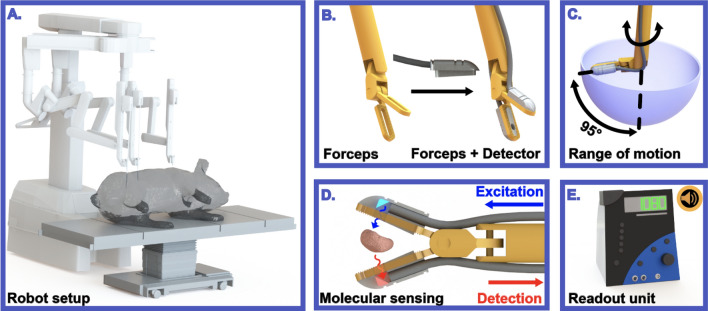
Fig. 1
Fig. 1
Schematic overview of the NIR fluorescence Click-On setup. AB The modules are clicked onto a standard ProGrasp Forceps of the Da Vinci surgical robot. C The range of motion of the steerable instrument is not limited by the Click-On modules. D Upon illumination with the excitation light (in blue), the instrument detects the fluorescent tracer (in red) between the jaws of the forceps. E Upon detection of NIR fluorescence, the read-out unit provides both a numerical (i.e., counts/s) and audible feedback
Fig. 2
Fig. 2
Characterization of the Click-On NIR fluorescence device and Firefly Si and Xi camera systems. A An overview of the relevant spectral properties of the Click-On system (i.e., excitation in green and detection window in yellow) in relation to the absorption (in red) and emission spectra (in blue) of ICG. B Graphical representation of the forceps jaws in a closed position (top) and an open position (bottom). C Influence of the forceps jaw angle on fluorescence detection sensitivity (without tissue). D Excitation spectrum of the Firefly Si system. E Excitation spectrum of the Firefly Xi system
Fig. 3
Fig. 3
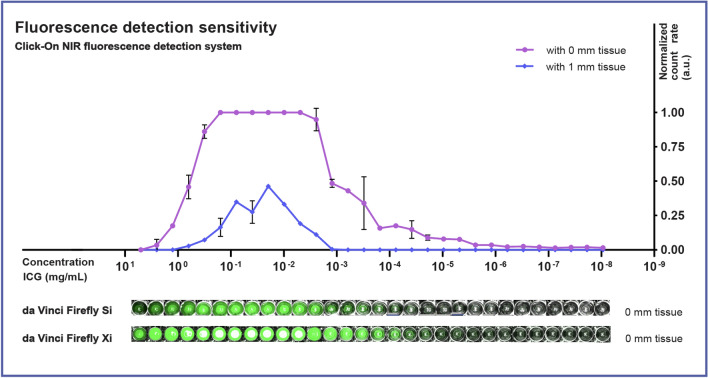
Fluorescence detection sensitivity of the Click-On NIR fluorescence device and Firefly Si and Xi camera systems
Fig. 4
Fig. 4
Overview of the in vivo evaluation of the Click-On NIR fluorescence setup, showing examples for different applications. The Click-On modality functions in both white light imaging mode and fluorescence imaging mode, rendering it independent of the laparoscopic camera setting. The Click-On modality provides both an audible and numerical feedback once ICG is detected. The latter is used the roughly estimate the ICG concentration in the tissue grasped
Fig. 5
Fig. 5
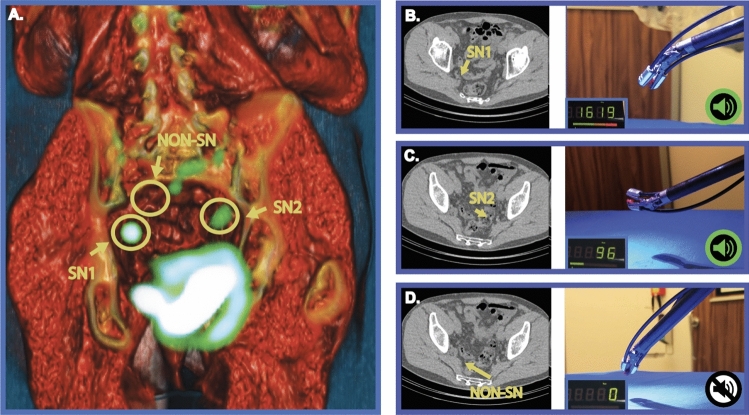
Example of the ex vivo evaluation in prostate cancer SN surgery. A A volume rendering of the patient SPECT/CT scan shows an overview of two SN locations, where tracer uptake is visualized in green. To illustrate the location of the non-SN specimen removed during surgery, an annotation of this lymph node was also added to the scan. BD The three annotated lymph nodes are shown on the individual CT slice (left) and evaluated with the Click-On fluorescence setup (right). The Click-On modality was able to identify SN specimens from non-SN specimens, providing a non-zero count rate and a sound when the SNs were detected
Fig. 6
Fig. 6
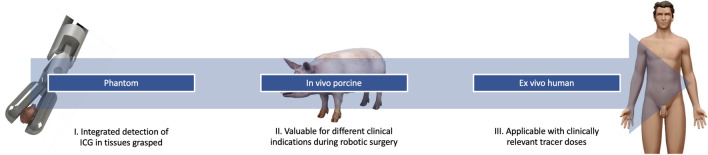
Overview of the Click-On fluorescence detector evaluation, displaying the three main stages: I. phantom, II. in vivo porcine and III. ex vivo human

References

    1. Cacciamani GE, et al. Best practices in near-infrared fluorescence imaging with indocyanine green (NIRF/ICG)-guided robotic urologic surgery: a systematic review-based expert consensus. World J Urol. 2020;38(4):883–896. doi: 10.1007/s00345-019-02870-z. - DOI - PubMed
    1. van der Poel HG, et al. Intraoperative laparoscopic fluorescence guidance to the sentinel lymph node in prostate cancer patients: clinical proof of concept of an integrated functional imaging approach using a multimodal tracer. Eur Urol. 2011;60(4):826–833. doi: 10.1016/j.eururo.2011.03.024. - DOI - PubMed
    1. Esposito C, et al. Image-guided pediatric surgery using indocyanine green (ICG) fluorescence in laparoscopic and robotic surgery. Front Pediatr. 2020;8:314. doi: 10.3389/fped.2020.00314. - DOI - PMC - PubMed
    1. Harke NN, et al. Fluorescence-supported lymphography and extended pelvic lymph node dissection in robot-assisted radical prostatectomy: a prospective, randomized trial. World J Urol. 2018;36(11):1817–1823. doi: 10.1007/s00345-018-2330-7. - DOI - PubMed
    1. Rajakumar T, et al. Use of intraoperative fluorescence to enhance robot-assisted radical prostatectomy. Future Oncol. 2020;17(9):1083–1095. doi: 10.2217/fon-2020-0370. - DOI - PubMed

Substances

LinkOut - more resources