


Estimating the cost of achieving basic water, sanitation, hygiene, and waste management services in public health-care facilities in the 46 UN designated least-developed countries: a modelling study
- PMID: 35397226
- PMCID: PMC9090898
- DOI: 10.1016/S2214-109X(22)00099-7
Estimating the cost of achieving basic water, sanitation, hygiene, and waste management services in public health-care facilities in the 46 UN designated least-developed countries: a modelling study
Abstract
Background: An alarming number of public health-care facilities in low-income and middle-income countries lack basic water, sanitation, hygiene (WASH), and waste management services. This study estimates the costs of achieving full coverage of basic WASH and waste services in existing public health facilities in the 46 UN designated least-developed countries (LDCs).
Methods: In this modelling study, in-need facilities were quantified by combining published counts of public facilities with estimated basic WASH and waste service coverage. Country-specific per-facility capital and recurrent costs to deliver basic services were collected via survey of country WASH experts and officials between Sept 24 and Dec 24, 2020. Baseline cost estimates were modelled and discounted by 5% per year. Key assumptions were adjusted to produce lower and upper estimates, including adjusting the discount rate to 8% and 3% per year, respectively.
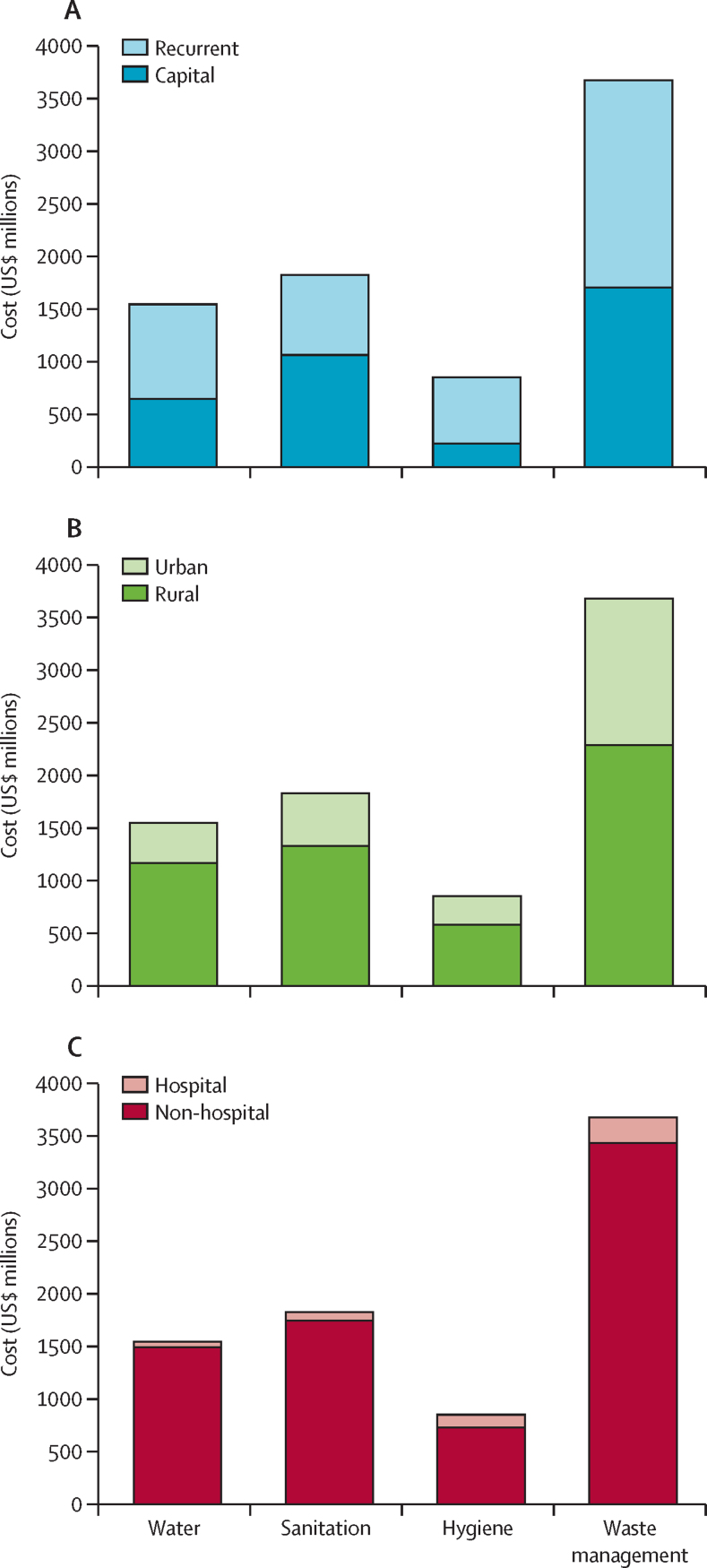
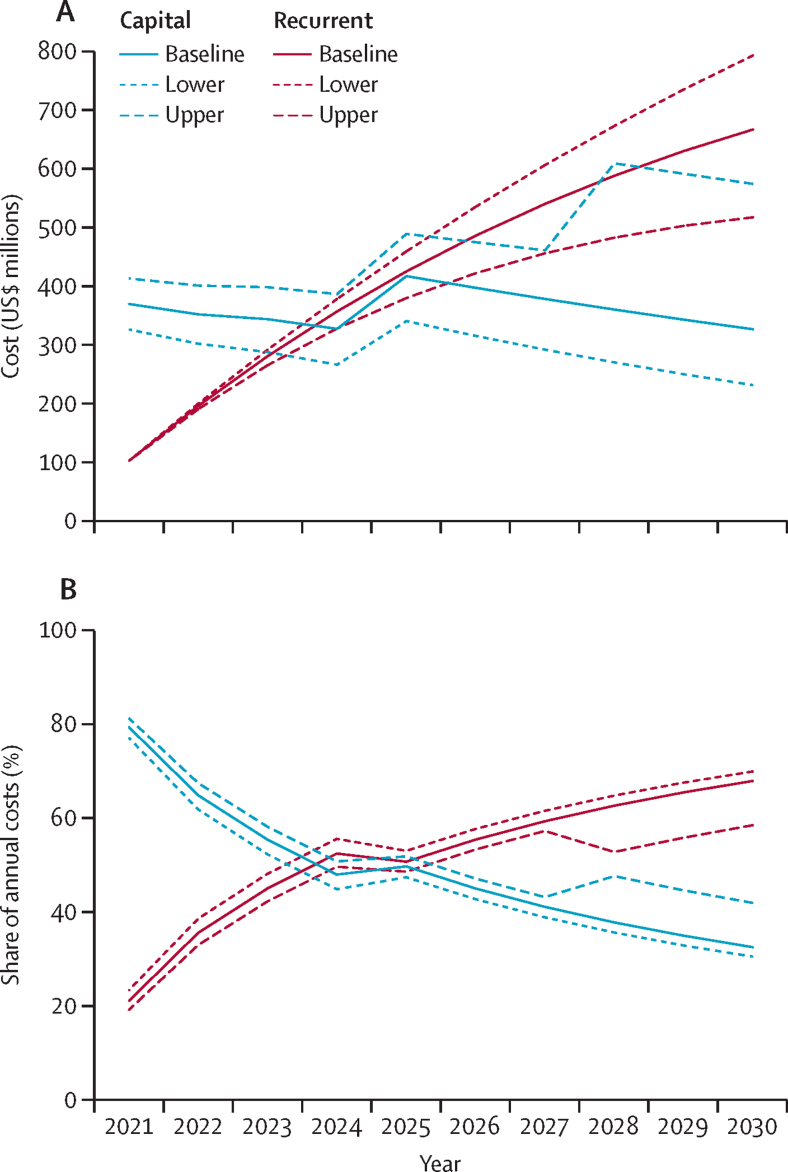
Findings: An estimated US$6·5 billion to $9·6 billion from 2021 to 2030 is needed to achieve full coverage of basic WASH and waste services in public health facilities in LDCs. Capital costs are $2·9 billion to $4·8 billion and recurrent costs are $3·6 billion to $4·8 billion over this time period. A mean of $0·24-0·40 per capita in capital investment is needed each year, and annual operations and maintenance costs are expected to increase from $0·10 in 2021 to $0·39-0·60 in 2030. Waste management accounts for the greatest share of costs, requiring $3·7 billion (46·6% of the total) in the baseline estimates, followed by $1·8 billion (23·1%) for sanitation, $1·5 billion (19·5%) for water, and $845 million (10·7%) for hygiene. Needs are greatest for non-hospital facilities ($7·4 billion [94%] of $7·9 billion) and for facilities in rural areas ($5·3 billion [68%]).
Interpretation: Investment will need to increase to reach full coverage of basic WASH and waste services in public health facilities. Financial needs are modest compared with current overall health and WASH spending, and better service coverage will yield substantial health benefits. To sustain services and prevent degradation and early replacement, countries will need to routinely budget for operations and maintenance of WASH and waste management assets.
Funding: WHO (including underlying grants from the governments of Japan, the Netherlands, and the UK), World Bank (including an underlying grant from the Global Water Security and Sanitation Partnership), and UNICEF.
Translations: For the Arabic, French and Portuguese translations of the abstract see Supplementary Materials section.
© 2022 World Health Organization; licensee Elsevier. This is an Open Access article published under the CC BY 3.0 IGO license which permits unrestricted use, distribution, and reproduction in any medium, provided the original work is properly cited. In any use of this article, there should be no suggestion that WHO endorses any specific organisation, products or services. The use of the WHO logo is not permitted. This notice should be preserved along with the article's original URL.
Conflict of interest statement
Declaration of interests MC reports personal fees from WHO during the conduct of the study and from Results for Development, ThinkWell, and the World Bank outside the submitted work. SM reports personal fees from WHO during the conduct of the study and from Evidence Action and Vysnova Partners outside the submitted work. ONH reports personal fees from WHO during the conduct of the study. RJ reports grants from Agence Française de Développement, the Bill & Melinda Gates Foundation, Government of the Netherlands Ministry of Foreign Affairs, UN-Water Inter-Agency Trust Fund, United Kingdom Foreign, Commonwealth & Development Office, and Swiss Agency for Development and Cooperation, both during the conduct of the study and outside the submitted work. All other authors declare no competing interests.
Figures
Comment in
-
Achieving basic rights in health-care facilities in low-income countries.Lancet Glob Health. 2022 Sep;10(9):e1243. doi: 10.1016/S2214-109X(22)00255-8. Lancet Glob Health. 2022. PMID: 35961345 No abstract available.
References
-
- WHO . World Health Organization; Geneva: 2019. Water, sanitation and hygiene in health care facilities: World Health Assembly Resolution 72.7.
-
- UN Secretary-General Secretary-General's remarks at launch of International Decade for Action ‘Water for Sustainable Development’ 2018-2028 [as delivered] 2018. https://www.un.org/sg/en/content/sg/statement/2018-03-22/secretary-gener...
-
- WHO. UNICEF Water, sanitation and hygiene in health care facilities: practical steps to achieve universal access. 2019. https://apps.who.int/iris/bitstream/handle/10665/311618/9789241515511-en...
-
- WHO. UNICEF Core questions and indicators for monitoring WASH in health care facilities in the Sustainable Development Goals. 2018. https://washdata.org/sites/default/files/documents/reports/2019-04/JMP-2...
-
- WHO. UNICEF WASH in health care facilities: Global Baseline Report 2019. 2019. https://www.who.int/water_sanitation_health/publications/wash-in-health-...
Publication types
MeSH terms
Substances
Grants and funding
LinkOut - more resources
Full Text Sources
Research Materials
