


Feasibility and implementation fidelity of a co-designed intervention to promote in-hospital mobility among older medical patients-the WALK-Copenhagen project (WALK-Cph)
- PMID: 35397574
- PMCID: PMC8994315
- DOI: 10.1186/s40814-022-01033-z
Feasibility and implementation fidelity of a co-designed intervention to promote in-hospital mobility among older medical patients-the WALK-Copenhagen project (WALK-Cph)
Abstract
Background: Mobility interventions can prevent functional decline among older patients, but implementation of such interventions may be complicated by barriers in the clinical setting. The WALK-Copenhagen project (WALK-Cph) is aimed at promoting a 24-h mobility among older medical patients during hospitalization. The WALK-Cph intervention was co-designed by researchers and stakeholders to tailor the intervention to the clinical context. The aim of this study was to investigate the feasibility and implementation fidelity of the WALK-Cph intervention before evaluating clinical effectiveness in a randomized controlled trial (ClinicalTrials.gov NCT03825497).
Methods: The WALK-Cph intervention consisted of six components: a welcome folder explaining the importance of in-hospital activity, a WALK-plan prescribing up to three daily walking sessions during and after hospitalization, a WALK-path in the hallway that patients were motivated to use daily, exercise posters in the hallways and bedrooms, self-service on beverages and clothes, and discharge with a WALK-plan. The present study reports on phase 2 of WALK-Cph and consists of a feasibility and a fidelity component. The study was conducted at the two WALK-Cph intervention departments after the initiation of the WALK-Cph intervention. A cohort of older medical patients (+65) was recruited for the feasibility study to assess recruitment and data collection procedures and the method for assessment of activity. Simultaneously, implementation fidelity was assessed by observing clinical practice and intervention delivery at the intervention departments.
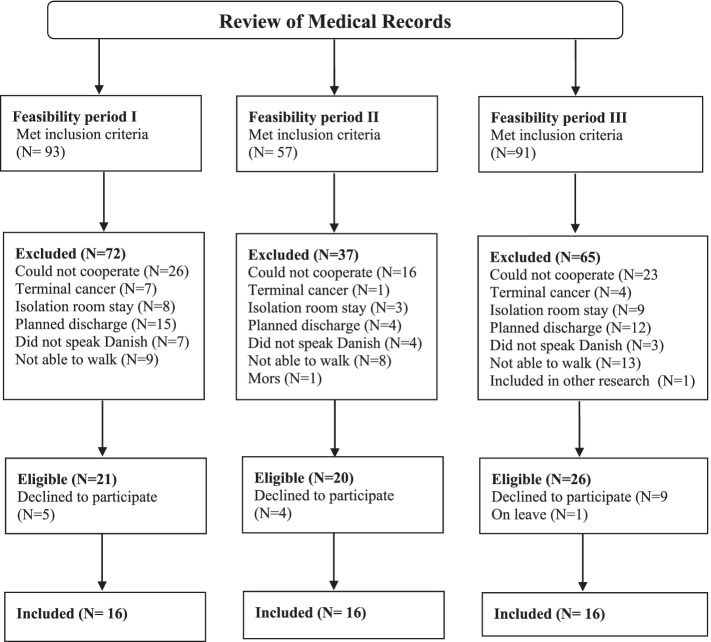
Results: A feasibility cohort of 48 patients was included. Inclusion was considered feasible with recruitment rates between 62% and 70% of all eligible patients. Also, data collection was conducted without obstacles, and all patients accepted to wear activity monitors. The fidelity observations showed that three of the six intervention components were partially implemented as planned whereas three components were not implemented as planned.
Conclusion: The WALK-Cph intervention was found feasible, and although the intervention was not implemented with fidelity, the level of fidelity was considered sufficient to continue with further testing of the WALK-Cph intervention in a large-scale trial.
Trial registration: ClinicalTrials.gov NCT03825497 (retrospectively registered). Protocol PubMed ID (PMID): 29523569.
Keywords: Accelerometers; Co-design; Feasibility and fidelity; Implementation; Mobility; Older medical patients.
© 2022. The Author(s).
Conflict of interest statement
The authors declare that they have no competing interests.
Figures
References
Associated data
Grants and funding
LinkOut - more resources
Full Text Sources
Medical
Research Materials
