


Do baseline industry and job group skill level predict welfare dependency at 1, 3 and 5 years after mental health related sickness absence? A Danish cohort study
- PMID: 35397597
- PMCID: PMC8994387
- DOI: 10.1186/s12889-022-13105-z
Do baseline industry and job group skill level predict welfare dependency at 1, 3 and 5 years after mental health related sickness absence? A Danish cohort study
Abstract
Background: The cost of mental ill health in the EU-28 nations has been estimated at approximately 4.1% of the total gross domestic products (GDP). Improved rates of return to sustainable employment among people who are sick-listed due to mental ill health would decrease spending on welfare benefits. The present cohort study provides statistical information that may be helpful in the design and prioritizing of efforts aimed at reducing the burden of sickness absence due to mental ill health among employees in the general working population of Denmark. Our primary aim was to estimate odds of being i) deceased or recipient of health related welfare benefits and ii) recipient non-health related welfare benefits, compared to being alive and self-reliant at 1, 3 and 5 years after first visit to a jobs and benefits office due to mental health related sickness absence, as a function of industrial sector and job group skill level at baseline. A secondary aim was to analyze these odds as a function of baseline age, gender, type of mental ill health, family type and employment status.
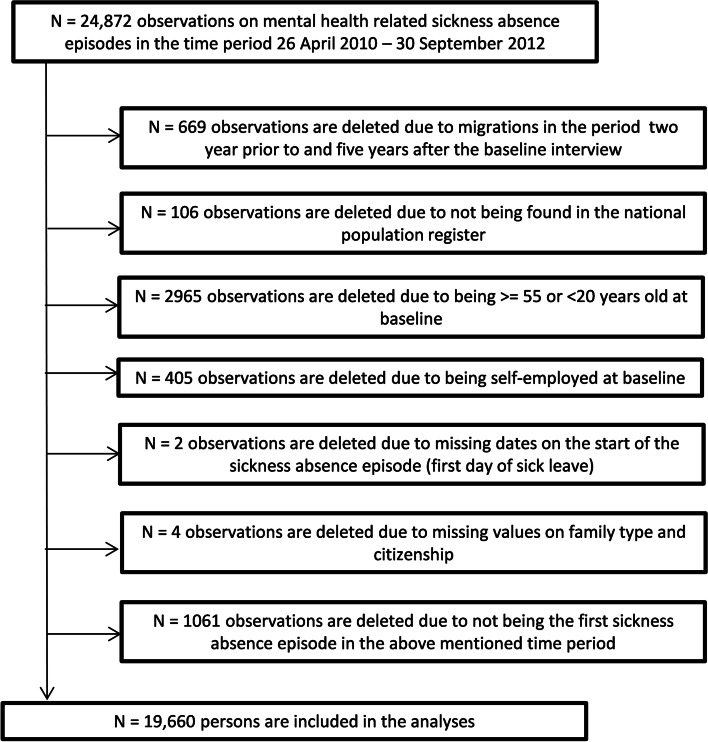
Methods: The study population consisted of 20-54 year-old persons on long-term sickness absence due to mental health problems in 21 Danish municipalities in 2010-2012 (N = 19,660). Odds ratios were estimated by use of multinomial logistic regression. The outcomes were ascertained through national registers.
Results: We did not find any statistically significant association between baseline industrial sector or job group skill level and welfare dependency at follow-up. In the secondary analyses, the estimated odds of health and non-health related welfare dependencies at follow-up tended to increase with unemployment, age, being single and being on sick leave due to self-reported anxiety or depression versus stress/burnout at baseline.
Conclusions: The present study does not support that industry and job group skill level predict welfare dependency after health related sickness absence, after adjustment for relevant covariates, in the general population of Denmark. It suggests, however, that the vulnerability lies in population groups characterized by unemployment, older age, being single and being on sick leave due to self-reported anxiety or depression versus stress/burnout.
Keywords: Industry; Mental health; Occupation; Return to work; Sick leave.
© 2022. The Author(s).
Conflict of interest statement
There are no conflicts of interest.
Figures
References
-
- OECD/EU . Health at a glance: Europe 2018: state of health in the EU cycle, OECD Publishing, Paris. 2018.
-
- Nigatu YT, Liu Y, Uppal M, McKinney S, Rao S, Gillis K, Wang J. Interventions for enhancing return to work in individuals with a common mental illness: systematic review and meta-analysis of randomized controlled trials. Psychol Med. 2016;46(16):3263–3274. doi: 10.1017/S0033291716002269. - DOI - PubMed
Publication types
MeSH terms
LinkOut - more resources
Full Text Sources
Medical
