


Development of a Temperate Climate-Adapted indica Multi-stress Tolerant Rice Variety by Pyramiding Quantitative Trait Loci
- PMID: 35397732
- PMCID: PMC8994804
- DOI: 10.1186/s12284-022-00568-2
Development of a Temperate Climate-Adapted indica Multi-stress Tolerant Rice Variety by Pyramiding Quantitative Trait Loci
Abstract
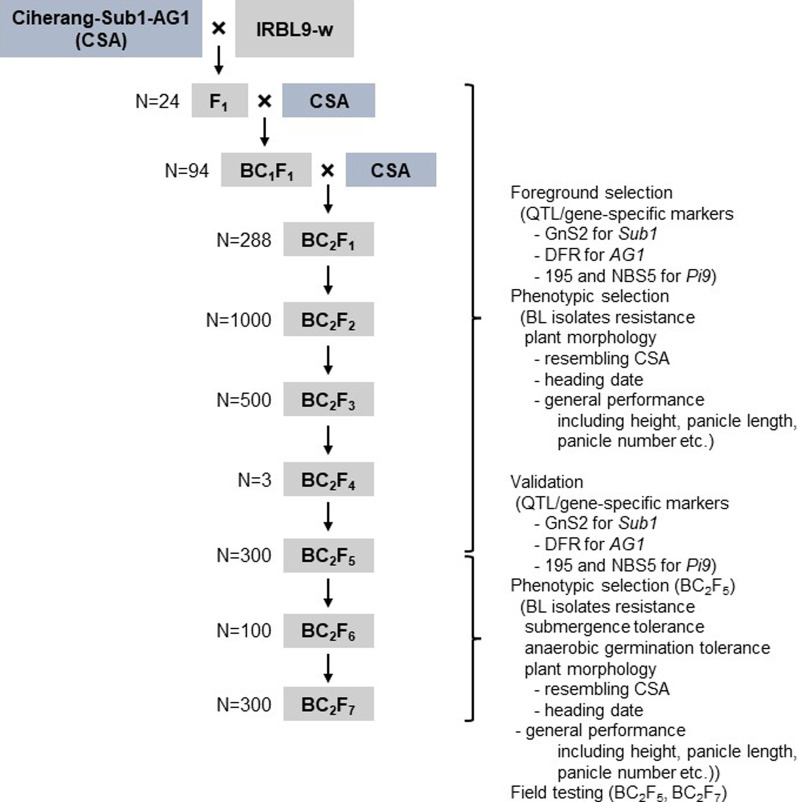
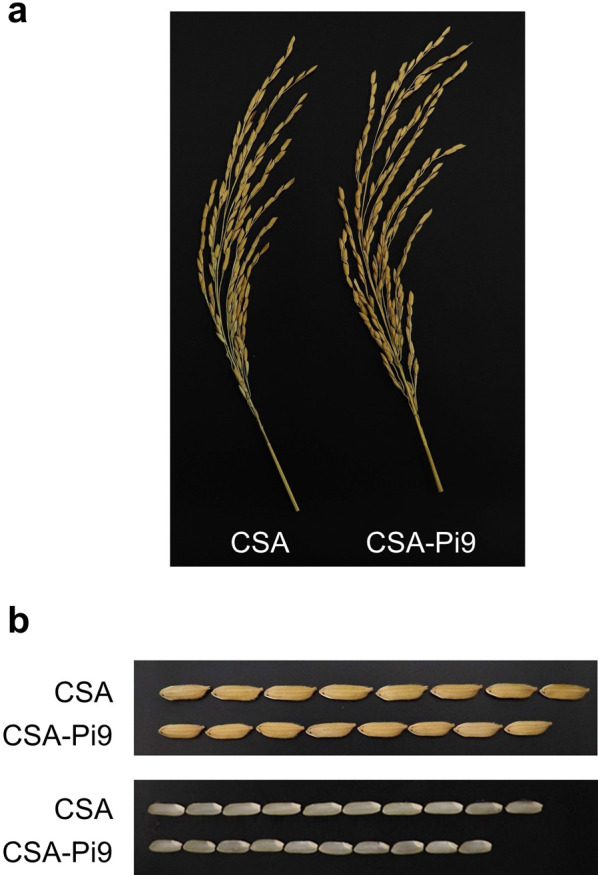
Successful cultivation of rice (Oryza sativa L.) in many Asian countries requires submergence stress tolerance at the germination and early establishment stages. Two quantitative trait loci, Sub1 (conferring submergence tolerance) and AG1 (conferring anaerobic germination), were recently pyramided into a single genetic background, without compromising any desirable agronomic traits, leading to the development of Ciherang-Sub1 + AG1 (CSA). However, little research has been conducted to enhance plant tolerance to abiotic stress (submergence) and biotic stress (rice blast), which occur in a damp climate following flooding. The BC2F5 breeding line was phenotypically characterized using the AvrPi9 isolate. The biotic and abiotic stress tolerance of selected lines was tested under submergence stress and anaerobic germination conditions, and lines tolerant to each stress condition were identified through phenotypic and gene expression analyses. The Ciherang-Sub1 + AG1 + Pi9 (CSA-Pi9) line showed similar agronomic performance to its recurrent parent, CSA, but had significantly reduced chalkiness in field trials conducted in temperate regions. Unexpectedly, the CSA-Pi9 line also showed salinity tolerance. Thus, the breeding line newly developed in this study, CSA-Pi9, functioned under stress conditions, in which Sub1, AG1, and Pi9 play a role and had superior grain quality traits compared to its recurrent parent in temperate regions. We speculate that CSA-Pi9 will enable the establishment of climate-resilient rice cropping systems, particularly in East Asia.
Keywords: AG1; Climate change; Pi9; QTL pyramiding; Rice; Rice blast disease; Sub1.
© 2022. The Author(s).
Conflict of interest statement
The authors declare no conflict of interest.
Figures


References
-
- Alam R, Hummel M, Yeung E, Locke AM, Ignacio JCI, Baltazar MD, Jia Z, Ismail AM, Septiningshi EM, Bailey-Serres J. Flood resilience loci SUBMERGENCE 1 and ANAEROBIC GERMINATION 1 interact in seedlings established underwater. Plant Direct. 2020;4(7):e00240. doi: 10.1002/pld3.240. - DOI - PMC - PubMed
-
- Ali AJ, Xu JL, Ismail AM, Fu BY, Vijaykumar CHM, Gao YM, Domingo J, Maghirang R, Yu SB, Gregorio G, Yanaghihara S, Cohen M, Carmen B, Mackill DJ, Li ZK. Hidden diversity for abiotic and biotic stress tolerances in the primary gene pool of rice revealed by a large backcross breeding program. Field Crop Res. 2006;97(1):66–76. doi: 10.1016/j.fcr.2005.08.016. - DOI
-
- Angaji SA, Septiningsih EM, Mackill DJ, Ismail AM. QTLs associated with tolerance of flooding during germination in rice (Oryza sativa L.) Euphytica. 2010;172(2):159–168. doi: 10.1007/s10681-009-0014-5. - DOI
-
- Arief RW, Asnawi R, Bakrie B. Analysis of physical quality and nutrition of two rice varieties, with the implementation of various planting systems. Curr Agric Res J. 2018;6(1):20. doi: 10.12944/CARJ.6.1.03. - DOI
Grants and funding
LinkOut - more resources
Full Text Sources
Research Materials
