


Microscopic and elemental characterization of hydrated dental pulp capping agents
- PMID: 35399764
- PMCID: PMC8989166
- DOI: 10.4103/jcd.jcd_460_21
Microscopic and elemental characterization of hydrated dental pulp capping agents
Abstract
Context: Characteristics of dental pulp capping agents may influence its interaction with the pulpal cells and can impact the treatment outcome.
Aims: This study aims to microscopically characterize various pulp capping agents following hydration.
Settings and design: Original research.
Materials and methods: Disk-shaped specimens of five calcium silicate-based materials, i.e., mineral trioxide aggregate (MTA) Angelus, Biodentine, TheraCal LC, ApaCal ART, and Endocem MTA were prepared. After final set, the materials were immersed in 10 mL of deionized water for 14 days at 37°C. The set materials were characterized by scanning electron microscopy (SEM), X-ray energy dispersive analysis (EDX), and X-ray diffraction (XRD) analysis along with pH analysis of the storage solution using pH meter.
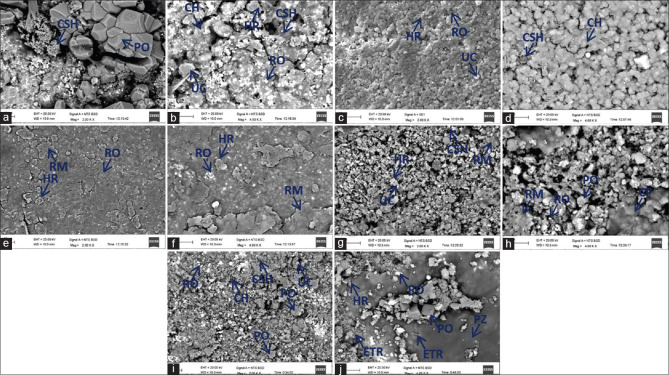
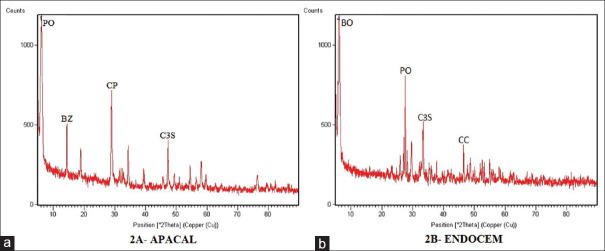
Results: On SEM analysis, all the materials showed crystalline deposition on the cement surface with Biodentine exhibiting the most dense and homogenous microstructure. Calcium-silicate-hydrate and calcium hydroxide (CH) were observed as dark-grey and light-grey matrix material, respectively. EDX analysis revealed a high concentration of calcium. The other major elements were oxygen and carbon. The surface calcium concentration in the tested specimens was as follows: Biodentine (42.59 wt.%) > MTA Angelus (38.51wt.%) > Endocem MTA (30.24wt.%) > TheraCal LC (27.51wt.%) > ApaCal ART (22.02wt.%). On XRD analysis, all the materials exhibited peaks for tricalcium silicate and CH, after 14 days of hydration.
Conclusions: The higher surface calcium level in Biodentine and MTA Angelus may enhance reparative dentin formation. The surface calcium concentration of Endocem MTA and ApaCal ART was found to be lesser than that of MTA Angelus, but with the added advantage of fast-setting property. Hence, they are potential alternative materials for vital pulp therapy.
Keywords: Biodentine; Endocem; TheraCal; dental pulp capping; mineral trioxide aggregate.
Copyright: © 2022 Journal of Conservative Dentistry.
Conflict of interest statement
There are no conflicts of interest.
Figures
References
-
- Simon S, Perard M, Zanini M, Smith AJ, Charpentier E, Djole SX, et al. Should pulp chamber pulpotomy be seen as a permanent treatment. Some preliminary thoughts? Int Endod J. 2013;46:79–87. - PubMed
-
- Schmalz G, Smith AJ. Pulp development, repair, and regeneration: Challenges of the transition from traditional dentistry to biologically based therapies. J Endod. 2014;40:S2–5. - PubMed
-
- Prati C, Gandolfi MG. Calcium silicate bioactive cements: Biological perspectives and clinical applications. Dent Mater. 2015;31:351–70. - PubMed
-
- Taha NA, Khazali MA. Partial pulpotomy in mature permanent teeth with clinical signs indicative of irreversible pulpitis: A randomized clinical trial. J Endod. 2017;43:1417–21. - PubMed
-
- Parirokh M, Torabinejad M. Mineral trioxide aggregate: A comprehensive literature review-part III: Clinical applications, drawbacks, and mechanism of action. J Endod. 2010;36:400–13. - PubMed
LinkOut - more resources
Full Text Sources