


Word's Predictability Can Modulate Semantic Preview Effect in High-Constraint Sentences
- PMID: 35401306
- PMCID: PMC8984147
- DOI: 10.3389/fpsyg.2022.849351
Word's Predictability Can Modulate Semantic Preview Effect in High-Constraint Sentences
Abstract
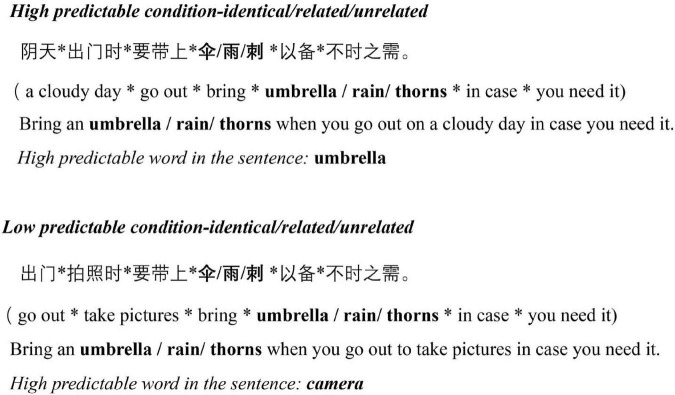
The processing of words in sentence reading is influenced by both information from sentential context (the effect of predictability) and information from previewing upcoming words (the preview effect), but how both effects interact during online reading is not clear. In this study, we tested the interaction of predictability effect and the preview effect in predicting reading processing. In the experiment, sentence constraint was controlled using all high-constraint sentences as materials. We manipulated both the predictability of the target word in the sentence and the semantic relationship between the preview word and the target word as predictors of the semantic preview effect. The results showed that the semantic preview effect was present only when the target word had low-predictability in the sentence but was not observed when the target word had high-predictability in the sentence. The results suggest that contextual information in reading can modulate the pre-activation of words and thus influence whether the preview word has a priming effect. The results of this study provide further evidence that reading comprehension involves an interactive system of processing multiple sources of information at multiple levels.
Keywords: contextual constraint; eye-tracking; predictability; preview; semantic.
Copyright © 2022 Xu, Liu, Wang, Sun and Li.
Conflict of interest statement
The authors declare that the research was conducted in the absence of any commercial or financial relationships that could be construed as a potential conflict of interest.
Figures
References
-
- Albrecht J. E., O’Brien E. J. (1993). Updating a mental model: maintaining both local and global coherence. J. Exp. Psychol.: Learn. 19 1061–1070.
-
- Brauer M., Judd C. M. (2000). Defining variables in relationship to other variables: when interactions suddenly turn out to be main effects. J. Exp. Soc. Psychol. 36 410–423. 10.1006/jesp.2000.1420 - DOI
LinkOut - more resources
Full Text Sources
