


A Study of Subliminal Emotion Classification Based on Entropy Features
- PMID: 35401346
- PMCID: PMC8989849
- DOI: 10.3389/fpsyg.2022.781448
A Study of Subliminal Emotion Classification Based on Entropy Features
Abstract
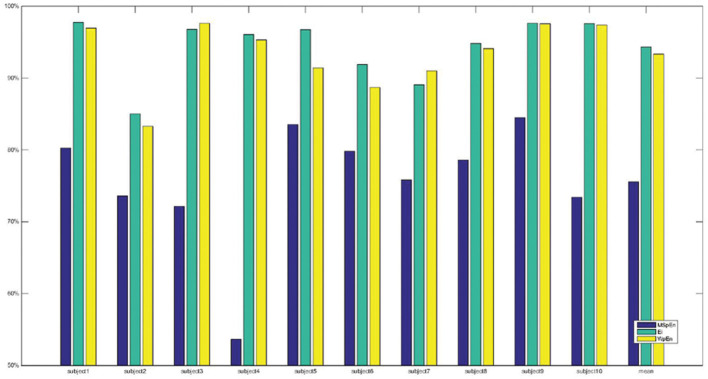
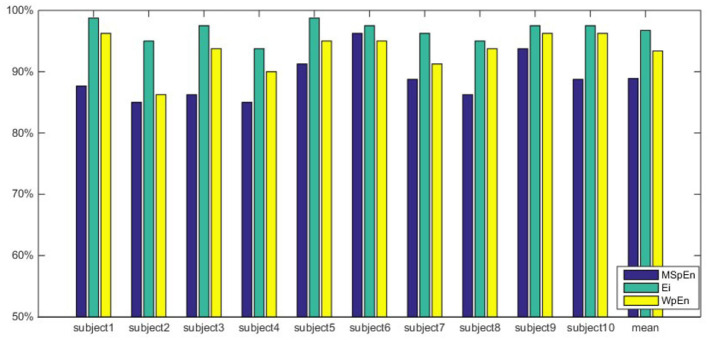
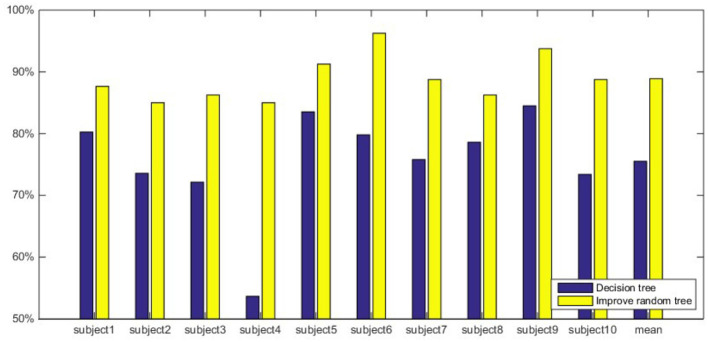
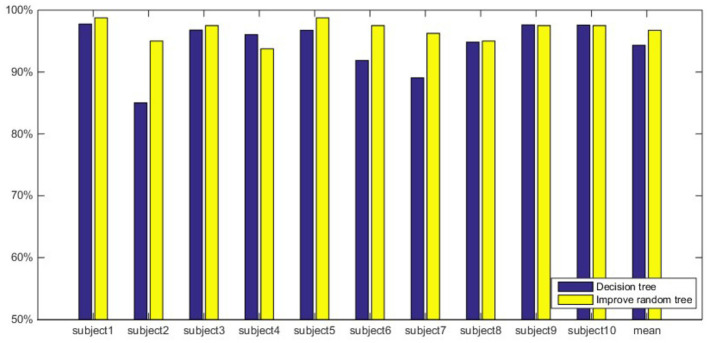
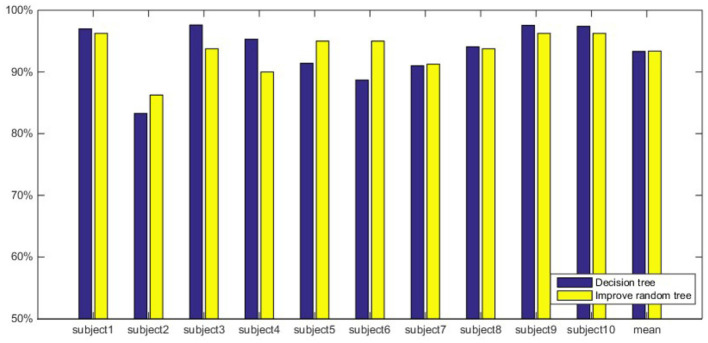
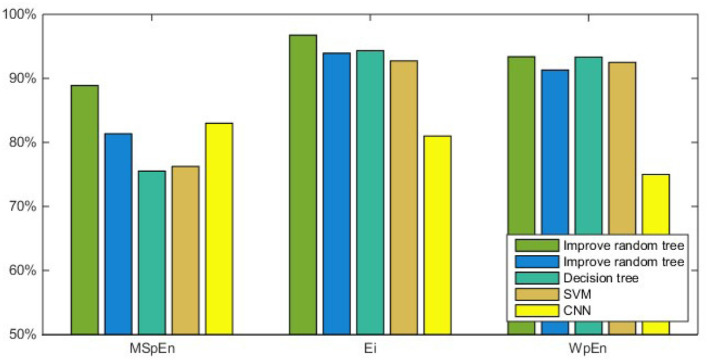
Electroencephalogram (EEG) has been widely utilized in emotion recognition. Psychologists have found that emotions can be divided into conscious emotion and unconscious emotion. In this article, we explore to classify subliminal emotions (happiness and anger) with EEG signals elicited by subliminal face stimulation, that is to select appropriate features to classify subliminal emotions. First, multi-scale sample entropy (MSpEn), wavelet packet energy (E i ), and wavelet packet entropy (WpEn) of EEG signals are extracted. Then, these features are fed into the decision tree and improved random forest, respectively. The classification accuracy with E i and WpEn is higher than MSpEn, which shows that E i and WpEn can be used as effective features to classify subliminal emotions. We compared the classification results of different features combined with the decision tree algorithm and the improved random forest algorithm. The experimental results indicate that the improved random forest algorithm attains the best classification accuracy for subliminal emotions. Finally, subliminal emotions and physiological proof of subliminal affective priming effect are discussed.
Keywords: EEG; feature extraction; improved random forest; subliminal emotion; subliminal emotion classification.
Copyright © 2022 Shi, Zheng, Zhang, Yan, Li and Yu.
Conflict of interest statement
The authors declare that the research was conducted in the absence of any commercial or financial relationships that could be construed as a potential conflict of interest.
Figures

References
-
- Bajaj V., Pachori R. B. (2014). Human emotion classification from eeg signals using multiwavelet transform, in International Conference on Medical Biometrics (Shenzhen: ).
-
- Bhatti A. M., Majid M., Anwar S. M., Khan B. (2016). Human emotion recognition and analysis in response to audio music using brain signals. Comput. Hum. Behav. 65, 267–275. 10.1016/j.chb.2016.08.029 - DOI
-
- Bo S.. (2017). Research on the classification of high dimensional imbalanced data based on the optimizational random forest algorithm, in International Conference on Measuring Technology & Mechatronics Automation (New York, NY: ).
LinkOut - more resources
Full Text Sources
