


How Classy Servant Leader at Workplace? Linking Servant Leadership and Task Performance During the COVID-19 Crisis: A Moderation and Mediation Approach
- PMID: 35401384
- PMCID: PMC8984191
- DOI: 10.3389/fpsyg.2022.810227
How Classy Servant Leader at Workplace? Linking Servant Leadership and Task Performance During the COVID-19 Crisis: A Moderation and Mediation Approach
Abstract
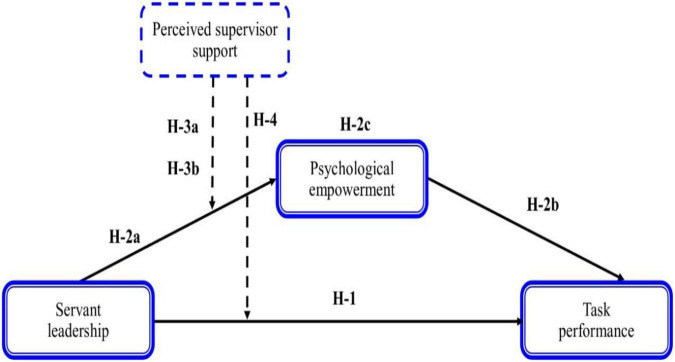
The COVID-19 pandemic has caused a record global crisis, particularly and extremely, for the service sectors. Due to extensive security measures, many service sector employees have to work remotely to maintain services. Drawing upon the conservation of resources theory, this research investigates the impact of servant leadership on the task performance of employees in virtual working environments during the COVID-19 crisis. Our theoretical model was tested using data collected from 335 individual employees in the education sector of Pakistan. SPSS version 26.0 was applied to find the hypothesized relationship between the study variables. To find the indirect mediating effect, we applied Model 4; for moderation, we applied Model 1; and for the moderation and mediation effect, we applied Model 7 of the Process Macro model of Hayes. The results of the study revealed that servant leadership is positively related to task performance in a virtual environment during crises. Furthermore, psychological empowerment partially mediates the relationship between servant leadership and task performance. Perceived supervisor support positively moderates the relationship between servant leadership and task performance. Moreover, the indirect effect of servant leadership on task performance via psychological empowerment is moderated by perceived supervisor support. The results provided guidance to the educational sector on how to lead effectively in times of crisis when service sector employees work predominantly in virtual environments. The theoretical and practical implications of these findings are discussed.
Keywords: COVID-19; crisis; perceived supervisor support; psychological empowerment; servant leadership; task performance; virtual work environment.
Copyright © 2022 Zada, Zada, Ali, Jun, Contreras-Barraza and Castillo.
Conflict of interest statement
The authors declare that the research was conducted in the absence of any commercial or financial relationships that could be construed as a potential conflict of interest.
Figures


References
-
- Aboramadan M. (2020). Servant leadership and followers’ creativity: does climate for creativity matter? Evid. Based HRM Glob. Forum Empirical Scholarsh. 9 1–17.
-
- Aboramadan M., Dahleez K. A. (2021). The impact of perceived servant leadership traits and safety climate on task performance and risk-taking behavior in times of crisis. Leadersh. Health Serv. 10.1108/LHS-05-2021-0049 [Epub ahead of print]. - DOI
-
- Aboramadan M., Dahleez K., Hamad M. H. (2020). Servant leadership and academics outcomes in higher education: the role of job satisfaction. Int. J. Org. Anal. 29 562–584.
-
- Aga D. A., Noorderhaven N., Vallejo B. (2016). Transformational leadership and project success: the mediating role of team-building. Int. J. Project Manage. 34 806–818.
-
- Alavi S., Habel J., Guenzi P., Wieseke J. (2018). The role of leadership in salespeople’s price negotiation behavior. J. Acad. Market. Sci. 46 703–724. 10.1007/s11747-017-0566-1 - DOI
LinkOut - more resources
Full Text Sources
