. 2022 Mar 23:13:845882.
doi: 10.3389/fimmu.2022.845882. eCollection 2022.

Development of Potent Cellular and Humoral Immune Responses in Long-Term Hemodialysis Patients After 1273-mRNA SARS-CoV-2 Vaccination

Affiliations

Development of Potent Cellular and Humoral Immune Responses in Long-Term Hemodialysis Patients After 1273-mRNA SARS-CoV-2 Vaccination

Maria Gonzalez-Perez et al. Front Immunol. .

Abstract

Long-term hemodialysis (HD) patients are considered vulnerable and at high-risk of developing severe acute respiratory syndrome coronavirus type 2 (SARS-CoV-2) infection due to their immunocompromised condition. Since COVID-19 associated mortality rates are higher in HD patients, vaccination is critical to protect them. The response towards vaccination against COVID-19 in HD patients is still uncertain and, in particular the cellular immune response is not fully understood. We monitored the humoral and cellular immune responses by analysis of the serological responses and Spike-specific cellular immunity in COVID-19-recovered and naïve HD patients in a longitudinal study shortly after vaccination to determine the protective effects of 1273-mRNA vaccination against SARS-CoV-2 in these high-risk patients. In naïve HD patients, the cellular immune response measured by IL-2 and IFN-ɣ secretion needed a second vaccine dose to significantly increase, with a similar pattern for the humoral response. In contrast, COVID-19 recovered HD patients developed a potent and rapid cellular and humoral immune response after the first vaccine dose. Interestingly, when comparing COVID-19 recovered healthy volunteers (HV), previously vaccinated with BNT162b2 vaccine to HD patients vaccinated with 1273-mRNA, these exhibited a more robust immune response that is maintained longitudinally. Our results indicate that HD patients develop strong cellular and humoral immune responses to 1273-mRNA vaccination and argue in favor of personalized immune monitoring studies in HD patients, especially if COVID-19 pre-exposed, to adapt COVID-19 vaccination protocols for this immunocompromised population.

Keywords: COVID-19; SARS-CoV-2 vaccine; cellular response; chronic kidney disease; hemodialysis; humoral response.


Conflict of interest statement

The authors declare that the research was conducted in the absence of any commercial or financial relationships that could be construed as a potential conflict of interest.

Figures
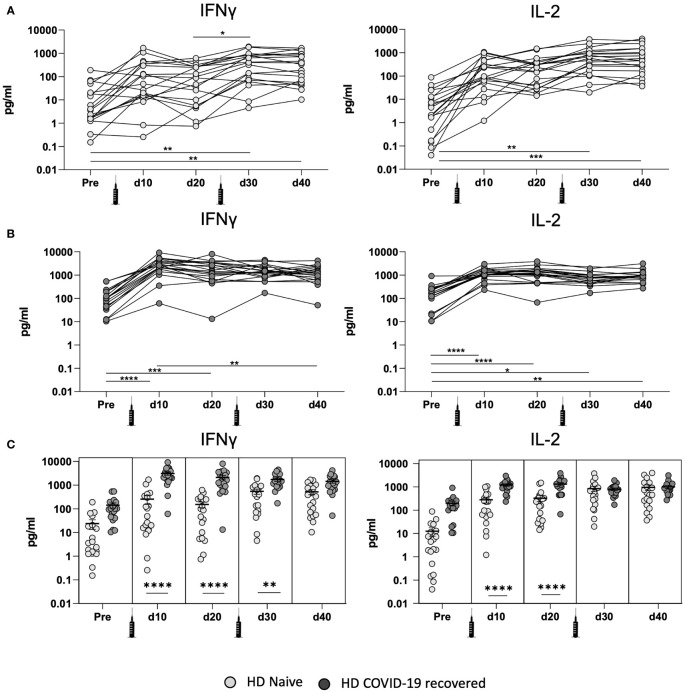
Figure 1
Figure 1
Development of cellular immunity after mRNA-1273 vaccination in COVID-19 recovered and naïve HD patients. (A) Quantification of IFN-ɣ and IL-2 production in the whole blood by naive HD patient cells at different time points: before vaccination (pre), after the first (d10 and d20) and second (d30 and d40) mRNA vaccine dose. (B) Quantification of IFN-ɣ and IL-2 production in the whole blood by COVID-19 recovered HD patient cells at different time points. (C) Comparison of IFN-ɣ and IL-2 production between naïve and COVID-19 recovered HD patients. All samples were analyzed after overnight stimulation of whole blood with SARS-CoV-2 peptide pools. IFN-ɣ and IL-2 levels were determined using ELLA single plex cartridges (n= 39; 19 naïve HD patients and 20 COVID-19 recovered HD patients). Values higher than 32.7 pg/ml and 36.8 pg/ml were considered positive for IL-2 in naïve HV and HD patients, respectively. Values higher than 9.0 pg/ml and 27.6 pg/ml were considered positive for IFN-ɣ in naïve HV and HD patients. * <0.05, ** <0.005, *** <0.0005, **** <0.0001.
Figure 2
Figure 2
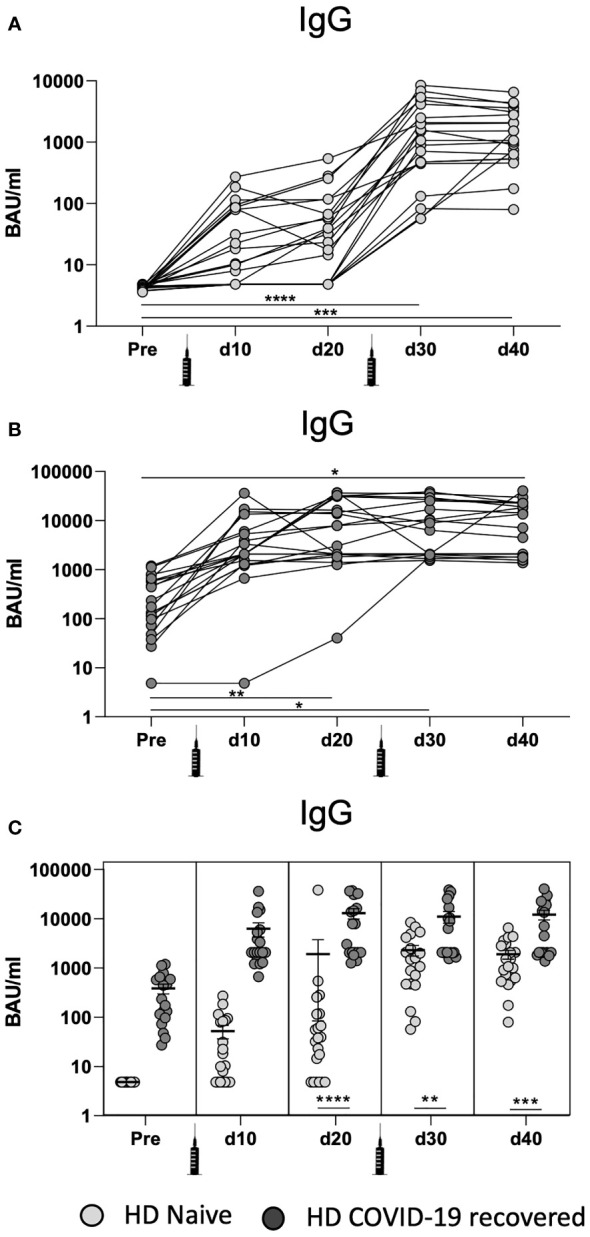
Development of humoral responses after mRNA-1273 vaccination in COVID-19 recovered and naïve HD patients. (A) Quantification of SARS-CoV-2 spike-specific IgG serum levels in naive HD patients at different time points: before vaccination (pre), after the first (d10 and d20) and second (d30 and d40) mRNA vaccine dose. (B) Quantification of SARS-CoV-2 spike-specific IgG serum levels in COVID-19 recovered HD patients at different time points. (C) Comparison of SARS-CoV-2 spike-specific IgG serum levels in naïve and COVID-19 recovered HD patients. Samples were measured with Liaison ® SARS-CoV-2 TrimetricS IgG assay. Values higher than 33.8 BAU/ml were considered positive. * <0.05, ** <0.005, *** <0.0005, **** <0.0001.
Figure 3
Figure 3
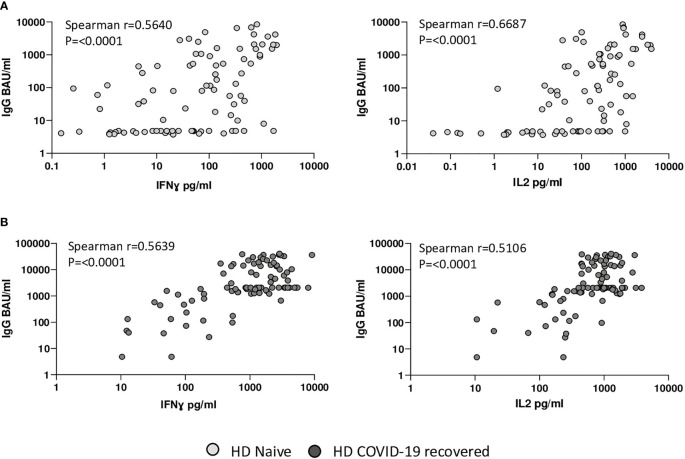
Relationship between cellular and humoral immune response in naïve and COVID-19 recovered HD patients. (A) Correlation between IFN-ɣ and IL-2 levels and SARS-CoV-2 spike-specific IgG serum levels in naïve HD patients. (B) Correlation between IFN-ɣ and IL-2 levels and of SARS-CoV-2 spike-specific IgG serum levels in COVID-19 recovered HD patients. Figure shows all data points available from any time point for all patients.
Figure 4
Figure 4
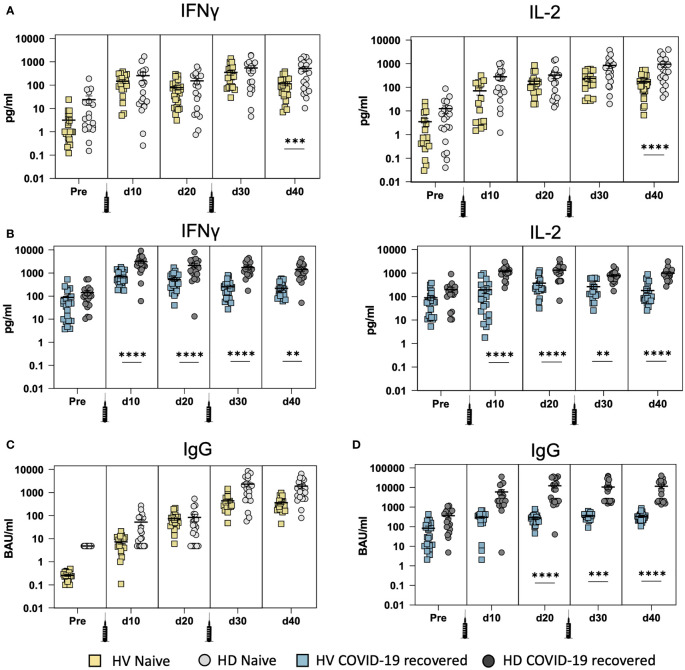
Development of cellular and humoral immunity after SARS-CoV-2 vaccination in COVID-19 recovered and naïve hemodialysis (HD) patients vaccinated with mRNA-1273 vaccine (100 µg/dose) and in healthy volunteers (HV) vaccinated with BNT162b2 (30 µg/dose). (A) Comparison of IFN-ɣ and IL-2 production between naïve HD patients and HV at different time points: before vaccination (pre), after the first (d10 and d20) and second (d30 and d40) mRNA vaccine dose. (B) Comparison of IFN-ɣ and IL-2 production in COVID-19 recovered HD patients and HV at different time points. (C) Comparison of SARS-CoV-2 spike-specific IgG serum levels in naïve HD patients and HV. (D) Comparison of SARS-CoV-2 spike-specific IgG serum levels in COVID-19 recovered HD patients and HV. ** <0.005, *** <0.0005, **** <0.0001.

References

    1. Sim JJ, Huang CW, Selevan DC, Chung J, Rutkowski MP, Zhou H. COVID-19 and Survival in Maintenance Dialysis. Kidney Med (2021) 3(1):132–5. doi: 10.1016/j.xkme.2020.11.005 - DOI - PMC - PubMed
    1. Alberto Ortiz M, Cozzolino RD, Duivenvoorden R, Fliser D, Fouque D, Franssen CFM, et al. Chronic Kidney Disease is a Key Risk Factor for Severe COVID-19: A Call to Action by the ERA-EDTA. Nephrol Dial Transplant (2021) 36(1):87–94. doi: 10.1093/ndt/gfaa314 - DOI - PMC - PubMed
    1. Labriola L, Scohy A, Seghers F, Perlot Q, De Greef J, Desmet C, et al. A Longitudinal, 3-Month Serologic Assessment of SARS-CoV-2 Infections in a Belgian Hemodialysis Facility. Clin J Am Soc Nephrol (2021) 16:613–4. doi: 10.2215/CJN.12490720 - DOI - PMC - PubMed
    1. Aydin Bahat K, Parmaksiz E, Sert S. The Clinical Characteristics and Course of COVID-19 in Hemodialysis Patients. Hemodial Int (2020) 24(4):534–40. doi: 10.1111/hdi.12861 - DOI - PubMed
    1. Sánchez-Álvarez JE, Pérez Fontán M, Jiménez Martín C, Blasco Pelícano M, Cabezas Reina CJ, Sevillano Prieto ÁM, et al. SARS-CoV-2 Infection in Patients on Renal Replacement Therapy. Report of the COVID-19 Registry of the Spanish Society of Nephrology (SEN). Nefrologia (Engl Ed) (2020) 40(3):272–8. doi: 10.1016/j.nefro.2020.04.002 - DOI - PMC - PubMed

Publication types