


Crossing double stent retriever technique for refractory terminal internal carotid artery occlusion
- PMID: 35401893
- PMCID: PMC8990047
- DOI: 10.1016/j.radcr.2022.03.023
Crossing double stent retriever technique for refractory terminal internal carotid artery occlusion
Erratum in
-
Erratum to "Crossing double stent retriever technique for refractory terminal internal carotid artery occlusion" [Radiology Case Reports 17 (2022) 1848-1852].Radiol Case Rep. 2024 Jan 12;19(4):1658. doi: 10.1016/j.radcr.2023.12.036. eCollection 2024 Apr. Radiol Case Rep. 2024. PMID: 38463690 Free PMC article.
Abstract
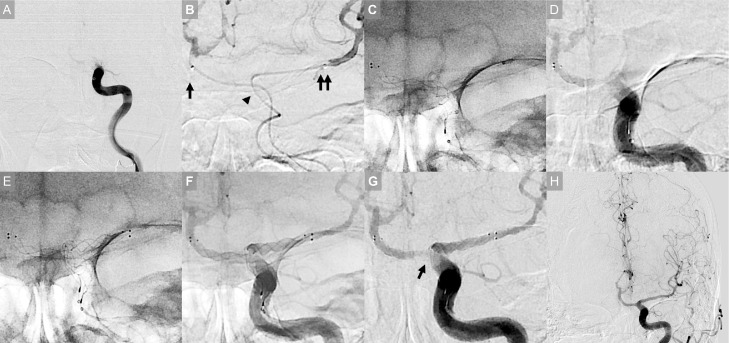
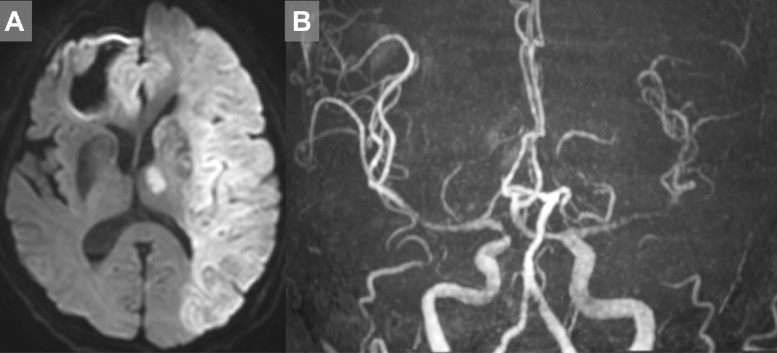
Mechanical thrombectomy is highly effective for the recovery of acute ischemic stroke with large vessel occlusion. However, refractory occlusions are still encountered despite the use of currently available devices. In this article, we present a case of refractory terminal internal carotid artery occlusion treated with the "crossing double stent retriever technique." Two thrombectomy procedures with the combined technique using a stent retriever and aspiration catheter failed to recanalize the terminal internal carotid artery occlusion that involved the dominant anterior cerebral artery. We then applied the crossing double stent retriever technique as a rescue technique. Two microcatheters were advanced across the occlusion: one to the anterior cerebral artery and the other to the middle cerebral artery. First, a Trevo NXT 4 mm stent retriever was deployed from the anterior cerebral artery. Next, an additional Trevo NXT 4 mm stent retriever was deployed from the middle cerebral artery, and full immediate restoration of flow was achieved on angiography. Intraprocedural radiological images showed that the 2 microcatheters traversed different pathways, and the 2 stent retrievers completely covered the entire vessel with apparent in-stent clot sign. Both stent retrievers were then pulled back together, and a hard clot was retrieved. Subsequent angiography revealed complete recanalization. The crossing double stent retriever technique seems an effective rescue technique for treating refractory terminal internal carotid artery occlusion, especially with the anatomical feature of branching of the dominant anterior cerebral artery. This technique can facilitate the device-clot-vessel interaction by engaging the clot via 2 different device pathways.
Keywords: ACA, anterior cerebral artery; Acute ischemic stroke; Device-clot-vessel interaction; Endovascular treatment; ICA, internal carotid artery; Large vessel occlusion; MRI, magnetic resonance imaging; MT, mechanical thrombectomy; Mechanical thrombectomy; SR, stent retriever; Stent retriever.
© 2022 The Authors. Published by Elsevier Inc. on behalf of University of Washington.
Figures


References
-
- Okada H, Matsuda Y, Chung J, Crowley RW, Lopes DK. Utility of a Y-configured stentriever technique as a rescue method of thrombectomy for an intractable rooted thrombus located on the middle cerebral artery bifurcation. Neurosurg Focus. 2017;42:E17. - PubMed
Publication types
LinkOut - more resources
Full Text Sources
Research Materials
Miscellaneous
