


Preoperative Prediction of Central Cervical Lymph Node Metastasis in Fine-Needle Aspiration Reporting Suspicious Papillary Thyroid Cancer or Papillary Thyroid Cancer Without Lateral Neck Metastasis
- PMID: 35402238
- PMCID: PMC8983925
- DOI: 10.3389/fonc.2022.712723
Preoperative Prediction of Central Cervical Lymph Node Metastasis in Fine-Needle Aspiration Reporting Suspicious Papillary Thyroid Cancer or Papillary Thyroid Cancer Without Lateral Neck Metastasis
Abstract
Purpose: No non-invasive method can accurately determine the presence of central cervical lymph node (CCLN) metastasis in papillary thyroid cancer (PTC) until now. This study aimed to investigate factors significantly associated with CCLN metastasis and then develop a model to preoperatively predict CCLN metastasis in fine-needle aspiration (FNA) reporting suspicious papillary thyroid cancer (PTC) or PTC without lateral neck metastasis.
Patients and methods: Consecutive inpatients who were diagnosed as suspicious PTC or PTC in FNA and underwent partial or total thyroidectomy and CCLN dissection between May 1st, 2016 and June 30th, 2018 were included. The total eligible patients were randomly divided into a training set and an internal validation set with the ratio of 7:3. Univariate analysis and multivariate analysis were conducted in the training set to investigate factors associated with CCLN metastasis. The predicting model was built with factors significantly correlated with CCLN metastasis and validated in the validation set.
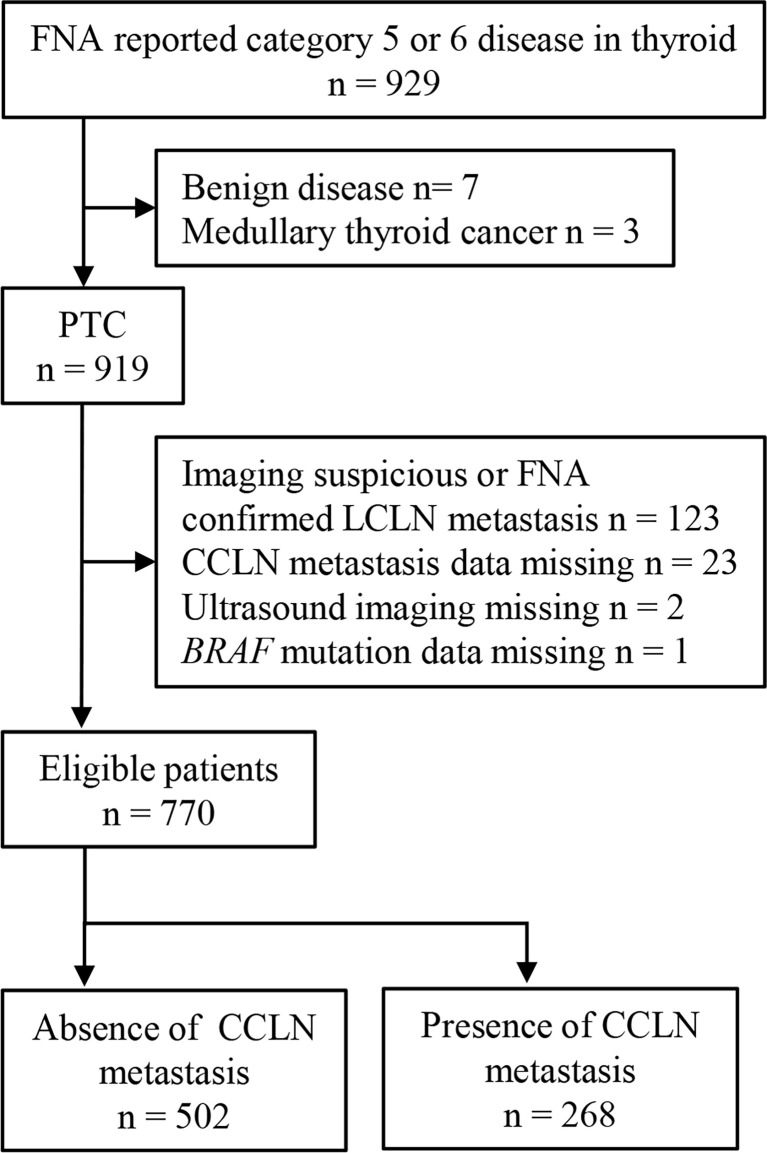
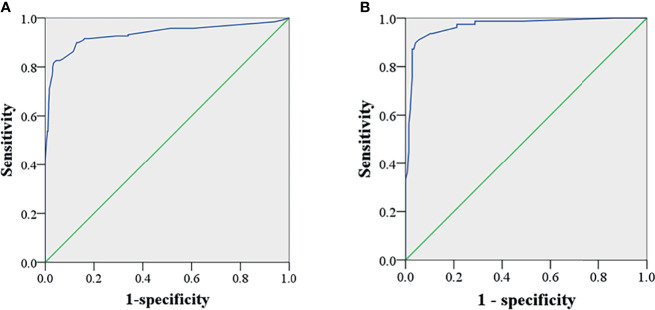
Results: A total of 770 patients were eligible in this study. Among them, 268 patients had histologically confirmed CCLN metastasis, while the remaining patients did not. Factors including age, BRAF mutation, multifocality, size, and capsule involvement were found to be significantly correlated with the CCLN metastasis in univariate and multivariate analysis. A model used to predict the presence CCLN metastasis based on these factors and US CCLN status yielded AUC, sensitivity, specificity and accuracy of 0.933 (95%CI: 0.905-0.960, p < 0.001), 0.816, 0.966 and 0.914 in the training set and 0.967 (95%CI: 0.943-0.991, p < 0.001), 0.897, 0.959 and 0.936 in the internal validation set.
Conclusion: Age, BRAF mutation, multifocality, size, and capsule involvement were independent predictors of CCLN metastasis in FNA reporting suspicious PTC or PTC without lateral neck metastasis. A simple model was successfully built and showed excellent discrimination to distinguish patients with or without CCLN metastasis.
Keywords: central neck dissection; cervical lymph node; lymph node metastasis; papillary thyroid cancer; thyroid cancer.
Copyright © 2022 Zhang, Qian, Chen, Zhu and Chang.
Conflict of interest statement
The authors declare that the research was conducted in the absence of any commercial or financial relationships that could be construed as a potential conflict of interest.
Figures
References
-
- Randolph GW, Duh QY, Heller KS, LiVolsi VA, Mandel SJ, Steward DL, et al. . The Prognostic Significance of Nodal Metastases From Papillary Thyroid Carcinoma Can be Stratified Based on the Size and Number of Metastatic Lymph Nodes, as Well as the Presence of Extranodal Extension. Thyroid Off J Am Thyroid Assoc (2012) 22(11):1144–52. doi: 10.1089/thy.2012.0043 - DOI - PubMed
-
- Adam MA, Pura J, Goffredo P, Dinan MA, Reed SD, Scheri RP, et al. . Presence and Number of Lymph Node Metastases Are Associated With Compromised Survival for Patients Younger Than Age 45 Years With Papillary Thyroid Cancer. J Clin Oncol Off J Am Soc Clin Oncol (2015) 33(21):2370–5. doi: 10.1200/JCO.2014.59.8391 - DOI - PubMed
LinkOut - more resources
Full Text Sources
Research Materials
