. 2024 Jan;14(1):56-66.
doi: 10.1177/21925682221094265. Epub 2022 Apr 9.

The Effect of Preoperative Cervical Spondylosis on Heterotopic Ossification After Cervical Disc Replacement

Affiliations

The Effect of Preoperative Cervical Spondylosis on Heterotopic Ossification After Cervical Disc Replacement

Yi-Wei Shen et al. Global Spine J. 2024 Jan.

Abstract

Study design: Retrospective cohort study.

Objectives: This study aimed to explore the effect of preoperative cervical spondylosis on the heterotopic ossification (HO) formation in different locations after cervical disc replacement (CDR).

Methods: The degree of preoperative cervical spondylosis was evaluated radiologically, including the intervertebral disc, uncovertebral joints, facet joints and ligaments. The effects of cervical spondylosis on the HO formation after CDR were analyzed according to the location of HO. Multivariate logistic regression was performed to identify the independent factors.

Results: 149 patients with a total of 196 arthroplasty segments were involved in this study. HO, anterior HO (AHO), and posterior HO (PHO) developed in 59.69%, 22.96%, and 41.84% levels, respectively. The significant factors in univariate analysis for PHO after CDR included the disc height loss, anterior osteophytes, preoperative uncovertebral joint osteophytes and facet joint degeneration. The incidence of adjacent segment degeneration (ASD) was significantly higher in the PHO group compared to that without PHO at the last follow-up (P = .003). The disc height loss in high-grade HO was significantly more than that in low-grade group (P = .039). Multivariate analysis identified disc height loss was the only independent factor for PHO (P = .009). No significant degenerative factors related to the formation of AHO were found.

Conclusions: Preoperative cervical spondylosis predominantly affected the HO formation in the posterior disc space after CDR. The disc height loss was an independent risk factor for PHO formation. Rigorous criteria for the extent of preoperative disc height loss should be used when selecting appropriate candidates for CDR.

Keywords: cervical disc replacement; cervical spondylosis; heterotopic ossification; intervertebral disc height.


Conflict of interest statement

Declaration of Conflicting InterestsThe author(s) declared no potential conflicts of interest with respect to the research, authorship, and/or publication of this article.

Figures
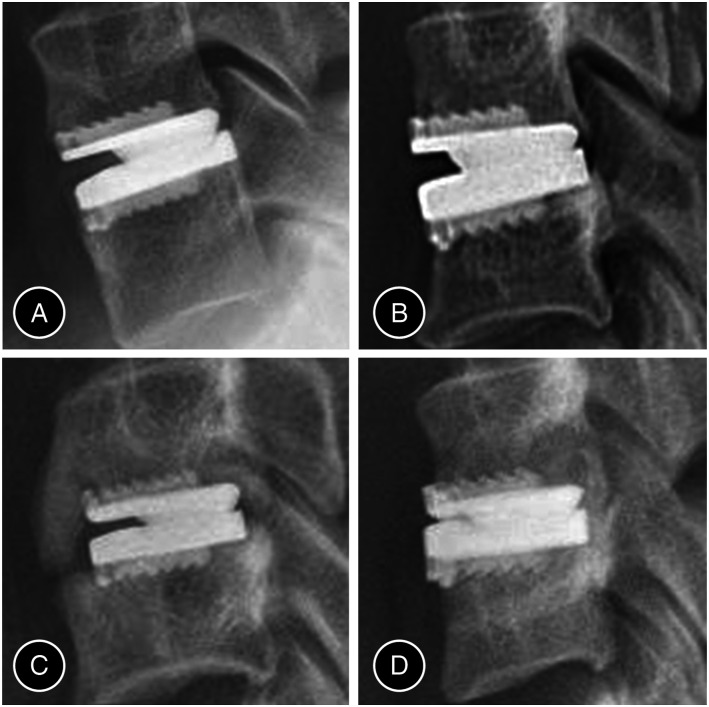
Figure 1.
Figure 1.
Low-grade heterotopic ossification (HO): anterior HO (AHO) (A) and posterior HO (PHO) (B). High-grade HO: both AHO and PHO (C), and PHO (D). Abbreviation: HO, heterotopic ossification; AHO, anterior heterotopic ossification, PHO, posterior heterotopic ossification.
Figure 2.
Figure 2.
A 46-year-old woman who underwent cervical disc replacement using Prestige-LP at the C5/6 level. The preoperative lateral radiograph showed that a decreased intervertebral disc height, anterior osteophyte and ossification of anterior longitudinal ligament (OALL) at C5/6 level (A). The preoperative coronal reconstruction computed tomography (CT) images indicated the uncovertebral joint osteophyte (B). The preoperative magnetic resonance image (MRI) showed cervical spondylosis at the C5/6 level (C). One week postoperatively, lateral radiograph showed cervical disc replacement at C5/6 level (D). At 50 months follow-up, neutral X-ray (E), magnified view of C5/6 region (F) and dynamic X-rays indicated low-grade posterior heterotopic ossification at the C5/6 level and the range of motion of the prosthesis was 13.19° (G and H).
Figure 3.
Figure 3.
A 52-year-old man who underwent cervical disc replacement using Prestige-LP at the C5/6 level. The preoperative lateral radiograph showed that a decreased intervertebral disc height, anterior osteophyte and ossification of anterior longitudinal ligament at C5/6 level (A). The preoperative coronal reconstruction computed tomograph images indicated the uncovertebral joint osteophyte (B). The preoperative MRI showed cervical spondylosis at the C5/6 level (C). One week postoperatively, lateral radiograph showed cervical disc replacement at C5/6 level (D). At 40 months follow-up, neutral X-ray (E), magnified view of C5/6 region (F) and dynamic X-rays (G and H) indicated high-grade posterior heterotopic ossification at the C5/6 level with limited prosthesis mobility and newly formed anterior osteophytes at caudal adjacent segment. The range of motion of the prosthesis was 3.07°.

References

    1. Gornet MF, Burkus JK, Shaffrey ME, Schranck FW, Copay AG. Cervical disc arthroplasty: 10-year outcomes of the Prestige LP cervical disc at a single level. J Neurosurg Spine. 2019;31(3):317-325. doi: 10.3171/2019.2.Spine1956. - DOI - PubMed
    1. Kim K, Hoffman G, Bae H, et al. Ten-year outcomes of 1- and 2-level cervical disc arthroplasty from the mobi-c investigational device exemption clinical trial. Neurosurgery . 2021;88(3):497-505. doi: 10.1093/neuros/nyaa459. - DOI - PubMed
    1. Zhang X, Zhang X, Chen C, et al. Randomized, controlled, multicenter, clinical trial comparing BRYAN cervical disc arthroplasty with anterior cervical decompression and fusion in China. Spine. 2012;37(6):433-438. doi: 10.1097/BRS.0b013e31822699fa. - DOI - PubMed
    1. Parkinson JF, Sekhon LHS. Cervical arthroplasty complicated by delayed spontaneous fusion. Case report. J Neurosurg Spine . 2005;2(3):377-380. doi: 10.3171/spi.2005.2.3.0377. - DOI - PubMed
    1. Theodore N. Degenerative cervical spondylosis. N Engl J Med . 2020;383(2):159-168. doi: 10.1056/NEJMra2003558. - DOI - PubMed
