


doi: 10.4244/EIJ-D-21-01021.
Mechanisms of ineffective patent foramen ovale closure using the percutaneous suture-mediated NobleStitch system
Affiliations
- PMID: 35403602
- PMCID: PMC9903156
- DOI: 10.4244/EIJ-D-21-01021
Item in Clipboard
Mechanisms of ineffective patent foramen ovale closure using the percutaneous suture-mediated NobleStitch system
EuroIntervention.
.
No abstract available
Conflict of interest statement
The authors have no conflicts of interest to declare.
Figures
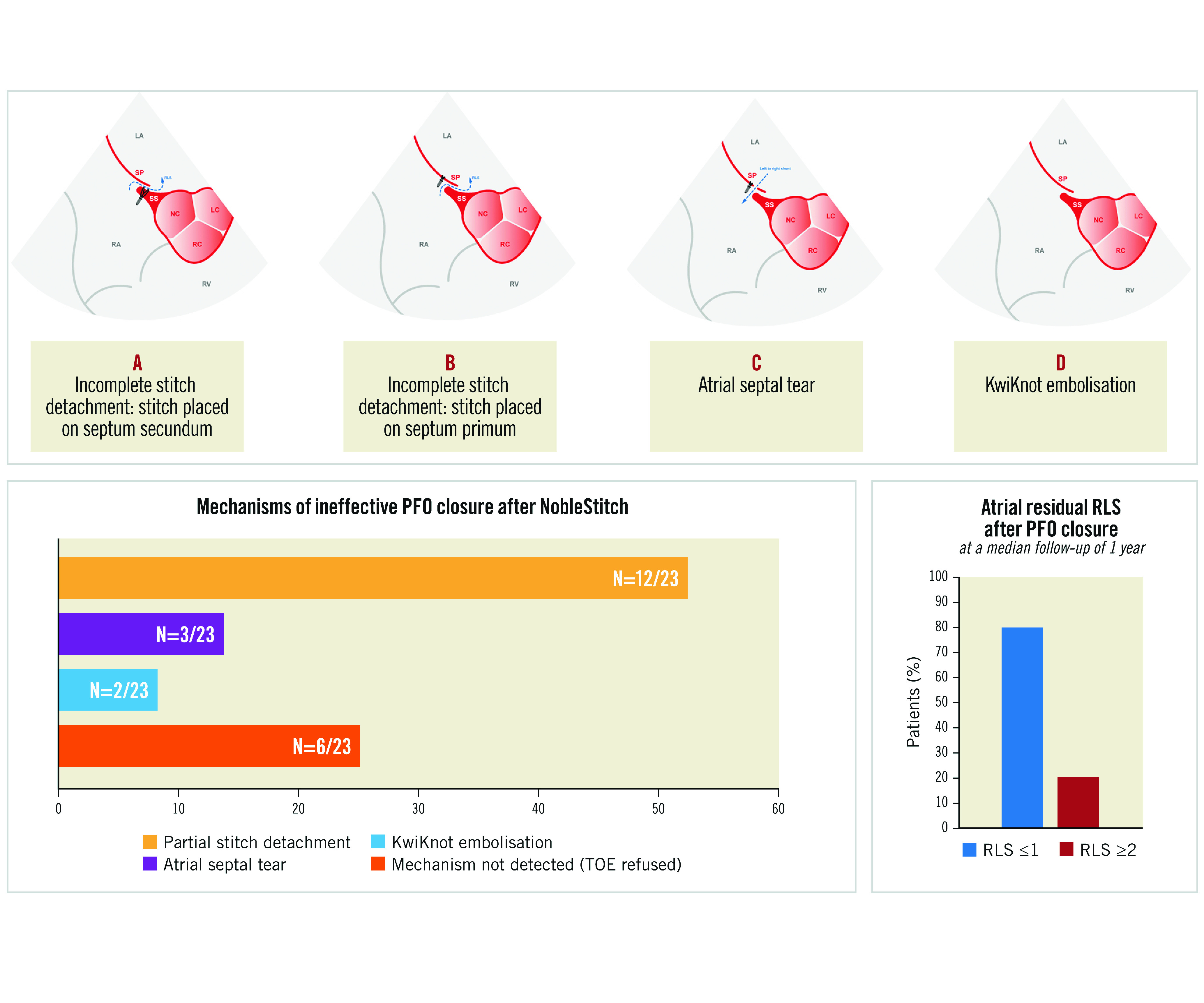
A. Incomplete stitch detachment: one of the most frequently identified mechanisms of ineffective PFO closure was partial stitch detachment with opening of the foramen ovale and right-to-left passage of microbubbles at bubble test. In this case the stitch is placed only on the septum secundum; B. Incomplete stitch detachment: the same mechanism described in (A) but in this case the NobleStitch was found on the septum primum resulting in recurrent atrial shunt; C. Atrial septal tear: a new atrial septal tear occurred very close to the stitch after the NobleStitch procedure causing a left-to-right shunt; D. KwiKnot embolisation: complete detachment of the stitch and the KwiKnot into the pulmonary circulation resulting in PFO reopening. PFO: patent foramen ovale; RLS: right-to-left shunt; TOE: transoesophageal echocardiography
References
-
- Gaspardone A, De Marco, Sgueglia GA, De Santis, Iamele M, D’Ascoli E, Tusa M, Corciu AI, Mullen M, Nobles A, Carminati M, Bedogni F. Novel percutaneous suture-mediated patent foramen ovale closure technique: early results of the NobleStitch EL Italian Registry. EuroIntervention. 2018;14:e272–9. - PubMed
-
- Gaspardone A, Sgueglia GA, De Santis, D’Ascoli E, Iamele M, Piccioni F, Giannico B, D’Errico F, Gioffrè G, Summaria F, Gaspardone C, Versaci F. Predictors of Residual Right-to-Left Shunt After Percutaneous Suture-Mediated Patent Fossa Ovalis Closure. JACC Cardiovasc Interv. 2020;13:2112–20. - PubMed
-
- Patent Foramen Ovale Closure or Antiplatelet Therapy for Cryptogenic Stroke. N Engl J Med. 2020;382:978. - PubMed
-
- Baldetti L, Ferri LA, Ancona M, Bellini B, Visco E, Melillo F, Beneduce A, Chieffo A, Ancona F, Agricola E, Montorfano M. Interatrial Septal Tear After Patent Foramen Ovale Closure With the NobleStitch Device. JACC Cardiovasc Interv. 2019;12:e139–40. - PubMed
MeSH terms
LinkOut - more resources
Full Text Sources
Medical
