Culture on Selective Media and Amplicon-Based Sequencing of 16S rRNA from Spontaneous Brain Abscess-the View from the Diagnostic Laboratory
- PMID: 35404098
- PMCID: PMC9045185
- DOI: 10.1128/spectrum.02407-21
Culture on Selective Media and Amplicon-Based Sequencing of 16S rRNA from Spontaneous Brain Abscess-the View from the Diagnostic Laboratory
Abstract
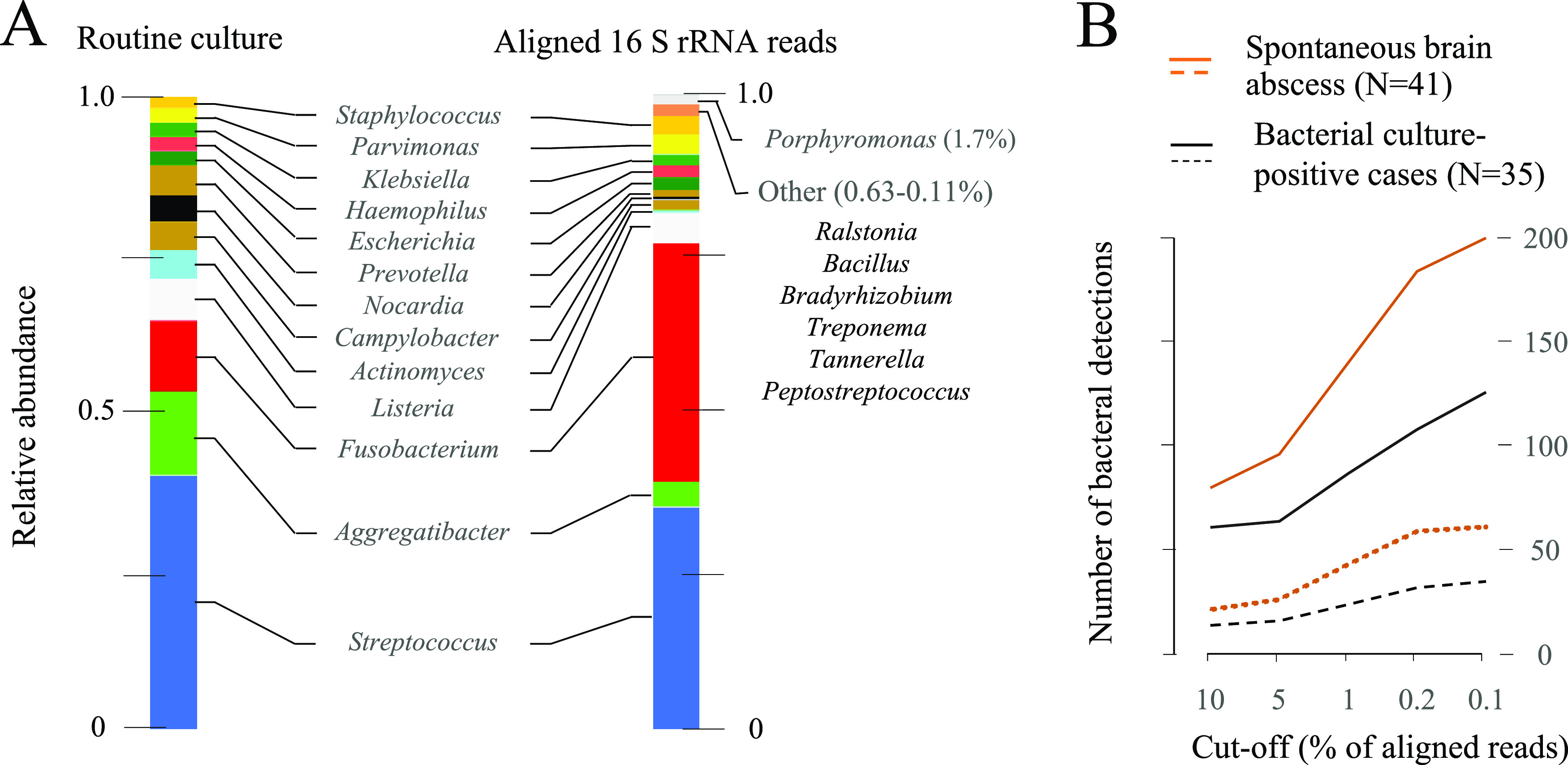
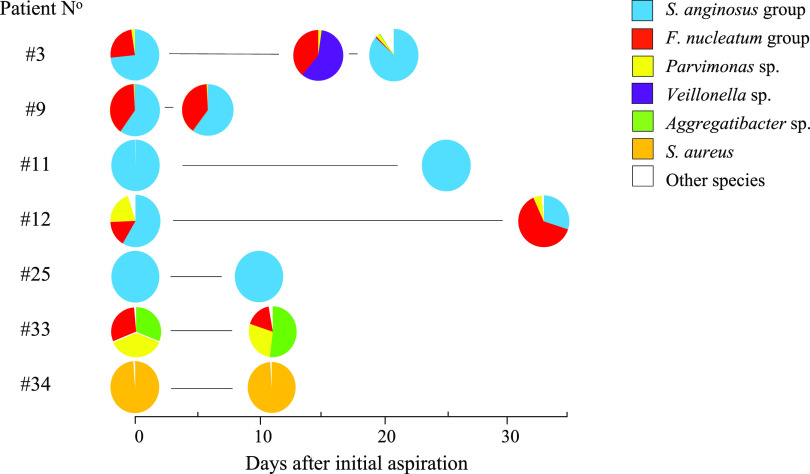
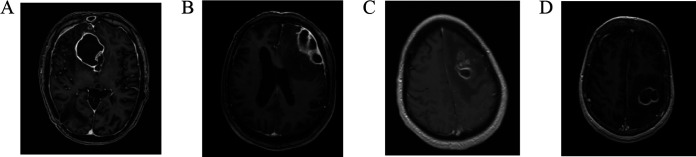
Forty-one stored samples from cases of spontaneous brain abscess were investigated to gain insight into the natural history, causative agents, and relevant laboratory diagnostics of a rare infection. Samples from a larger collection were selected based on retrospective analysis of patient records. All samples were subjected to amplicon sequencing of 16S rRNA gene fragments. Supplementary culture on selected media was performed as suggested by bioinformatics analysis. For three cases, no microorganism was disclosed, while Toxoplasma gondii, Aspergillus fumigatus, and various bacteria were the cause of 1, 2, and 35 cases, respectively. Bacterial infections were monomicrobial in 20 cases and polymicrobial in 15; the microorganisms of the latter cases were restricted to residents of cavum oris. Amplicon sequencing did not further enhance the importance of the Streptococcus anginosus group, which was involved in 17 cases, and the single primer set used may be suboptimal for amplification of Actinomyces and Nocardia. But, amplicon-based sequencing unquestionably expanded the number of polybacterial infections, with focus on the Fusobacterium nucleatum group, Parvimonas, and Porphyromonas. Culture on selective media confirmed the presence of F. nucleatum group bacteria, which attained a prominence in spontaneous brain abscess similar to the S. anginosus group. Metagenomics is a powerful tool to disclose the spectrum of agents in polymicrobial infections, but a reliable cutoff value for substantial detection is complex. Commercial media for isolation of F. nucleatum group bacteria from mixed infections are available, and these pathogens should be carefully characterized. Isolation of Parvimonas and Porphyromonas in polymicrobial infections has not been resolved. IMPORTANCE Polymicrobial brain abscess is a challenge to the clinical microbiology laboratory due to the aggregative nature of the dental and oral microbiota. Because polymicrobial infections may escape detection by conventional culture methods, directed therapy toward a single detected bacterium is problematic. Amplicon-based sequencing provides important clues to these infections, but only cultured microorganisms can be fully characterized, subjected to antimicrobial susceptibility testing, and formally named. By use of specific selective culture plates, we successfully isolated bacteria of the Fusobacterium nucleatum group, and these bacteria rose to the same prominence as the widely recognized pathogen, the Streptococcus anginosus group. Named and unnamed members of the Fusobacterium nucleatum group must be further investigated to gain insight into a rare but grave disease.
Keywords: Fusobacterium; Parvimonas; odontogenic infection; oropharyngeal microbiota; polymicrobial.
Conflict of interest statement
The authors declare no conflict of interest.
Figures
References
Publication types
MeSH terms
Substances
LinkOut - more resources
Full Text Sources