


Functional roles of xylanase enhancing intestinal health and growth performance of nursery pigs by reducing the digesta viscosity and modulating the mucosa-associated microbiota in the jejunum
- PMID: 35404463
- PMCID: PMC9115903
- DOI: 10.1093/jas/skac116
Functional roles of xylanase enhancing intestinal health and growth performance of nursery pigs by reducing the digesta viscosity and modulating the mucosa-associated microbiota in the jejunum
Abstract
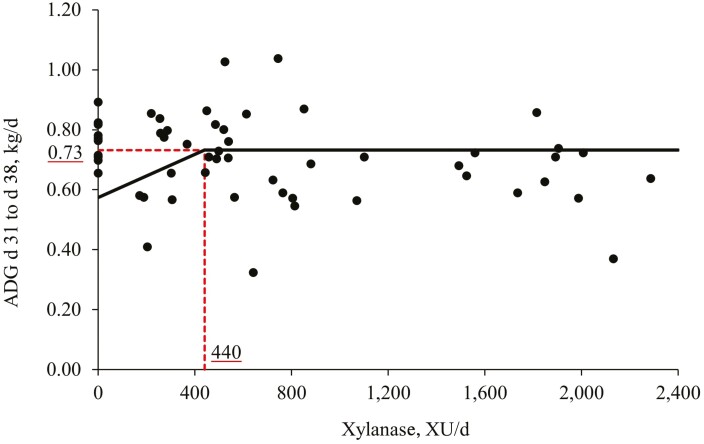
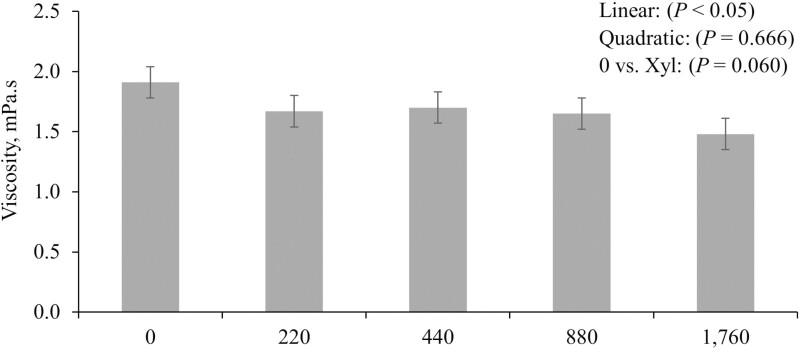
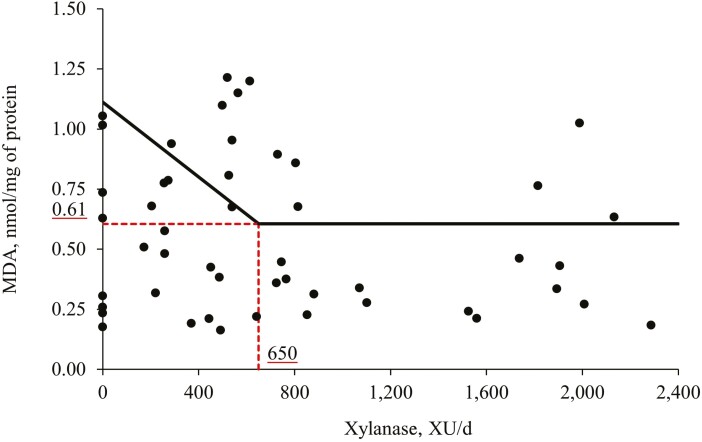
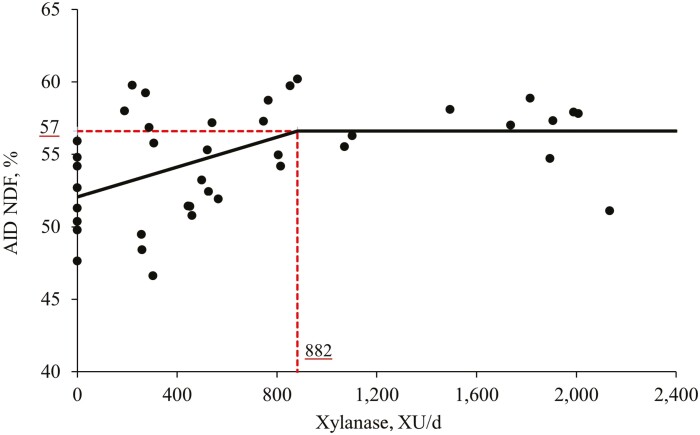
This study was conducted to investigate the functional roles of an endo-β-1,4-xylanase on the intestinal health and growth performance of nursery pigs. A total of 60 pigs (21 d old, 6.9 ± 0.8 kg body weight [BW]) were allotted based on a randomized complete block design with sex and initial BW as blocks. Dietary treatments had nutrients meeting the requirements with increasing levels of endo-β-1,4-xylanase (0, 220, 440, 880, 1,760 xylanase unit [XU] per kg feed) and fed to pigs in three phases (phases 1, 2, and 3 for 10, 14, and 14 d, respectively). Titanium dioxide (0.4%) was added to the phase 3 diets as an indigestible marker. On day 38, all pigs were euthanized to collect ileal digesta to measure apparent ileal digestibility (AID), jejunal digesta to measure viscosity, and jejunal mucosa to evaluate intestinal health. Data were analyzed using the MIXED procedure for polynomial contrasts and the NLMIXED procedure for broken line analysis of SAS. Increasing xylanase in the nursery diets reduced (linear, P < 0.05) the digesta viscosity in the jejunum. Increasing xylanase tended to reduce the relative abundance of Cupriavidus (P = 0.073) and Megasphaera (P = 0.063); tended to increase the relative abundance of Succinivibrio (P = 0.076) and Pseudomonas (P = 0.060); and had a quadratic effect (P < 0.05) on the relative abundance of Acinetobacter (maximum: 2.01% at 867 XU per kg feed). Xylanase from 0 to 1,087 XU per kg feed reduced (P < 0.05) jejunal malondialdehyde. Xylanase from 0 to 1,475 XU per kg feed increased (P < 0.05) the AID of neutral detergent fiber. Increasing xylanase increased (P < 0.05) the AID of ether extract and tended to increase (P = 0.058) the AID of crude protein. Increasing xylanase did not affect growth performance on overall period, whereas xylanase from 0 to 736 XU per kg feed increased (P < 0.05) average daily gain (ADG) during days 31 to 38. In conclusion, xylanase supplementation showed benefits on intestinal health by reducing digesta viscosity, the relative abundance of potentially harmful bacteria, and the oxidative stress in the jejunal mucosa, collectively enhancing intestinal morphology and the AID of nutrients. Xylanase supplementation at a range of 750 to 1,500 XU per kg feed provided benefits associated with reduced oxidative stress, increased nutrient digestibility, resulting in potential improvement on growth performance of nursery pigs by increasing the average daily feed intake and moderately improving the ADG throughout the last week of feeding.
Keywords: apparent ileal digestibility; intestinal health; nursery pigs; oxidative stress; viscosity; xylanase.
Plain language summary
Cereal grains and by-products from cereal processing are extensively used in diets for pigs. These feedstuffs contain soluble fiber that makes digesta viscous in the small intestine. Increased digesta viscosity interferes with the digestion process, changes the ecosystem of bacteria on the mucosal lining of the small intestine, and impairs the intestinal health of young pigs. Supplemental enzymes targeting soluble fiber have been used in feeding young pigs in order to remove the negative impacts of soluble fiber on nutrient utilization and intestinal health. This study used the enzyme xylanase that specifically targets xylan and arabinoxylan largely present in corn and corn by-products. The aim of this study was to investigate how effectively this xylanase work in the small intestine of young pigs by reducing digesta viscosity, positively modulating the bacterial ecosystem on the mucosal lining of the small intestine, improving intestinal health, nutrient digestibility, and finally supporting growth. Xylanase supplementation to feeds for nursery pigs showed benefits on intestinal health by reducing digesta viscosity, oxidative stress, and potentially harmful bacteria in the jejunal mucosa, collectively enhancing intestinal morphology and nutrient digestibility.
© The Author(s) 2022. Published by Oxford University Press on behalf of the American Society of Animal Science.
Figures
References
-
- Agyekum, A. K., and Nyachoti C. M.. . 2017. Nutritional and metabolic consequences of feeding high-fiber diets to swine: a review. Engineering 3:716–725. doi: 10.1016/J.ENG.2017.03.010 - DOI
-
- AOAC. 2006. Official methods of analysis, 18th ed. In: Latimer George W., editor. Gaithersburg (MD): AOAC International.
-
- AOAC. 2016. Appendix F: guidelines for standard method performance requirements. AOAC Official methods of analysis, 20th ed. In: Latimer George W., editor. Gaithersburg (MD): AOAC International.
-
- Arzola-Alvarez, C., Hume M. E., Anderson R. C., Latham E. A., Ruiz-Barrera O., Castillo-Castillo Y., Olivas-Palacios A. L., Felix-Portillo M., Armendariz-Rivas R. L., Arzola-Rubio A., . et al. 2020. Influence of sodium chlorate, ferulic acid, and essential oils on Escherichia coli and porcine fecal microbiota. J. Anim. Sci. 98:1–9. doi: 10.1093/jas/skaa059 - DOI - PMC - PubMed
Publication types
MeSH terms
LinkOut - more resources
Full Text Sources
