


Risk of myopericarditis following COVID-19 mRNA vaccination in a large integrated health system: A comparison of completeness and timeliness of two methods
- PMID: 35404496
- PMCID: PMC9088632
- DOI: 10.1002/pds.5439
Risk of myopericarditis following COVID-19 mRNA vaccination in a large integrated health system: A comparison of completeness and timeliness of two methods
Abstract
Purpose: How completely do hospital discharge diagnoses identify cases of myopericarditis after an mRNA vaccine?
Methods: We assembled a cohort 12-39 year-old patients, insured by Kaiser Permanente Northwest, who received at least one dose of an mRNA vaccine (Pfizer-BioNTech or Moderna) between December 2020 and October 2021. We followed them for up to 30 days after their second dose of an mRNA vaccine to identify encounters for myocarditis, pericarditis or myopericarditis. We compared two identification methods: A method that searched all encounter diagnoses using a brief text description (e.g., ICD-10-CM code I40.9 is defined as 'acute myocarditis, unspecified'). We searched the text description of all inpatient or outpatient encounter diagnoses (in any position) for "myocarditis" or "pericarditis." The other method was developed by the Centers for Disease Control and Prevention's Vaccine Safety Datalink (VSD), which searched for emergency department visits or hospitalizations with a select set of discharge ICD-10-CM diagnosis codes. For both methods, two physicians independently reviewed the identified patient records and classified them as confirmed, probable or not cases using the CDC's case definition.
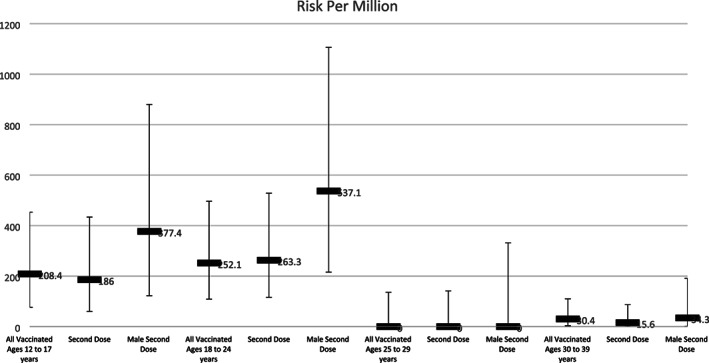
Results: The encounter methodology identified 14 distinct patients who met the confirmed or probable CDC case definition for acute myocarditis or pericarditis with an onset within 21 days of receipt of COVID-19 vaccination. When we extended the search for relevant diagnoses to 30 days since vaccination, we identified two additional patients (for a total of 16 patients) who met the case definition for acute myocarditis or pericarditis, but those patients had been misdiagnosed at the time of their original presentation. Three of these patients had an ICD-10-CM code of I51.4 "Myocarditis, Unspecified;" that code was omitted by the VSD algorithm (in the late fall of 2021). The VSD methodology identified 11 patients who met the CDC case definition for acute myocarditis or pericarditis. Seven (64%) of the 11 patients had initial care for myopericarditis outside of a KPNW facility and their diagnosis could not be ascertained by the VSD methodology until claims were submitted (median delay of 33 days; range of 12-195 days). Among those who received a second dose of vaccine (n = 146 785), we estimated a risk as 95.4 cases of myopericarditis per million second doses administered (95% CI, 52.1-160.0).
Conclusion: We identified additional valid cases of myopericarditis following an mRNA vaccination that would be missed by the VSD's search algorithm, which depends on select hospital discharge diagnosis codes. The true incidence of myopericarditis is markedly higher than the incidence reported to US advisory committees in the fall of 2021. The VSD should validate its search algorithm to improve its sensitivity for myopericarditis.
Keywords: COVID-19 vaccination; ICD-10 code; Vaccine Safety Datalink; hospital claims; incidence of myopericarditis; myopericarditis.
© 2022 John Wiley & Sons Ltd.
Conflict of interest statement
All authors declare that they have no conflicts of interest.
Figures
Comment in
-
Myopericarditis following COVID-19 mRNA vaccination.Pharmacoepidemiol Drug Saf. 2022 Aug;31(8):926. doi: 10.1002/pds.5478. Epub 2022 May 27. Pharmacoepidemiol Drug Saf. 2022. PMID: 35569136 Free PMC article. No abstract available.
References
-
- Marshall M, Ferguson ID, Lewis P, et al. Symptomatic acute myocarditis in 7 adolescents after Pfizer‐BioNTech COVID‐19 vaccination. Pediatrics. 2021;148(3):e2021052478. - PubMed
MeSH terms
Substances
LinkOut - more resources
Full Text Sources
Medical
Miscellaneous
