Review
. 2022 Apr 4;12(7):928.
doi: 10.3390/ani12070928.

The Neurobiology of Behavior and Its Applicability for Animal Welfare: A Review

Affiliations
Review

The Neurobiology of Behavior and Its Applicability for Animal Welfare: A Review

Genaro A Coria-Avila et al. Animals (Basel). .

Abstract

Understanding the foundations of the neurobiology of behavior and well-being can help us better achieve animal welfare. Behavior is the expression of several physiological, endocrine, motor and emotional responses that are coordinated by the central nervous system from the processing of internal and external stimuli. In mammals, seven basic emotional systems have been described that when activated by the right stimuli evoke positive or negative innate responses that evolved to facilitate biological fitness. This review describes the process of how those neurobiological systems can directly influence animal welfare. We also describe examples of the interaction between primary (innate) and secondary (learned) processes that influence behavior.

Keywords: Panksepp; emotions; learning; neurobiology; welfare; well-being.


Conflict of interest statement

The authors declare no conflict of interest.

Figures
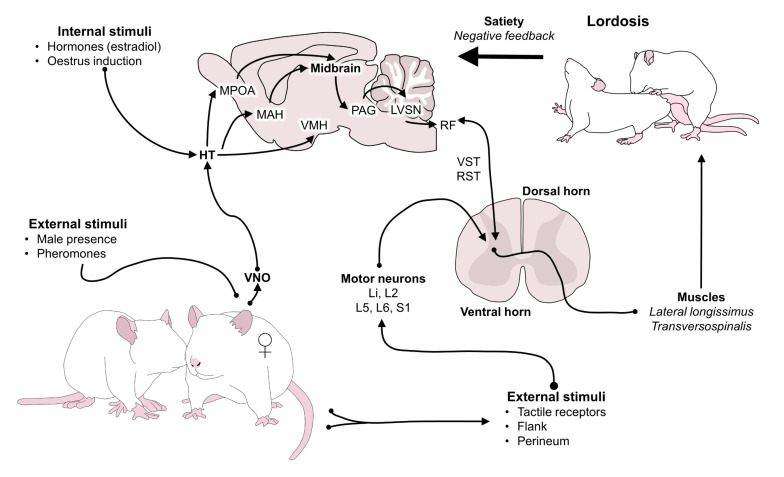
Figure 6
Figure 6
The mechanisms of motivation and satiety are complementary and mediate the appetitiveness or aversivity of stimuli. For example, a female rat may perceive a male as a positive stimulus. His odor triggers sexual motivation through the vomeronasal organ (VNO). The male produces positive feedback via tactile stimulation of the flanks and perineum. The valence of the odor and genital stimulation is processed in the medial amygdala, piriform cortex, and NAc, structures that project to the middle preoptic area (mPOA) and the anterior (MAH) and ventromedial hypothalamus (VMH), where appetitive sexual states are perceived. The information is projected to the midbrain (PAG), where the superior motor neurons convey it to the lumbosacral segments. The motor response involves centers of the lateral vestibular nucleus (LVSN) and reticular formation (RF). These axons reach the spinal cord through the lateral spinal vestibule (VET) and reticulospinal tract (RET) where, in conjunction with signals from tactile receptors, the contraction of the lateral longissimus and transverse spinal muscles are generated to produce lordosis [159]. HT: hypothalamus. After copulation, during satiety, the same olfactory and genital stimuli reduce their incentive value, and females will no longer experience reward. If they cannot get away, then copulation can evoke aversion.
Figure 1
Figure 1
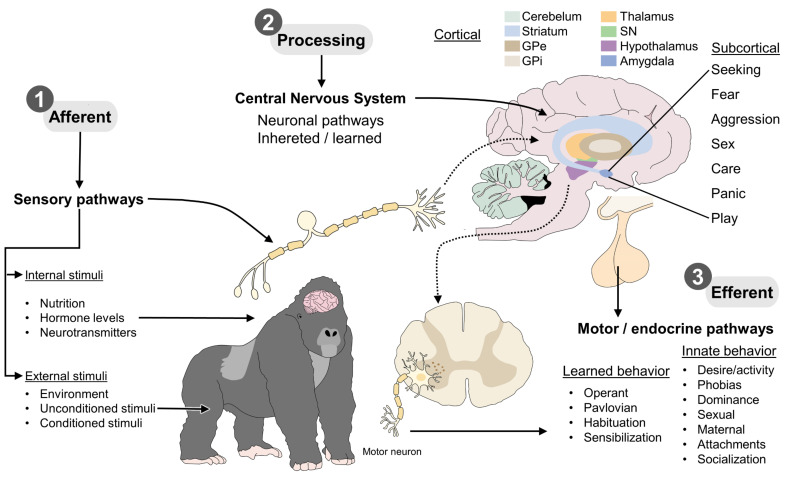
The big picture of how the neurobiology of behavior is relevant for animal welfare. All animals share general mechanisms of afference, processing and efference. The nervous system receives inputs from internal or external stimuli. Inputs are processed in various subcortical neurobiological systems to generate innate physiological and emotional responses that result in overt behavioral patterns. It can also be integrated into neurocircuits that employ learning to compare information stored in the form of memories to facilitate the expression of behavioral patterns. GPe: globus pallidus externus; GPi: globus pallidus internus; SN: sustantia nigra.
Figure 2
Figure 2
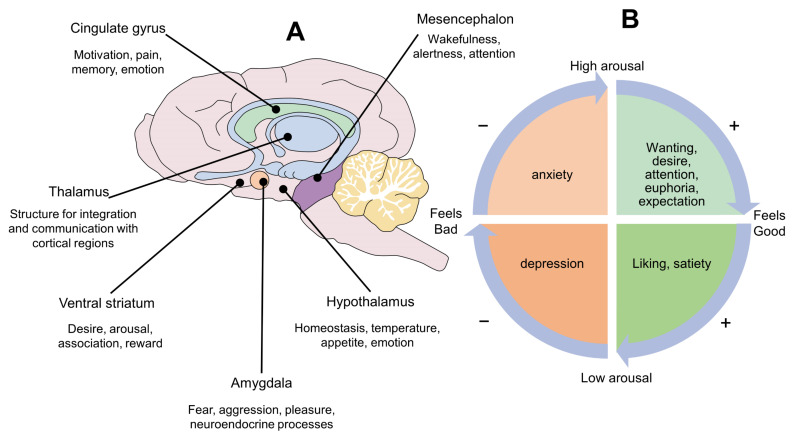
(A) Schematization and function of the limbic system in subcortical areas of the brain. Sagittal view of a dog’s brain (midline) indicating the main sub-cortical structures that mediate emotions. (B) Panksepp’s circumplex of emotions. The limbic system generates emotions that signal potential increases or decreases in biological fitness. Well-being is best achieved when animals experience emotions that move the vector towards the right quadrants. During the appetitive phase the vector moves to the right-upper quadrant (wanting), then during the consummatory phase the vector moves to the right-lower quadrant (liking). Emotions that move the vector away from the left side may be experienced as positive as well.
Figure 3
Figure 3
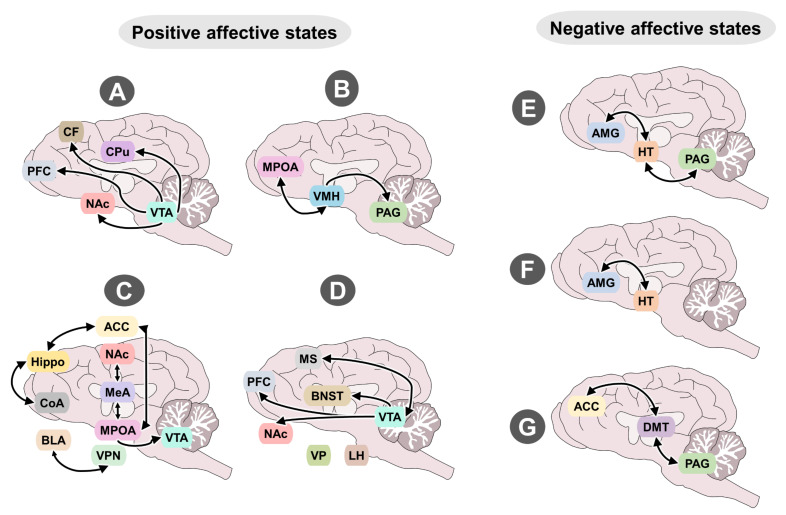
The seven basic behavioral neurocircuits according to Panksepp [9], schematized in a sagittal section of a dog’s brain. On the left side are the systems that evoke positive affective states: (A) seeking; (B) lust; (C) care and (D) play. On the right are the ones that evoke negative affective states: (E) rage; (F) fear; and (G) panic. Numerous brain regions are involved in these systems: amygdala (AMG), hypothalamus (HT), periaqueductal gray matter (PAG), anterior cingulate cortex (ACC), dorsomedial thalamus (DMT), prefrontal cortex (PFC), frontal cortex (CF), nucleus accumbens (NAc), ventral tegmental area (VTA), caudal putamen (CPU), medial preoptic area (MPOA), ventromedial hypothalamus (VMH), hippocampus (Hippo), cortical amygdala (CoA), basolateral (BLA), medial (MBA), and paraventricular nuclei (PVN), medial septum (MeA), bed nucleus of the stria terminalis (BNST), ventral pallidum (VP), and lateral hypothalamus (LH).
Figure 4
Figure 4
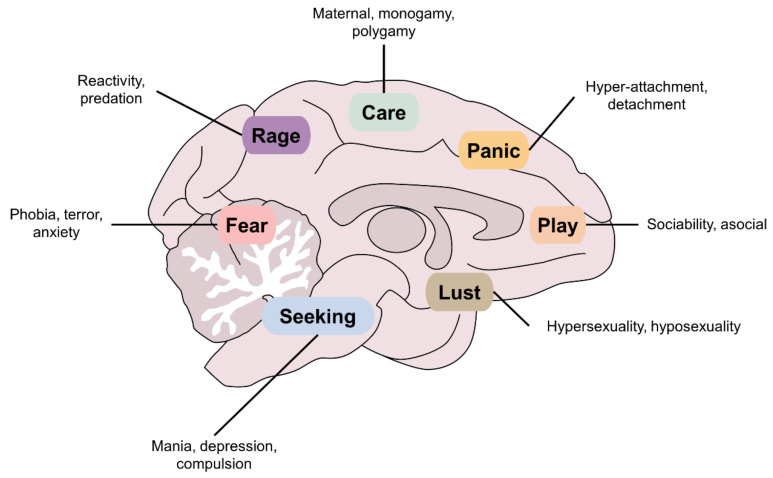
Examples of genetic influence on animal behavior. The basic neurobiological systems represent the phylogenetically robust neural substrate for the expression of behaviors. Selective mating can generate individuals with enhanced sensitivity to a certain kind of stimulation, leading to overexpression of the behavior involved. Likewise, selection can decrease sensitivity to stimuli, thus reducing the probability of a certain behavior being expressed. Those manipulations can be positive or negative to animal welfare.
Figure 5
Figure 5
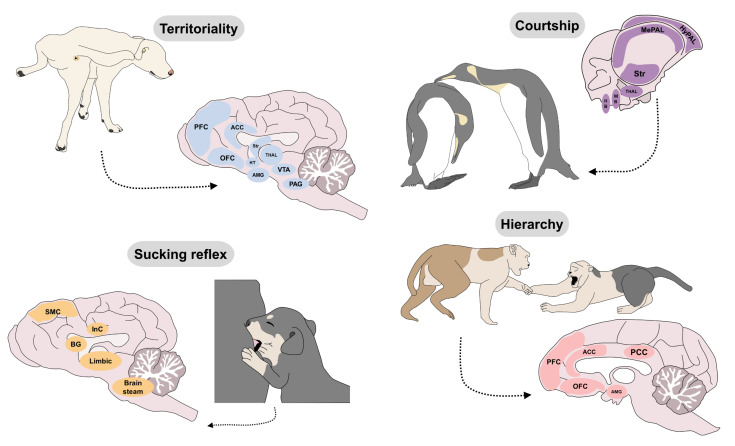
The basic neurobiological systems of behavior evoke developmentally-dependent innate responses. For example, delimiting a territory by marking it with urine reflects the systematic activity of the rage/seeking/lust systems and begins at puberty. Courtship behavior, as in the case of the male penguin that sticks out its chest, raises its beak, and tilts its head back (lust/care systems). The suckling reflex in puppies (seeking, panic) and the establishment of dominance hierarchies in wolf packs (rage/seeking) are other examples. In every innate response, the main cerebral structures involved in the processing of its respective integration is schematized in the brain. ACC: anterior cingulate cortex; AMG: amygdala; BG: basal ganglia; HB: hindbrain; HT: hypothalamus; HyPAL: hyperpallium; InC: insular cortex; MB: midbrain; MePAL: mesopallium; OFC: orbitofrontal cortex; PAG: periaqueductal gray; PCC: posterior cingulate cortex; PFC: prefrontal cortex; SMC: sensorimotor cortex; Str: striatum; THAL: thalamus; VTA: ventral teg-mental area.

References

    1. Duncan I.J. The welfare of farm animals: An ethological approach. Sci. Prog. 1987;71:317–326. - PubMed
    1. Coria-Avila G.A., Herrera-Covarrubias D. The neuroscience of animal welfare: Theory 80–20. eNeurobiologia. 2012;3:161012.
    1. Korte S.M., Olivier B., Koolhaas J.M. A new animal welfare concept based on allostasis. Physiol. Behav. 2007;92:422–428. doi: 10.1016/j.physbeh.2006.10.018. - DOI - PubMed
    1. Boissy A., Manteuffel G., Jensen M.B., Moe R.O., Spruijt B., Keeling L.J., Winckler C., Forkman B., Dimitrov I., Langbein J., et al. Assessment of positive emotions in animals to improve their welfare. Physiol. Behav. 2007;92:375–397. doi: 10.1016/j.physbeh.2007.02.003. - DOI - PubMed
    1. Yeates J., Main D. Assessment of positive welfare: A review. Vet. J. 2008;175:293–300. doi: 10.1016/j.tvjl.2007.05.009. - DOI - PubMed

LinkOut - more resources