Review
. 2022 Mar 22;14(7):1322.
doi: 10.3390/nu14071322.

Ketogenic Diet and Cardiac Substrate Metabolism

Affiliations
Review

Ketogenic Diet and Cardiac Substrate Metabolism

Thien Vinh Luong et al. Nutrients. .

Abstract

The ketogenic diet (KD) entails a high intake of fat, moderate intake of protein, and a very limited intake of carbohydrates. Ketogenic dieting has been proposed as an effective intervention for type 2 diabetes and obesity since glycemic control is improved and sustained weight loss can be achieved. Interestingly, hyperketonemia is also associated with beneficial cardiovascular effects, possibly caused by improved cardiac energetics and reduced oxygen use. Therefore, the KD has the potential to both treat and prevent cardiovascular disease. However, the KD has some adverse effects that could counteract the beneficial cardiovascular properties. Of these, hyperlipidemia with elevation of triglycerides and LDL cholesterol levels are the most important. In addition, poor diet adherence and lack of knowledge regarding long-term effects may also reduce the broader applicability of the KD. The objective of this narrative review is to provide insights into the KD and its effects on myocardial ketone body utilization and, consequently, cardiovascular health.

Keywords: diabetic cardiomyopathy; heart; heart failure; ketogenic diet; ketone bodies; metabolism.


Conflict of interest statement

The authors have no relevant financial or non-financial interests to disclose. The authors declare that they have no conflict of interests.

Figures
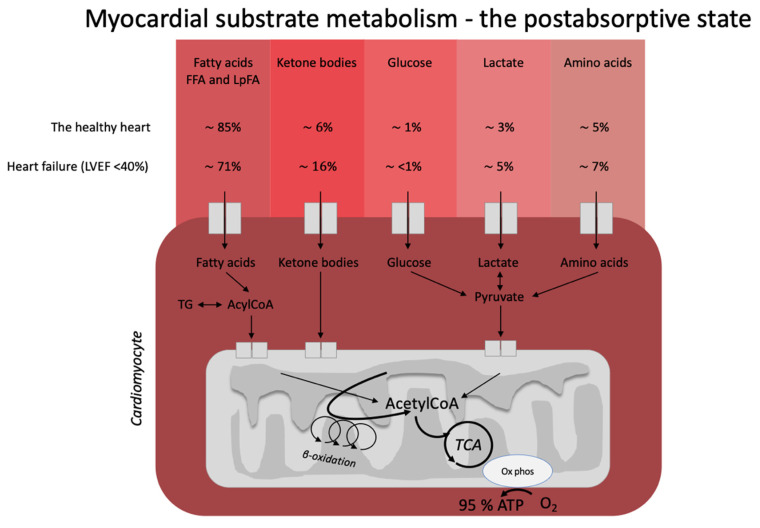
Figure 1
Figure 1
Postabsorptive myocardial substrate metabolism. In the healthy heart, the majority of energy expenditure arises from oxidation of fatty acids from FFA and circulating lipoproteins. In individuals with heart failure, oxidation of ketone bodies (3-hydroxybutyrate, acetoacetate) is upregulated at the expense of fatty acid oxidation. The estimates in the figure were extracted from the recent paper by Murashige et al. [22]. FFA: free fatty acids; LpFA: fatty acids from circulating lipoproteins; LVEF: left ventricle ejection fraction, ATP: adenosine triphosphate, TCA: tricarboxylic acid cycle, AcetylCoA: acetyl coenzyme A, TG: triglycerides.

References

    1. Ye F., Li X.J., Jiang W.L., Sun H.B., Liu J. Efficacy of and patient compliance with a ketogenic diet in adults with intractable epilepsy: A meta-analysis. J. Clin. Neurol. 2015;11:26–31. doi: 10.3988/jcn.2015.11.1.26. - DOI - PMC - PubMed
    1. Neves G.S., Lunardi M.S., Lin K., Rieger D.K., Ribeiro L.C., Moreira J.D. Ketogenic diet, seizure control, and cardiometabolic risk in adult patients with pharmacoresistant epilepsy: A review. Nutr. Rev. 2021;79:931–944. doi: 10.1093/nutrit/nuaa112. - DOI - PubMed
    1. Dąbek A., Wojtala M., Pirola L., Balcerczyk A. Modulation of Cellular Biochemistry, Epigenetics and Metabolomics by Ketone Bodies. Implications of the Ketogenic Diet in the Physiology of the Organism and Pathological States. Nutrients. 2020;12:788. doi: 10.3390/nu12030788. - DOI - PMC - PubMed
    1. Rusek M., Pluta R., Ułamek-Kozioł M., Czuczwar S.J. Ketogenic Diet in Alzheimer’s Disease. Int. J. Mol. Sci. 2019;20:3892. doi: 10.3390/ijms20163892. - DOI - PMC - PubMed
    1. Weber D.D., Aminzadeh-Gohari S., Tulipan J., Catalano L., Feichtinger R.G., Kofler B. Ketogenic diet in the treatment of cancer—Where do we stand? Mol. Metab. 2020;33:102–121. doi: 10.1016/j.molmet.2019.06.026. - DOI - PMC - PubMed
